

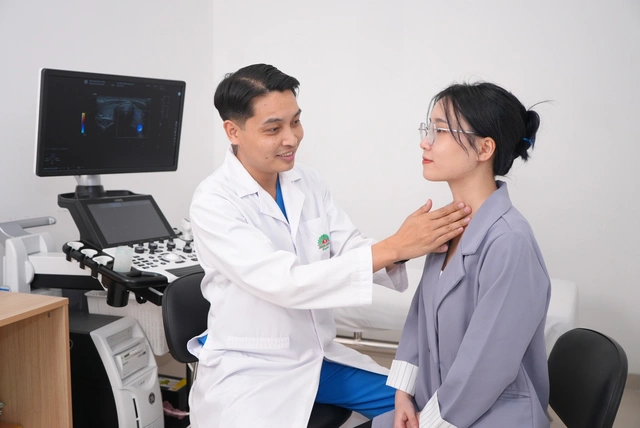
In the context of increasing thyroid disease rates among younger populations, the integration of advanced technology into diagnostics is creating new opportunities for patients. At a specialized symposium held in mid-January 2026, medical experts discussed the role of Artificial Intelligence (AI) in enhancing the accuracy of evaluating small nodules.
Analyzing thyroid nodule characteristics—such as structure, echogenicity, or calcification—has traditionally relied heavily on the subjective perception and experience of the sonographer. This can sometimes lead to challenges in risk classification. Current AI technology serves as an independent reference system, providing detailed image analysis to assist physicians in early identification of malignant signs, even in lesions measuring only a few millimeters.
Accurately determining the nature of a tumor at its onset offers dual benefits to patients. Medically, it allows access to minimally invasive interventions that preserve thyroid function and limit the need for subsequent chemotherapy. Economically, it reduces the frequency of unnecessary invasive procedures, such as fine-needle aspiration or biopsies for benign lesions.
Experts emphasize that while AI does not replace human decision-making, the synergy between clinical expertise and AI’s data processing capabilities is establishing an optimized healthcare process, ensuring both aesthetic outcomes and long-term treatment efficacy.