

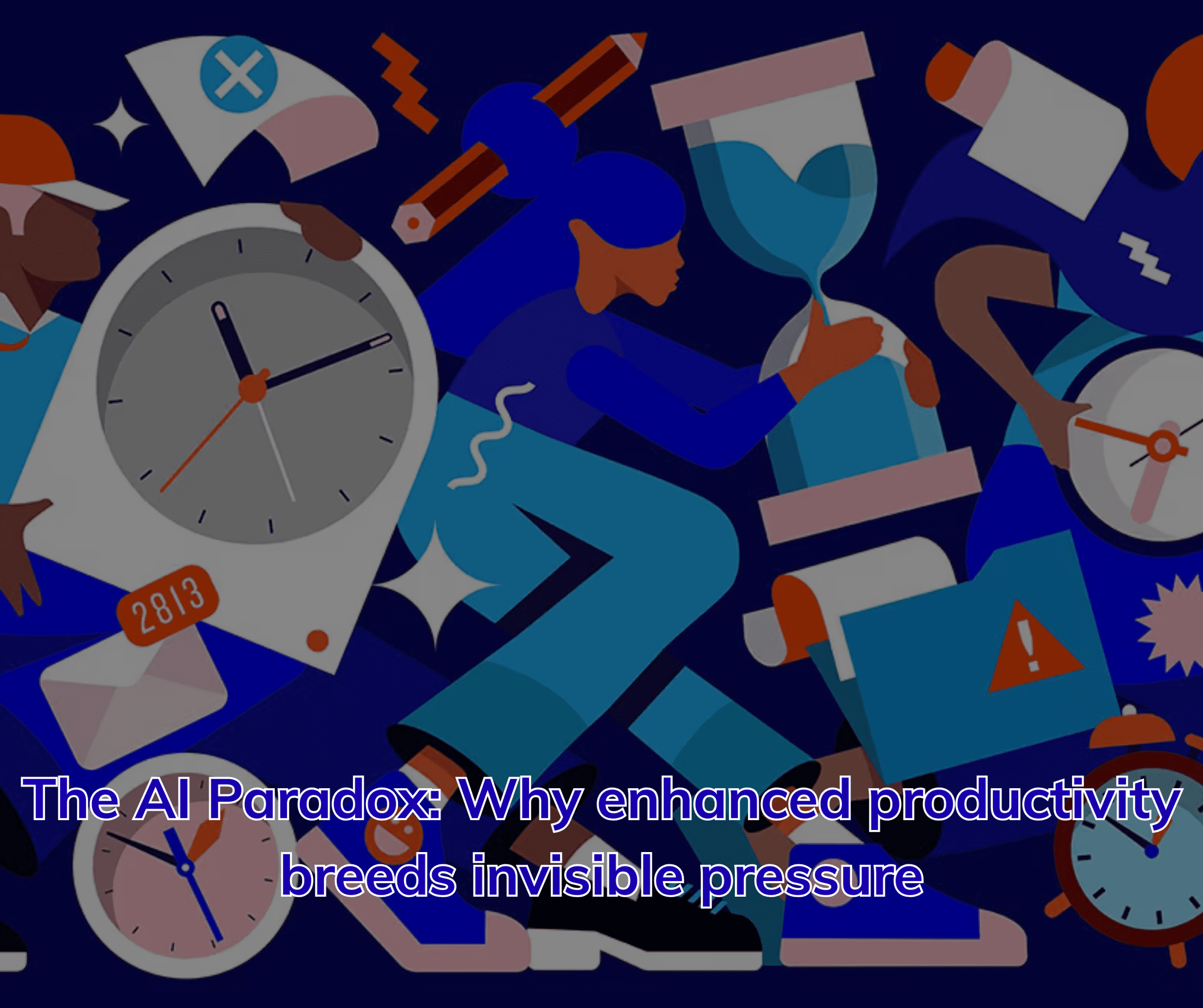
In the digital era, Generative AI is often heralded as a “panacea” for labor liberation. However, an 8-month empirical study at a U.S. technology firm has unveiled a counter-intuitive reality: AI does not reduce workloads; it merely restructures and intensifies them. Instead of utilizing saved time for recovery, employees tend to backfill those gaps with new tasks, creating an unsustainable cycle of performance pressure.
The research identifies three core mechanisms through which AI amplifies work intensity:
-
The Expansion of Hybrid Roles: By lowering technical barriers, AI enables individuals to undertake cross-functional tasks. While this creates “versatile employees,” it inadvertently increases the oversight burden on specialists—such as engineers spending more time auditing and fixing AI-assisted outputs generated by non-technical colleagues.
-
The Encroachment on Personal Space: Due to its instantaneous feedback and conversational interface, AI transforms work into an “ever-present” entity. Natural pauses, such as lunch breaks or system wait times, are increasingly replaced by prompt engineering. This keeps the employee’s mental state in a constant “on” mode, effectively eliminating psychological recovery.
-
The Normalization of Accelerated Speed: As AI speeds up individual components of a project, organizational expectations for overall velocity rise accordingly. Workers find themselves in a state of perpetual multitasking to keep pace with machine outputs, leading to cognitive fatigue and impaired long-term strategic decision-making.
To mitigate these risks, organizations must pivot from “ad-hoc AI adoption” to developing a strategic “AI Practice”:
-
Implementing Intentional Pauses: Establishing mandatory checkpoints in the workflow to allow employees to reassess alignment and prevent the “drift” caused by unmanaged acceleration.
-
Sequencing Workflows: Instead of reacting to AI outputs in real-time, companies should encourage batch processing and protect “deep work” windows from the interruptions of automated notifications.
-
Prioritizing Human Grounding: Investing in face-to-face dialogue and collaborative spaces to counterbalance the isolating effects of solo AI engagement, thereby preserving creative friction and organizational cohesion.
Source: https://hbr.org/2026/02/ai-doesnt-reduce-work-it-intensifies-it?ab=HP-hero-featured-1