

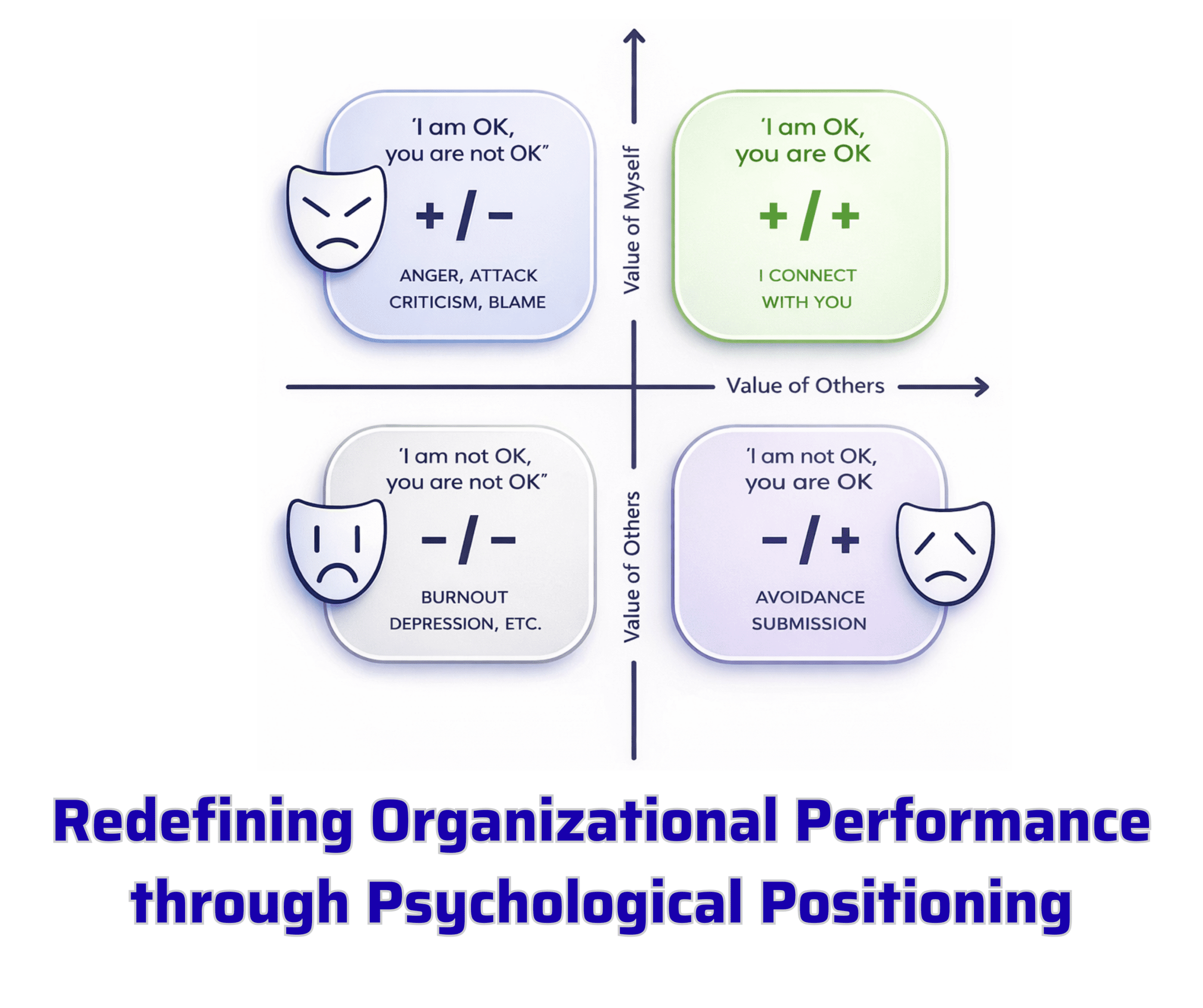
In modern management, the primary obstacle to seamless collaboration is often not systemic, but rather the unconscious “psychological stances” adopted by team members. Rooted in Transactional Analysis and the Process Communication Model® (PCM), interpersonal effectiveness is governed by the cognitive framework individuals use to evaluate their own competence and that of their peers.
The Value Reference System in Professional Interactions
The framework categorizes organizational behavior into four strategic psychological positions:
-
The Constructive Stance (OK–OK): The hallmark of high-performing teams, where personal self-assurance aligns with the mutual recognition of talent. In this state, divergent perspectives are leveraged as assets rather than perceived as threats.
-
The Dominant Stance (I’m OK – You’re Not OK): Manifested through autocratic leadership, micromanagement, and the use of criticism as a mechanism to maintain hierarchical control.
-
The Submissive Stance (I’m Not OK – You’re OK): Characterized by risk aversion, indecisiveness, and a chronic dependency on external validation.
-
The Nihilistic Stance (I’m Not OK – You’re Not OK): A state of collective cynicism that leads to operational paralysis and the erosion of corporate culture.
Strategic Implementation for Corporate Culture
To cultivate a high-trust environment, the “OK–OK” mindset must be institutionalized through specific management competencies:
-
Strategic Assertiveness: Articulating viewpoints with data-driven clarity while maintaining professional boundaries without interpersonal friction.
-
Objectifying Outcomes: Decoupling performance metrics from intrinsic human value. Failures are treated as diagnostic data for process optimization rather than character assessments.
-
Neutralizing Defense Mechanisms: Identifying and stripping away psychological “masks” triggered by stress—such as maladaptive perfectionism or withdrawal—to restore authentic, purpose-driven dialogue.
True organizational transformation is not a byproduct of top-down mandates but an incremental result of individual leaders recalibrating their psychological stance in every micro-interaction.