

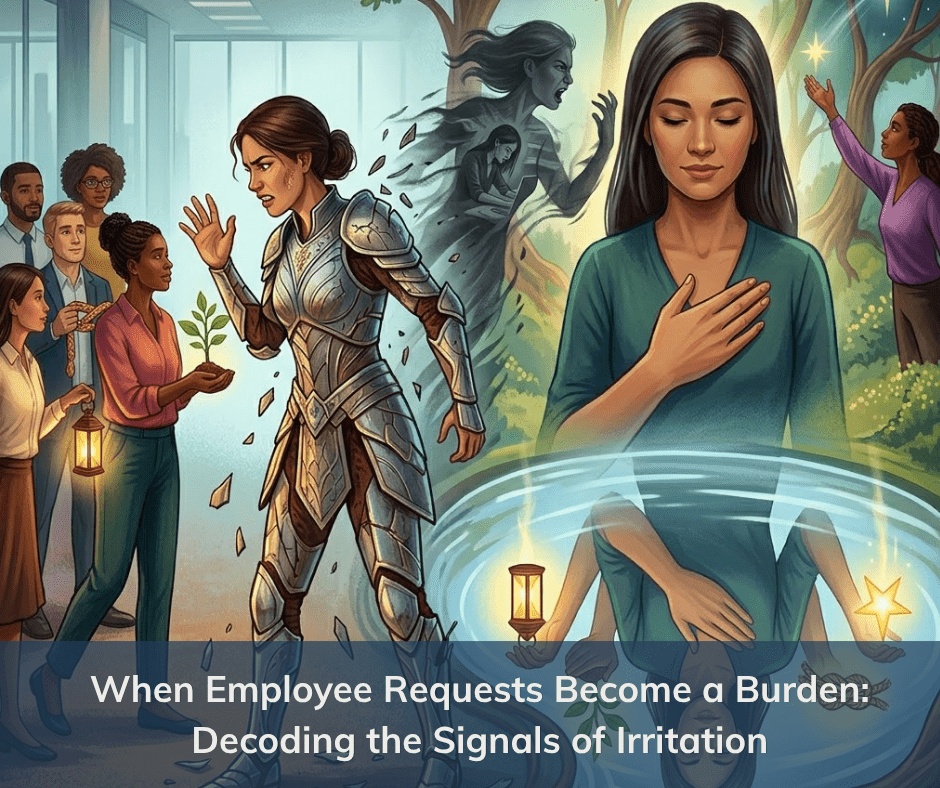
Many leaders feel “hijacked” by a flood of subordinate requests: from conflict mediation and training approvals to promotion discussions. When your reaction outweighs the severity of the issue, the root cause is often not the volume of requests but how you interpret their legitimacy. Irritation is not a random emotion; it is data reflecting unresolved narratives in the leader’s own past.
I. Irritation as Essential Diagnostic Data Every workplace request is essentially an expression of desire. A leader’s response reveals their own relationship with personal needs they may have abandoned or been denied in the past.
-
Countertransference: This is the immediate reaction and the narrative a leader constructs about the requester. For example, if you rose through the ranks by overworking without complaint, you may perceive an employee’s request for work-life balance as a sign of weakness.
-
Projection: You aren’t just annoyed by the request; you are reacting to the employee’s “audacity” in wanting something you have spent a lifetime denying yourself.
II. The Four Core Longings Beneath Every Request Research indicates that behind every workplace interaction lie four non-negotiable human needs. Irritation arises when one of these needs within the leader themselves is fragile:
-
Safety: Employees questioning decisions or admitting mistakes. If a leader feels insecure, they tighten control rather than engaging in dialogue.
-
Love/Care: Employees seeking support or coaching. Leaders with unmet care needs often feel depleted or resent the perceived dependency of others.
-
Belonging: Employees wanting to be heard or included. Leaders lacking a secure sense of belonging often experience dissent as a personal betrayal.
-
Meaning: Requests for promotion or recognition. If a leader is struggling to prove their own worth, they may view a subordinate’s ambition as a threat.
III. Transforming Irritation into a Leadership Tool Instead of reacting instinctively, leaders must practice self-stabilization:
-
Identify the “Armor”: Ask yourself: “What is this request threatening in me?” If the internal response is “Earn it like I did,” you are protecting yourself from re-experiencing past deprivation.
-
Responding with Kindness and Conviction:
-
For Safety: Remind yourself: “Disagreement is not danger.”
-
For Care: Offer support without over-functioning (rescuing).
-
For Belonging: Attune to the longing before redirecting the task.
-
For Meaning: Share authority instead of hoarding credibility.
-
Source: https://hbr.org/2026/04/when-you-start-to-find-employee-requests-irritating?ab=HP-latest-text-1