

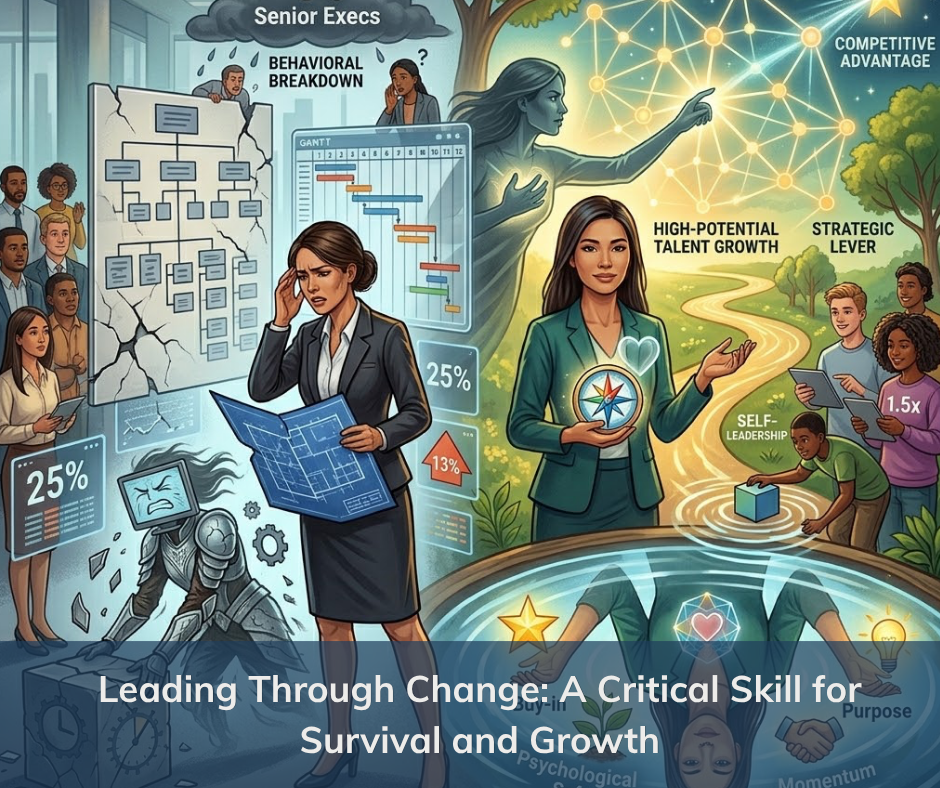
The Crisis of Change Leadership Competency Data from DDI’s Global Leadership Forecast reveals a stark paradox: while volatility is constant, the percentage of leaders feeling prepared to manage change has plummeted from 25% to 13% over the past five years. Even more concerning, senior executives score the lowest, with only 8% demonstrating strong change leadership. This breakdown occurs primarily at the behavioral level, where managers struggle to articulate the necessity of change, address resistance, and reinforce new operational methods.
I. Change Management vs. Leading Through Change Success hinges on distinguishing between these two frequently conflated concepts:
-
Change Management: Focuses on technical mechanics — planning, structuring, execution, timelines, and communication protocols. It is necessary but insufficient on its own.
-
Leading Through Change: Focuses on the human element — how people experience disruption. Effective leaders set direction, reinforce purpose, remove psychological barriers, and sustain momentum within the organizational culture.
II. Characteristics of Change-Ready Leaders The failure of transformation initiatives is rarely strategic; it is typically a collapse of trust and commitment. Essential skills include:
-
Building Buy-in: Driving initiatives forward while fostering genuine commitment across the team.
-
Maintaining Psychological Safety: Creating an environment where employees feel comfortable questioning, experimenting, and raising concerns without fear of reprisal.
-
Balancing Strategy and People: The ability to weigh immediate emotional needs against the organization’s long-term strategic direction.
III. Gen Z and the Concept of Self-Leadership
-
The Gen Z Edge: Emerging leaders are 1.5 times more likely to feel confident in responding to disruption, having entered the workforce during an era of constant change. However, development is crucial to translate this confidence into the capability to lead large-scale transformations.
-
Self-Leadership: In the absence of formal guidance, employees can lead themselves by maintaining an open mindset, clarifying goals, and identifying constraints. This individual initiative creates a ripple effect, allowing the organization to progress despite imperfect conditions.
Conclusion: Change Readiness as a Competitive Advantage Developing change-ready skills is no longer optional; it is a strategic lever. Organizations that neglect this development face the risk of losing high-potential talent (who are 3.7 times more likely to leave without growth opportunities). Conversely, organizations and individuals that treat adaptability as a competitive advantage are better positioned to execute strategy and achieve long-term goals.