

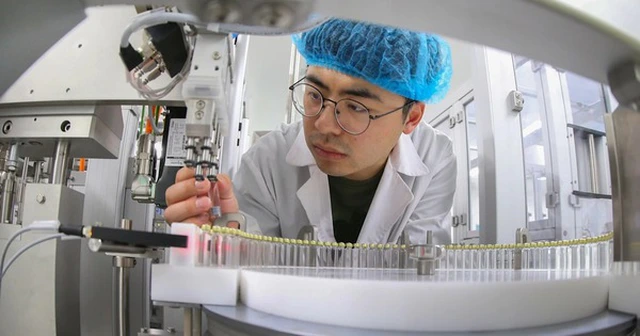
International financial and medical registries have logged a major wave of capital reallocation as dominant U.S. and European pharmaceutical conglomerates continuously secure multi-billion-dollar R&D licensing and partnership agreements with Chinese biotech enterprises. This expanding cross-border dependency has sounded alarm bells among American lawmakers and institutional funds, who voice concerns that the global medical supply chain could face a monopoly risk reminiscent of historical bottlenecks in raw rare earth elements and semiconductor technologies.
The explicit transactional parameters, underlying market catalysts, and evolving political responses out of Washington include:
-
High-Volume Corporate Transactions and Outlays:
-
Pfizer: The American pharmaceutical leader finalized a major developmental pact with Suzhou-based Innovent Biologics. Pfizer committed $650 million in an immediate upfront cash consideration to secure global rights for select oncology candidates, driving the total transactional value up to a potential $10.5 billion contingent upon milestone approvals. This marks Pfizer’s second oncology asset acquisition inside China within a trailing 12-month window.
-
Bristol Myers Squibb (BMS): On May 12, BMS deployed $950 million to purchase therapeutic asset rights from China’s Hengrui Pharmaceutical, embedding joint developmental provisions into the contract.
-
Alternative Sector Allocations: Analytics compiled by data provider Evaluate reveal that since the beginning of the year, a tier-one cohort of five pharmaceutical manufacturers — AbbVie, AstraZeneca, Eli Lilly, Novartis, and Sanofi — has collectively distributed $2.5 vaporized billion in upfront cash tranches directly to Chinese biotech counterparties.
-
-
Primary Macroeconomic and Clinical Drivers: Despite sharpening geopolitical headwinds, Western pharma corporations are aggressively seeking out Chinese research and development (R&D) assets. The primary catalyst stems from a massive wave of upcoming patent expirations targeting the West’s top-selling blockbusters, forcing firms to rapidly replenish their internal pipelines. Concurrently, China’s early-stage clinical trial infrastructure has scaled rapidly, with its total volume of early-phase clinical evaluations officially eclipsing that of the United States.
-
Political Escalation and National Security Concerns: The aggressive outflow of American capital has drawn fierce resistance from localized U.S. officials and investment funds. A former head of the U.S. FDA explicitly warned that China currently represents the primary structural threat to the pharmaceutical sector. Bio-investment institutions fear an economic repeat of the rare earths chokehold — where China maintains total dominance over materials critical to electric vehicles, smartphones, and defense aviation — transferring directly into the healthcare market. In response, Republican Representative John Moolenaar formally requested Treasury Secretary Scott Bessent to incorporate biotechnology assets into upcoming national security frameworks to restrict American capital flows to adversarial nations.
-
Divergent Viewpoints Within Western Investment Circles: Conversely, the China dependency has triggered a profound divide across Western financial boards. Alternative fund executives argue that enforcing rigid cross-border restrictions on drug pipelines would backfire significantly, starving the domestic American biotechnology market of crucial outside innovations and inflicting severe commercial damage.