

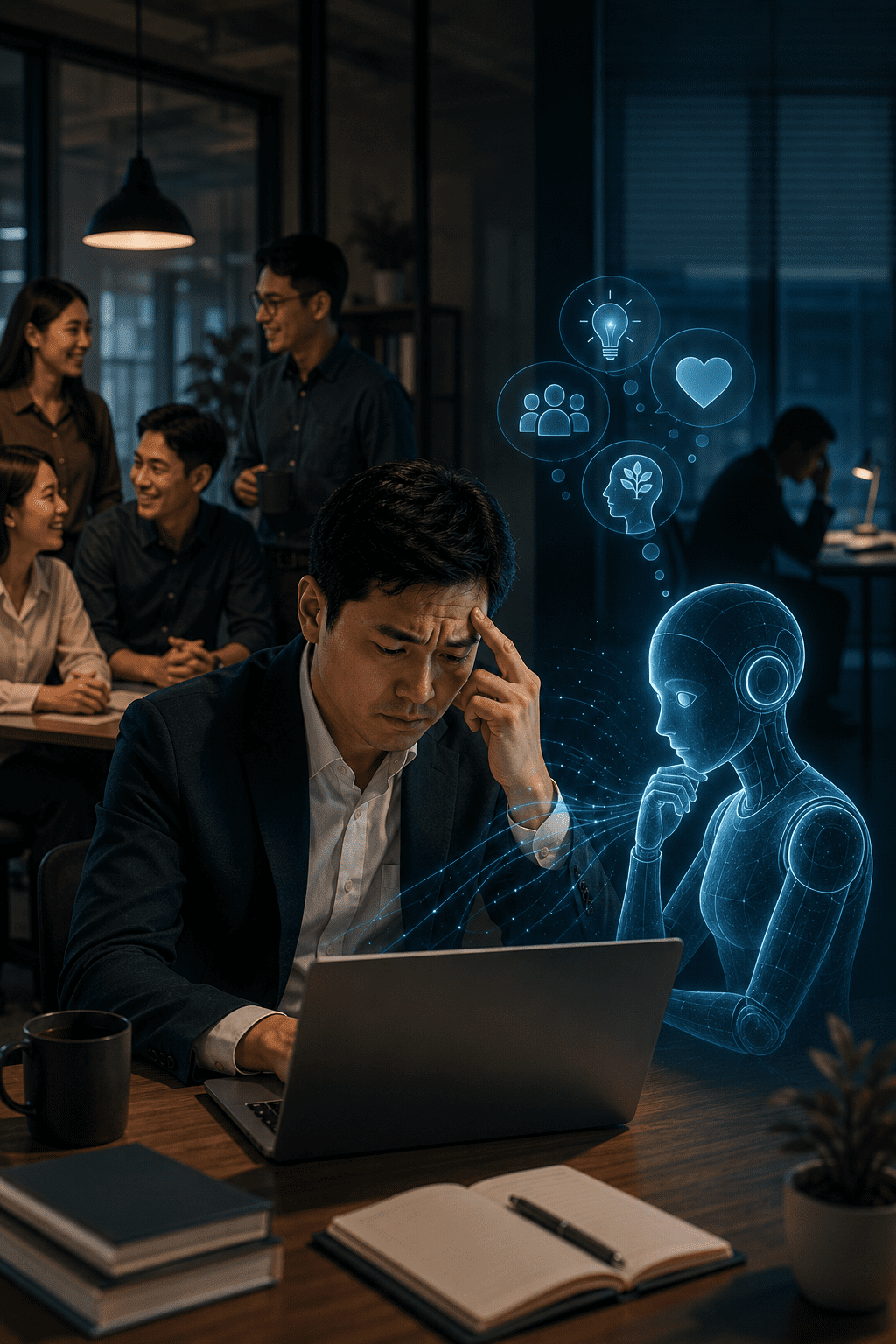
The reality: Anthropomorphizing digital tools into emotional anchors
An unprecedented paradigm shift is altering modern corporate life: for the first time, employees are turning to non-human entities for workplace companionship and validation. Empirical data tracking over 1,500 advanced AI users reveals that 78% routinely employ polite language like “please” and “thank you” when prompting systems. Furthermore, nearly 30% define AI using relational terms such as “personal assistant,” “teammate,” or “work friend” rather than technical descriptions.
Surprisingly, 74% of knowledge workers actively rely on artificial intelligence for non-task relational functions—roles traditionally reserved exclusively for human peers. This structural reliance manifests across four distinct categories:
-
Career advocacy (64%): Utilizing algorithmic feedback to discover professional pathways, particularly when navigating unsupportive human leadership.
-
Personal growth (54%): Relying on bots to refine interpersonal competencies, practice active listening, and structure sensitive professional communications.
-
Workplace companionship (50%): Treating interactive software as a proxy colleague to mitigate the silence of independent execution.
-
Emotional validation (35%): Venting corporate stressors to virtual interfaces to receive immediate, non-judgmental processing and structural coping advice.
The loneliness paradox and 4 warnings for organizational culture
Despite high satisfaction rates with algorithmic responses, the research uncovers a stark reality: Deepening interactions with AI does not alleviate workplace loneliness. Over half (52% ) of the surveyed workforce experiences moderate to high levels of isolation, despite operating within co-located physical offices and integrated project teams. These lonely individuals report 27% lower job satisfaction and nearly double the turnover intentions compared to well-connected peers.
Left unmanaged, this behavioral shift introduces four systemic risks to the foundational tissue of corporate culture:
-
The erosion of collaborative networks: When individuals view AI as a self-contained oracle, they cease tapping internal subject matter experts or collaborative junior talent, driving the fragmentation of workplace operations.
-
Atrophy of interpersonal mechanics: Interacting with an uncritical, permanently available, and sycophantic digital companion reduces an individual’s motivation to navigate the complex, sometimes friction-filled dynamics of real human relationships.
-
Deterioration of institutional trust: Mutual reliance—the foundational architecture of trust—is built through the micro-exchanges of offering and receiving human support. Outsourcing these requests to machines breaks this relational circuit.
-
The onset of existential isolation: Algorithmic empathy remains a structural simulation. Over-indexing on what technologists call “false friendships” ultimately leaves employees feeling profoundly disconnected, facing an environment populated by reactive but inherently absent digital entities.
A 5-pillar strategic framework to safeguard human connection
To successfully capture the functional optimization of artificial intelligence without diluting the human essence of the enterprise, HCX Coaching recommends senior leadership institutionalize five protective policies:
-
Audit the sociological impact of technology: Systematically integrate workspace loneliness and team-cohesion metrics into corporate auditing cycles. Leverage anonymized, aggregate-level collaboration data to spot isolation patterns while maintaining absolute ethical boundaries against individual surveillance.
-
Enforce a “Human-in-the-Loop” mandate: Explicitly designate core interpersonal domains—specifically executive coaching, leadership mentorship, systemic conflict resolution, and cultural team building—as strictly human-centric, face-to-face environments. Establish transparent guidelines governing the boundaries and disclosure of virtual avatars.
-
Architect “Positive Friction” within systems: Intentionally design interface parameters to prevent toxic technological dependency. Program enterprise AI models to deploy cognitive provocations that encourage independent thought, or configure them to dynamically redirect nuanced queries to specific human colleagues within the organization.
-
Repurpose technology to engineer physical rituals: Reallocate the baseline processing time recovered through AI automation toward human-centric bonding initiatives. Utilize intelligent tools to eliminate the administrative scheduling overhead of team outings, optimize mentor-mentee matching, and design targeted icebreaker prompts that catalyze meaningful in-person dialogue.
-
Institutionalize Digital Wellness training: Actively educate the workforce on identifying the psychological warning signs of over-reliance on artificial intimacy. Senior leadership must actively model balanced behaviors, visibly demonstrating when to prioritize computational efficiency and when to preserve deep, unmediated human interaction.