

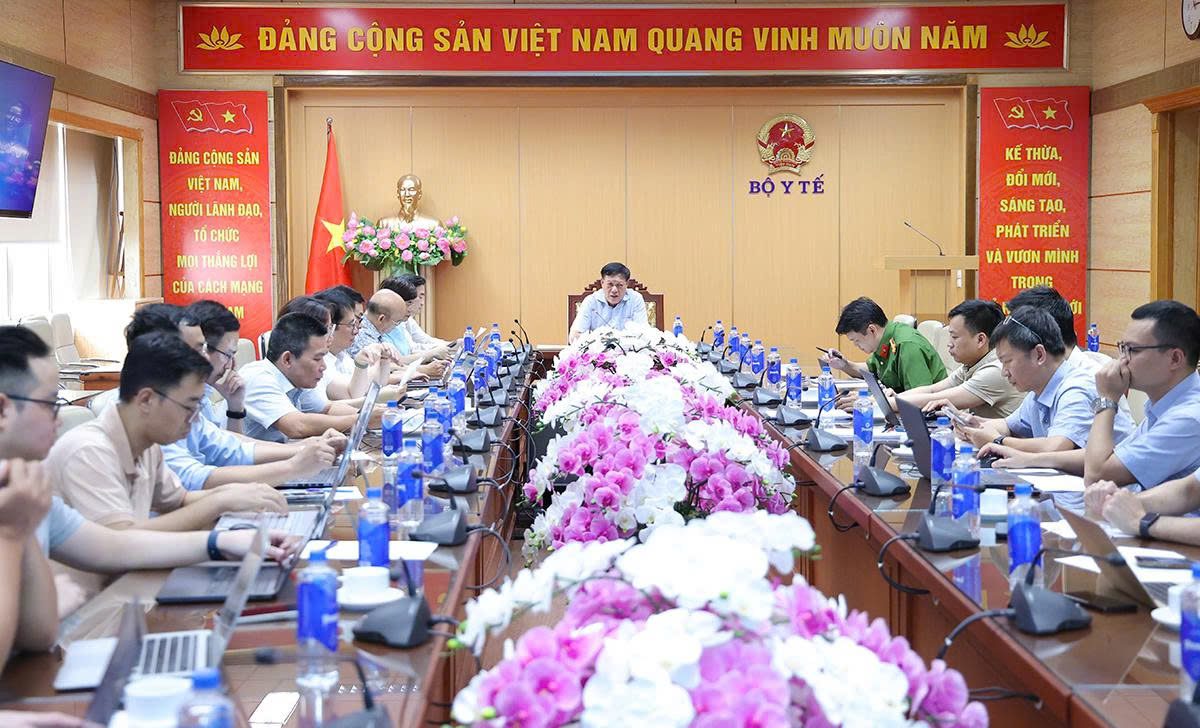
On the afternoon of June 17, 2026, at the headquarters of the Ministry of Health, Vice Minister Do Xuan Tuyen chaired an executive review meeting with the Drafting Committee to evaluate and address the preliminary judicial assessment issued by the Ministry of Justice regarding the policy framework for the draft Amended Law on Food Safety. The session focused on resolving data deficits in the regulatory impact assessment while establishing core legal designs for digital transformation, risk governance, and farm-to-table traceability to eliminate administrative bottlenecks for enterprises.
The documented 5 core policy overhauls, the three-tiered supply-chain security framework, and executive directives issued by the Ministry of Health feature:
-
Review and Addressment of 5 Core Policy Pillars Outlined by the Ministry of Justice:
-
Policy 1 (Manufacturing Standardization): The Ministry of Justice mandated the clarification of a structured, mandatory timeline for facilities to achieve GHP, HACCP, ISO, and BRC standards. The regulatory impact assessment must quantify the financial compliance limits and operational adaptability of small and medium-sized enterprises (SMEs).
-
Policy 2 (Market Inspection Modalities): The drafting body must outline solutions to upgrade the state-backed laboratory testing network. It must explicitly identify the entities responsible for building market-monitoring screening mechanisms and justify how these custom tools differ from established platforms regulated under the Law on E-Commerce.
-
Policy 3 (Unified National Digital Database): The policy must clarify the systemic integration of rapid alerts and the national incident warning infrastructure. Furthermore, it must determine whether enforcement tracking for digital identities, e-labeling, and barcode traceability falls under the jurisdiction of the Food Safety Law or legacy cross-agency laws on product quality and commodity management.
-
Policy 4 (Street Food and Institutional Catering): Cleared by the Ministry of Justice with zero supplemental revisions.
-
Policy 5 (Administrative Governance Consolidation): The Ministry of Justice evaluated the proposed operational launch date of January 1, 2027, for the unified local management model as structurally unfeasible. The ministry directed the committee to incorporate comprehensive impact data regarding localized public payroll expansions in events where commune-level governments establish independent Food Safety Divisions under the commune-level People’s Committees.
-
-
Strategic Transformation: Three-Tiered Risk Governance and Smart Post-Audits:
-
Conceptual Posture Shift: Expert testimonies, represented by Dr. Nguyen Huy Quang (Vietnam Medical Association), emphasized that the updated statutory framework must manifest an ideological pivot: moving away from paper-based product-by-product verification toward active risk management anchored by “live data” (real-time synchronized metrics), and transitioning from rigid pre-clearance bureaucracy to automated, smart post-market audits.
-
Three-Tiered Oversight Framework: Food safety control operations are directed to be systematically decoupled into three distinct progressive defensive layers:
-
Tier 1 (Legacy Bio-Sanitation): Monitoring traditional microbial, chemical, and physical hazards alongside baseline sanitary conditions.
-
Tier 2 (Commercial Fraud Interdiction): Actively combating food fraud vectors regarding source origin counterfeiting, component manipulation, unauthorized therapeutic claims, falsified laboratory testing readouts, misleading advertisements, and non-compliant quality standards.
-
Tier 3 (Supply-Chain Infrastructure Security): Mitigating risks involving intentional contamination, agro-terrorism, malicious sabotage, or the exploitation of logistics corridors to inflict public harm, explicitly binding food safety to localized security and broader national security metrics.
-
-
-
Urgent Regulatory Deliverables Mandated by Vice Minister Do Xuan Tuyen:
-
Mapping Regional Hazards: Addressing the digitalization pillar (Policy 3), Vice Minister Do Xuan Tuyen directed the Drafting Committee to compile highly airtight statutory text tracking real-time supply-chain data from agricultural cultivation and harvesting through manufacturing pipelines to final consumer tables. This synchronized database will serve as the technical engine to construct the national “Food Safety Risk Heatmap” enabling proactive algorithmic intervention.
-
The “6-Clears” Doctrine and Filing Deadlines: The Vice Minister instructed the Vietnam Food Administration and the Department of Legal Affairs to lock steps with the Ministry of Justice to secure the final written judicial evaluation. The executive directorate ordered the concurrent drafting of the statutory text and the 8-part executive report to the Government under the “6-Clears” administrative doctrine (clear, comprehensible, memorable, executable, feasible, specific, and transparent) to maximize market fluidities and compress enterprise compliance overheads.
-