

Key Development
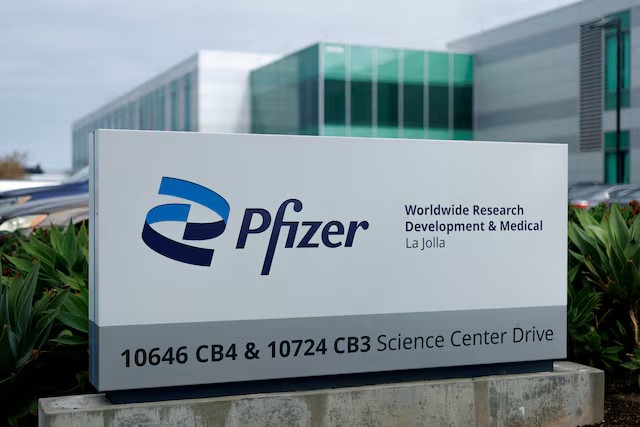
A U.S. Federal Judge has officially dismissed global biopharmaceutical giant Pfizer from a sweeping multi-state antitrust lawsuit accusing dozens of drugmakers of conspiring to fix generic drug prices and artificially inflating costs for patients. The ruling, issued by Chief Judge Michael Shea of the U.S. District Court for the District of Columbia, determined that the plaintiff states failed to establish that Pfizer or its former generic subsidiary, Greenstone, directly participated in bid-rigging or customer allocation schemes between 2010 and 2014.
The litigation, led by state attorneys general, alleged that Greenstone executives engaged in over 360 phone calls and text messages with Swiss generic manufacturer Sandoz to coordinate anticompetitive market behaviors across six products, including therapies for hypertension and glaucoma. However, the court established that Greenstone operated as an independent commercial entity pursuing individual profitability, meaning Pfizer could not be held vicariously liable under the assumption that the subsidiary acted merely as its agent.
Why It Matters
-
Clarifying Parent-Subsidiary Liability Borders: The decision sets a critical legal precedent, shielding Big Pharma parent companies from systemic antitrust liabilities generated by independent subsidiary operations, even when those subsidiaries manufacture authorized generics of the parent’s branded portfolio.
-
Mitigating Legacy Post-Spin-Off Risk: Pfizer spun off Greenstone in a 2020 transaction that established Viatris. This dismissal successfully insulates Pfizer from long-tail financial indemnities stemming from the historical commercial practices of its divested asset.
-
Sustained Regulatory Scrutiny on Generic Pricing: While Pfizer has been extracted, the litigation continues aggressively against 35 remaining corporate and individual defendants. This forces generic manufacturers to comprehensively audit their pricing and institutional bidding mechanisms.
-
Political Mandate Countering High Drug Costs: Statements from state prosecutors reaffirm that restoring fair competition within the generic drug market remains an absolute regulatory priority, signaling a highly adversarial environment for pharmaceutical margin expansions in the U.S..
Healthcare Insight Analysis
From the perspective of Healthcare Insight, Pfizer’s successful dismissal from this pricing conspiracy case underscores a structural victory for the principle of Corporate Liability Separation within Complex Bio-Pharma Architectures. Big Pharma frequently deploys or maintains authorized generic subdivisions to capture residual value and manage price erosion once proprietary, block-buster chemical entities lose patent exclusivity. This structural approach inherently introduces risk, often blurring the line between parent portfolio strategy and subsidiary market execution.
The court’s ruling reinforces a core economic truth: a corporate subsidiary functioning to generate self-sustained profit and deliver broad strategic value cannot be categorically defined as an agent acting solely on behalf of its parent corporation in antitrust claims. Had the court ruled otherwise, the foundational corporate design of multinational healthcare conglomerates—which rely heavily on decentralized, multi-tiered business units across markets and asset classes—would face an unsustainable wave of structural litigious exposure.
Market Implications
-
For Corporate Restructuring and Divestitures: Large-scale pharmaceutical operators can proceed with corporate spin-offs or risky asset carved-outs with greater structural confidence, provided they implement distinct operational governance and rigorous corporate firewalls from inception.
-
For Generic Market Dynamics: Ongoing multi-state antitrust enforcement targeting 80 key generic drug molecules ensures that the low-cost manufacturing sector will enter an era of hyper-regulated compliance. Companies will heavily restrict peer-to-peer market communication, structurally slowing down widespread, parallel price adjustments.
-
For Healthcare Private Equity and Institutional Investors: Asset allocators conducting due diligence on mid-tier generic drug targets, particularly those with legacy corporate ties to larger pharmaceutical conglomerates, must perform deeper legal audits regarding historical pricing behaviors to insulate themselves from protracted state-level litigious liabilities.