

Key Development
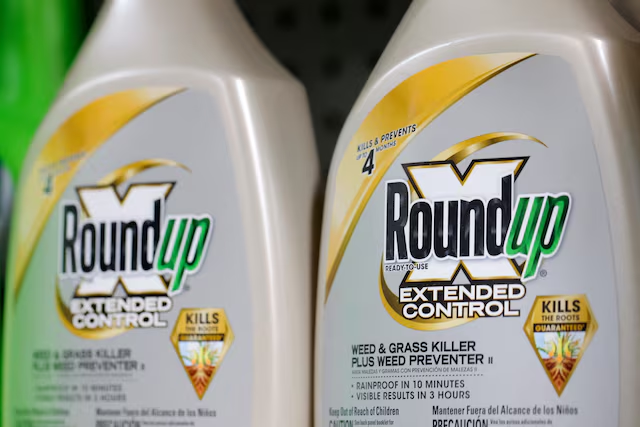
The U.S. Supreme Court has delivered a landmark legal victory to German life sciences conglomerate Bayer, issuing a 7-2 decision that significantly curtails thousands of state-level lawsuits alleging that the company failed to warn consumers of cancer risks linked to its Roundup weedkiller. The conservative-majority court overturned a prior Missouri jury verdict that had awarded $1.25 million to plaintiff John Durnell, who attributed his non-Hodgkin lymphoma to long-term glyphosate exposure. The Justices agreed with Bayer’s core thesis that federal pesticide regulations preempt failure-to-warn claims brought under individual state laws.
Writing for the majority, Justice Brett Kavanaugh emphasized that the U.S. Environmental Protection Agency (EPA) has consistently concluded that glyphosate does not pose a carcinogenic risk and explicitly required product labels to omit cancer warnings. Consequently, state common-law claims cannot legally compel Bayer to alter EPA-approved labeling. Following the decision, Bayer’s heavily depressed shares rallied by approximately 16%.
Why It Matters
-
Dismantling a 100,000-Claim Litigation Moat: The ruling effectively breaks a decade-long litigious gridlock that has paralyzed Bayer since its $63 billion acquisition of Monsanto in 2018, providing a definitive roadmap to clear out historical liabilities.
-
De-risking Massive Capital Outflows: Prior to the Supreme Court intervention, Bayer had proposed a $7.25 billion settlement in February 2026 to neutralize tens of thousands of current and future claims. This new appellate precedent drastically deflates the long-tail liability premium of remaining out-of-deal exposures.
-
Insulating Global Agricultural Supply Chains: Securing the unchecked commercial availability of glyphosate preserves core operational supply lines for global agricultural sectors, protecting corporate margins for large-scale crop science ecosystems.
-
Re-establishing Federal Regulatory Supremacy: The 7-2 consensus reinforces the absolute authority of central federal scientific agencies (such as the EPA) over fragmented, state-level tort court interventions.
Healthcare Insight Analysis
From the perspective of Healthcare Insight, the Supreme Court’s decisive 7-2 ruling in favor of Bayer represents far more than an isolated corporate victory; it serves as a Systemic Risk Governance Reset for the broader global biopharmaceutical and chemical manufacturing sectors. Since consolidating Monsanto into its balance sheet, Bayer has endured a brutal 50% collapse in equity market capitalization, heavily constraining its healthcare R&D expenditure because massive capital reserves were frozen to absorb rolling legal damage exposures.
The court’s affirmation of the federal preemption doctrine based on the EPA’s scientific assessments delivers a critical structural stabilizing mechanism to international healthcare aggregators. It establishes that corporate innovation boundaries and regulatory label compliances cannot be subject to parallel, emotional re-interpretations by state-level civil juries. Had the court validated the dissent, the foundational go-to-market architecture for every multinational life sciences operator would become untenable; a therapeutic drug or chemical composition fully validated by the FDA or EPA could face systemic multi-billion-dollar product liability bans at a localized state level. This ruling gives executive management the legal leverage required to transition into a “new era,” enabling Bayer to refocus its balance sheet on operational scaling and advanced clinical breakthroughs.
Market Implications
-
For Life Sciences M&A and Valuation Recoveries: The Monsanto transaction will transition from being labeled an institutional “M&A disaster” to an undervalued asset recovery play. Institutional capital is highly likely to rotate back into heavily shorted agrochemical and biochemical assets that were weighed down by litigation discount premiums.
-
For the Approaching July 2026 Settlement Finalization: This decision systematically strips plaintiff counsels of their primary point of leverage ahead of the final competent court review of the $7.25 billion settlement structure scheduled for July. Plaintiffs are now heavily incentivized to accept the agreed terms given that state tort courthouse options have been heavily restricted.
-
For Public Health Activism and Green Chemistry Horizons: Fierce pushback from environmental networks (such as Food and Water Watch) highlights an expanding societal divide. While insulated legally, biochemical operators must accelerate internal R&D allocations toward non-glyphosate consumer alternatives to preemptively manage escalating ESG and consumer-driven market erosion.
Source: https://www.reuters.com/world/us-supreme-court-scales-back-roundup-cancer-lawsuits-2026-06-25/