

Key Development
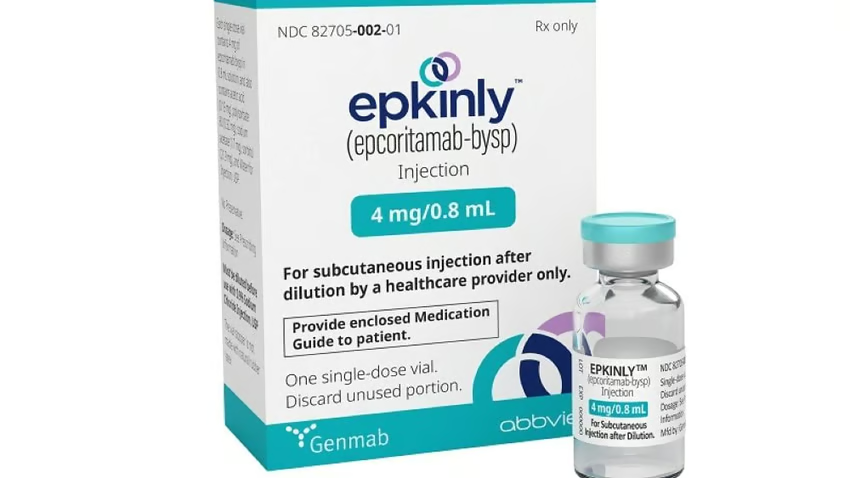
Biopharmaceutical aggregators AbbVie and Genmab have jointly released positive top-line data from their definitive Phase III Epcore DLBCL-4 trial. The clinical readout demonstrates that combining Epkinly® (epcoritamab)—their proprietary, subcutaneously administered CD20xCD3 T-cell engaging bispecific antibody—with oral lenalidomide (Revlimid) structurally reduced the risk of disease progression or death (PFS) by an exceptional 60% compared to standard-of-care R-GemOx chemotherapy (rituximab, gemcitabine, oxaliplatin) in patients presenting with diffuse large B-cell lymphoma (DLBCL) who failed at least one prior line of systemic therapy.
For regulatory jurisdictions outside the United States, the progression-free survival (PFS) optimization metric delivered a highly consistent 56% reduction baseline. This statistical victory serves as a critical corporate turnaround for the partnership, surfacing immediately after Epkinly monotherapy faced an unexpected Phase III survival miss in the Epcore DLBCL-1 trial, which failed to show a statistically significant overall survival (OS) benefit at the European Hematology Association (EHA) congress earlier this month.
Why It Matters
-
De-risking the Frontline Battleground: The Epcore DLBCL-4 victory effectively restores market and analyst confidence ahead of the high-stakes Epcore DLBCL-2 trial readout due later this year, which evaluates Epkinly combined with standard R-CHOP in frontline (1L) DLBCL cohorts.
-
Capitalizing on a $700 Million Market Segment: Financial consensus indices from Jefferies project that the second-line (2L) combination framework encapsulates roughly 15% of Epkinly’s aggregate global commercial opportunity, representing approximately $700 million in potential peak annual sales.
-
Unlocking Outpatient Administrative Advantages: Marrying a subcutaneous bispecific injection with an oral immunomodulatory pill yields a highly simplified clinical regimen optimized for routine outpatient administration. This grants AbbVie an excellent point of differentiation against Roche’s complex, intravenous-dependent therapeutic regimens.
-
Exploiting Competitive Regulatory Vacuum: The second-line large B-cell lymphoma space is undergoing significant disruption following the FDA’s formal refusal last year to approve Roche’s competing bispecific combination, Columvi plus GemOx, over regional efficacy imbalances detected between U.S. and Asian clinical trial subsets.
Healthcare Insight Analysis
From the perspective of Healthcare Insight, AbbVie and Genmab’s strategic outcome in the Epcore DLBCL-4 trial represents a masterful clinical deployment of a “Monotherapy-to-Synergistic Combo Pivot” inside the competitive immuno-oncology market. The prior failure of standalone Epkinly within the Epcore DLBCL-1 layout was fundamentally a trial-design anomaly rather than a biological deficit. Because 26% of the failing control-arm patients rapidly crossed over to salvage cellular therapies or alternative bispecifics upon progression (compared to only 6% in the active Epkinly arm), the absolute overall survival (OS) curve was severely confounded, diluting statistical significance.
By pivoting the compound into a combination layout alongside lenalidomide for the DLBCL-4 registration trial, the molecular engineers successfully tapped into a dual-action mechanism of action:
-
Epkinly (CD20xCD3): Serves as an extracellular micro-bridge, simultaneously targeting the CD20 antigen on malignant B-cells while engaging the CD3 receptor on endogenous T-cells to trigger direct cytolytic cascades.
-
Lenalidomide: Functions as an immunomodulatory agent that physically alters the tumor microenvironment, stimulating localized T-cell clonal expansion and down-regulating baseline tumor immunosuppression, thereby multiplying Epkinly’s target avidity.
This biological synergy generated the magnificent 60% reduction in risk of progression or death, establishing an efficacy bar that severely marginalizes traditional cytotoxic platinum chemotherapies.
Commercially, AbbVie/Genmab’s primary lever against oncology legacy holder Roche rests on structural health-system operational efficiency. Roche’s newest application—the Sunmo regimen combining its bispecific Lunsumio with the antibody-drug conjugate (ADC) Polivy—was accepted by the FDA earlier this month with a PDUFA action date set for February 9, 2027. However, the Sunmo protocol mandates extensive, multi-hour intravenous infusions of Polivy, binding patients to dedicated hospital infusion infrastructure. Conversely, Epkinly’s subcutaneous delivery coupled with at-home oral compliance significantly reduces localized nursing burdens within oncology wards. This administrative simplicity positions the AbbVie asset as the default preference for high-volume clinical practices seeking to optimize outpatient workflow throughput.
Market Implications
-
Re-Aligning the Hemato-Oncology Commercial Matrix: The premium bispecific market for large B-cell lymphomas will shift from evaluating basic clinical efficacy to competing on patient adherence profiles, localized toxicity management, and out-of-pocket outpatient insurance structures.
-
Accelerating the Marginalization of Traditional Cytotoxic Chemotherapy: Delivering a 56% to 60% progression-free survival benefit will rapidly displace legacy platinum-based salvage regimens (such as R-GemOx) from early lines of therapy, codifying specialized bispecific combinations as the absolute New Standard of Care in second-line DLBCL.
-
Reshaping Long-Term Immuno-Oncology R&D Allocations: This outcome will stabilize corporate valuations for Genmab and AbbVie, driving institutional capital flows into exploratory clinical pipelines designed to bind large-molecule bispecific formats with high-compliance oral small molecules to capture home-care oncology markets.
Second-Line DLBCL Combination Regimen Matrix
| Combination Phalanxes | Component Architecture | PFS Performance Indicator | Delivery Infrastructure | U.S. Regulatory Status (FDA) |
| Epkinly Regimen (AbbVie / Genmab) | Epkinly (Subcutaneous) + Lenalidomide (Oral) | 60% Risk Reduction (U.S.) / 56% (Global) | High Outpatient Agility (Subcutaneous + Pill) | Phase III victory disclosed June 29, 2026; filing preparation active. |
| Sunmo Regimen (Roche) | Lunsumio (Bispecific) + Polivy (ADC) | 59% Risk Reduction (vs. R-GemOx) | High Infusion Burden (Requires continuous IV lines) | FDA accepted sBLA dossier; Action Date fixed for Feb 9, 2027. |
| Columvi Regimen (Roche) | Columvi (Bispecific) + Chemotherapy GemOx | Demonstrated significant OS benefit (Starglo Trial) | In-Hospital IV Infrastructure | Complete Response Letter (CRL) issued; rejected over U.S.-Asia regional variance data. |