

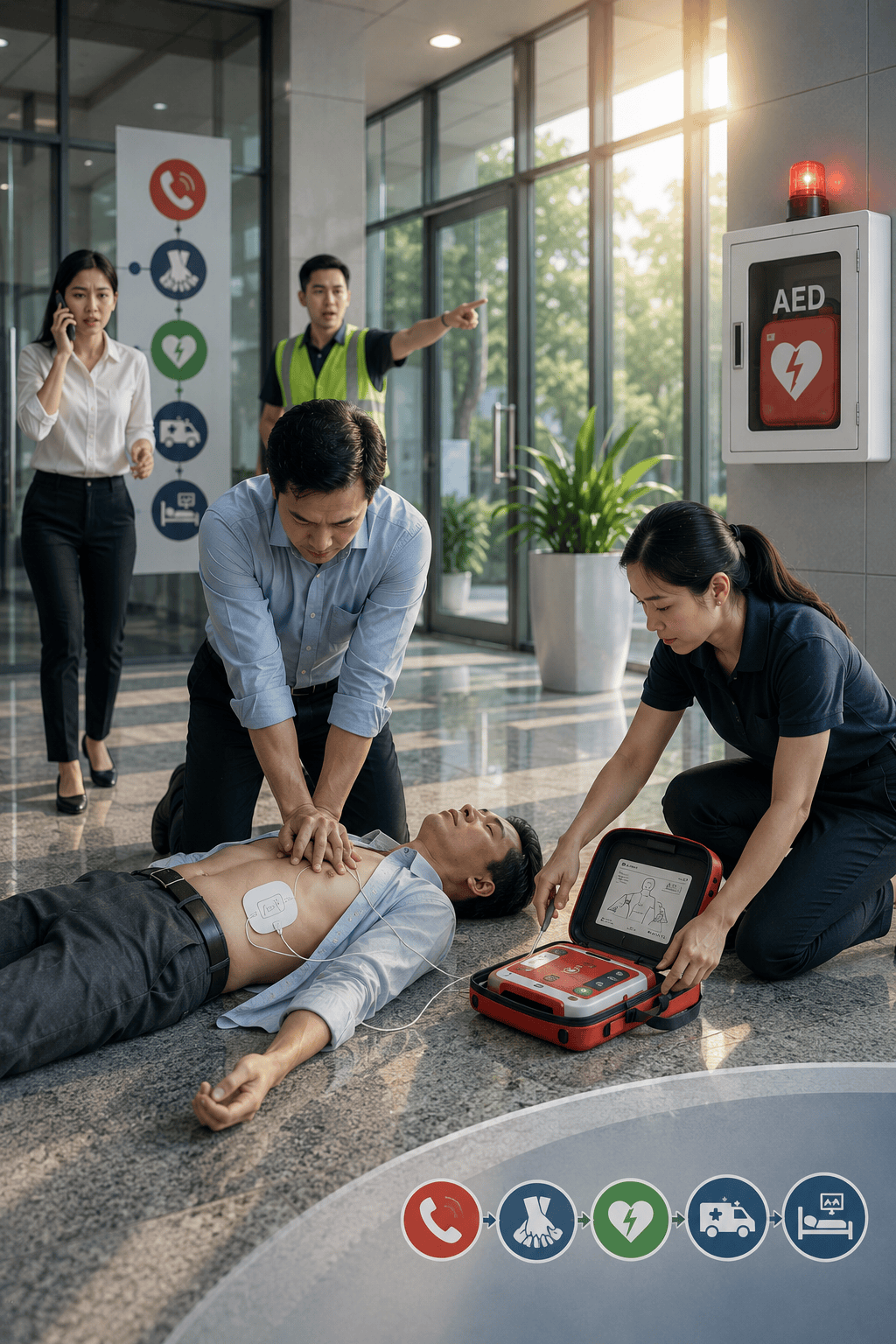
“An office employee suddenly collapsed in the company lobby. No one realized he was experiencing a sudden cardiac arrest. During those critical first minutes, neither a physician nor emergency medical services had arrived. At that moment, his greatest chance of survival depended on the colleague standing beside him—and an Automated External Defibrillator (AED) readily available at the workplace.”
This is far from a rare occurrence. Sudden cardiac arrest can happen anywhere—at the office, in factories, schools, airports, shopping malls, fitness centers, or even in our own homes. In cardiac arrest emergencies, time is not measured in hours, but in seconds and minutes. Every moment counts.
Sudden Cardiac Arrest – A Time-Critical Medical Emergency
Sudden Cardiac Arrest (SCA) is a life-threatening medical emergency in which the heart abruptly loses its ability to pump blood effectively due to a malfunction of its electrical system. Individuals experiencing SCA typically present with:
- Sudden loss of consciousness.
- No response to verbal or physical stimulation.
- Absence of normal breathing or only agonal gasping.
- No effective circulation or detectable pulse.
Sudden cardiac arrest is fundamentally different from myocardial infarction (heart attack). A heart attack occurs when blood flow to the heart muscle is blocked, whereas sudden cardiac arrest is the abrupt cessation of effective cardiac pumping. Nevertheless, a myocardial infarction may trigger sudden cardiac arrest.
Without immediate intervention:
- Brain injury may begin within 4–6 minutes due to oxygen deprivation.
- After approximately 10 minutes, the likelihood of irreversible brain damage or death increases dramatically.
- Every minute of delay in defibrillation reduces the chance of survival by approximately 7–10%.
This is why the actions of nearby bystanders—and the immediate availability of lifesaving equipment—often determine a patient’s outcome.
The Chain of Survival
According to internationally recognized resuscitation guidelines, survival from sudden cardiac arrest depends on the timely completion of the five links in the Chain of Survival:
- Early recognition of cardiac arrest and activation of the emergency response system.
- Immediate, high-quality cardiopulmonary resuscitation (CPR).
- Early defibrillation using an Automated External Defibrillator (AED), when indicated.
- Advanced Life Support (ALS).
- Integrated post–cardiac arrest care.
Failure or delay at any point in the Chain of Survival can significantly reduce the likelihood of survival. Among these interventions, early high-quality CPR and early defibrillation are the two most critical actions before emergency medical personnel arrive.
What Is An AED?
An Automated External Defibrillator (AED) is a portable medical device designed to analyze the heart rhythm and, when indicated, deliver a controlled electrical shock to restore an effective cardiac rhythm.
An important point to understand is that an AED does not “restart” the heart.
Instead, it delivers a defibrillation shock only when it detects a shockable cardiac rhythm, primarily:
- Ventricular Fibrillation (VF)
- Pulseless Ventricular Tachycardia (pVT)
If the patient is found to be in:
- Asystole, or
- Pulseless Electrical Activity (PEA),
How Does an AED Work?
AEDs are designed to be simple and intuitive, enabling rescuers to provide effective assistance during a cardiac emergency.
Step 1: Ensure the scene is safe and assess the victim’s responsiveness.
Step 2: Activate the emergency medical system and request that an AED be brought to the scene.
Step 3: Begin high-quality CPR immediately.
Step 4: Turn on the AED and attach the electrode pads as instructed.
Step 5: Allow the AED to automatically analyze the patient’s heart rhythm.
- If a shockable rhythm is detected, the AED will instruct the rescuer to deliver a defibrillation shock.
- If no shock is advised, the AED will prompt the rescuer to resume CPR immediately.
The cycle of CPR and rhythm analysis should be repeated until return of spontaneous circulation (ROSC) is achieved or the patient is transferred to the care of emergency medical professionals.
Why Should an AED Be Used as Early as Possible?
For patients experiencing Ventricular Fibrillation (VF) or Pulseless Ventricular Tachycardia (pVT), early defibrillation is the most effective treatment.
International studies have consistently demonstrated that:
- When high-quality CPR is combined with defibrillation within the first 3–5 minutes, survival rates may reach 50–70% in many cases of out-of-hospital cardiac arrest (OHCA).
- Every minute of delay in defibrillation significantly decreases the likelihood of survival.
- While CPR helps maintain temporary blood flow to the brain and heart, it cannot replace defibrillation for patients with a shockable cardiac rhythm.
Why Have Many Countries Implemented Public Access AED Programs?
More than 70% of sudden cardiac arrests occur outside the hospital, with the majority taking place at home or in the workplace.
To improve survival from out-of-hospital cardiac arrest, many countries have established Public Access Defibrillation (PAD) programs by placing AEDs in public locations such as:
- Airports
- Railway and transit stations
- Shopping malls
- Schools
- Manufacturing facilities
- Fitness centers and sports complexes
- Residential communities
- Office buildings
The objective is to enable trained bystanders to provide immediate defibrillation during the critical first minutes of a cardiac arrest—before Emergency Medical Services (EMS) arrive.
Should Businesses Invest in AEDs?
For businesses, an AED is more than just a medical device—it is an essential component of an effective emergency response system.
Workplaces that should strongly consider AED deployment include:
- Manufacturing plants and industrial facilities
- Large corporate offices
- Hotels and resorts
- Shopping malls
- Schools and educational institutions
- Fitness centers and sports facilities
- Convention and event venues
- High-rise residential buildings
- Tourist attractions
Installing AEDs in the workplace can:
- Reduce the time to defibrillation.
- Improve survival before Emergency Medical Services (EMS) arrive.
- Enhance the safety of employees, customers, and visitors.
- Demonstrate an organization’s commitment to occupational health, workplace safety, and corporate sustainability.
Should Families Have an AED at Home?
An AED is not necessary for every household. However, home AED placement may be considered in families with:
- Individuals at high risk of cardiac arrest due to underlying cardiovascular disease.
- Survivors of previous sudden cardiac arrest or those with a history of life-threatening ventricular arrhythmias.
- Individuals with cardiomyopathy or advanced heart failure.
- Households located in remote areas where Emergency Medical Services may require extended response times.
For most families, the highest priority should be:
- Receiving CPR training.
- Recognizing the signs of sudden cardiac arrest.
- Knowing how to activate the emergency medical system.
- Being prepared to use an AED when one is available in a public setting.
Ultimately, the knowledge and skills of the rescuer remain the most important factors in determining whether an AED can be used effectively.
An AED Alone Is Not Enough
An AED delivers its greatest value only when integrated into a comprehensive emergency response system.
Organizations should establish a Public Access Defibrillation (PAD) program that includes:
- Strategically placing AEDs in easily accessible locations.
- Providing regular CPR and AED training for employees.
- Developing clear emergency response protocols.
- Performing routine inspection and maintenance in accordance with the manufacturer’s recommendations.
- Conducting regular emergency drills to ensure personnel are prepared to respond confidently and effectively.
The combination of trained people, well-defined procedures, and readily available equipment forms the foundation of an effective emergency response system.
At GHME, we believe that equipment alone does not save lives—people do.
An AED placed in the right location, combined with personnel who are properly trained in CPR and AED use, can significantly shorten the time to defibrillation, improve survival outcomes, and reduce the risk of long-term neurological complications following sudden cardiac arrest.
Investing in first aid training and AED deployment is not merely an investment in medical equipment—it is an investment in people, organizational resilience, workplace safety, and a culture that values and protects human life.