

Key Development
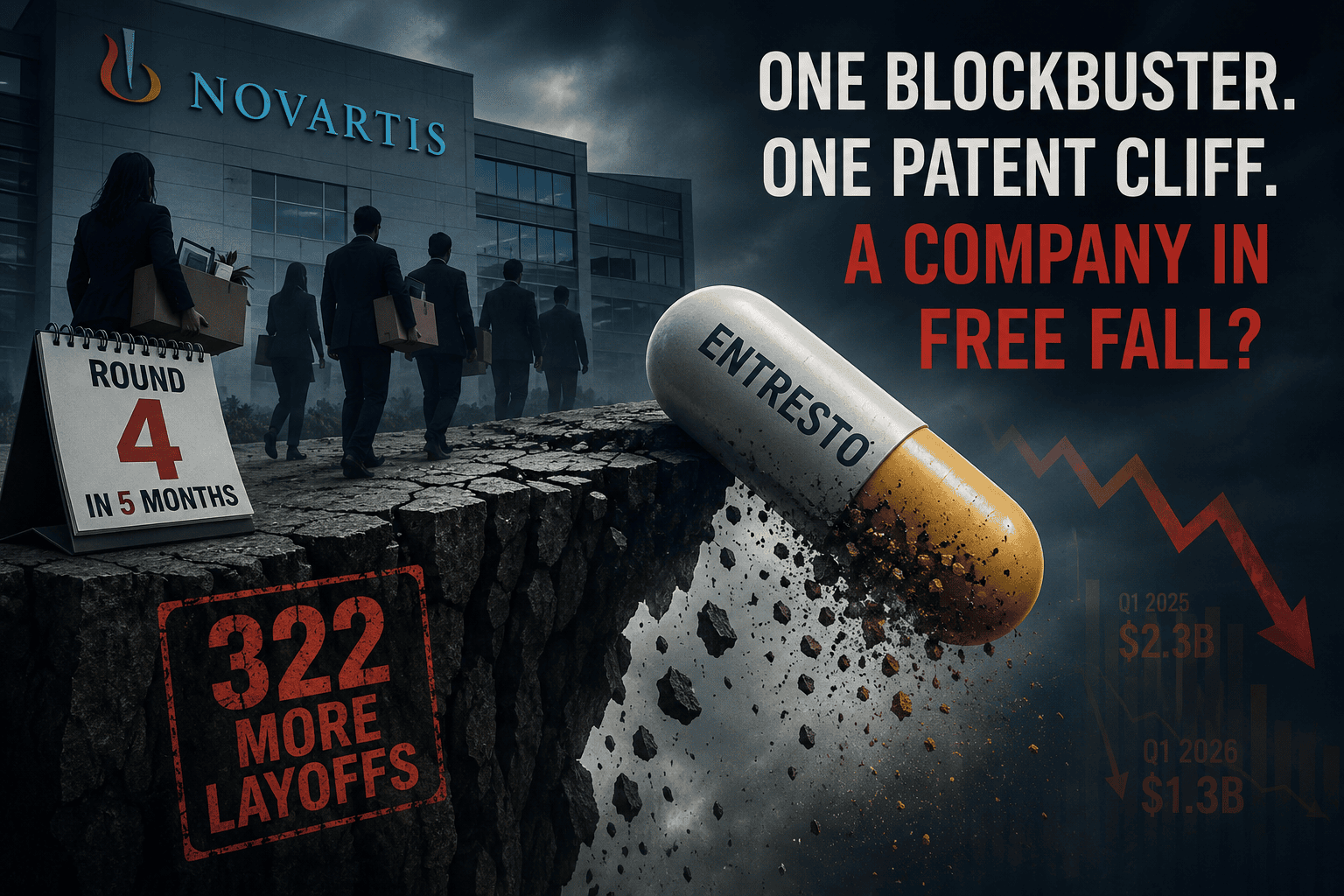
Novartis has announced another workforce reduction, eliminating 322 positions at its East Hanover, New Jersey headquarters, according to a recent WARN Act filing. Effective October 2, this latest move represents the fourth layoff round at the same site within five months, bringing the total number of affected employees in 2026 to nearly 600.
The catalyst remains unmistakable: Entresto, once one of the pharmaceutical industry’s most successful cardiovascular medicines, has entered the post-patent reality. Following the loss of U.S. exclusivity in July 2025, the drug’s quarterly revenue fell dramatically from $2.3 billion in Q1 2025 to $1.3 billion in Q1 2026. The nearly $1 billion revenue contraction in a single quarter was significant enough to push Novartis’ total company sales down 1%, abruptly ending two consecutive years of strong double-digit growth.
This latest workforce reduction is not an isolated cost-cutting exercise but the continuation of a carefully sequenced restructuring strategy. Earlier this year, Novartis eliminated 114 commercial roles supporting mature brands such as Tasigna and Promacta, followed by 76 research positions, before trimming another 60 sales roles across Oncology, Rheumatology, Dermatology, and Neuroscience. Rather than one headline-grabbing restructuring announcement, the company is executing a series of targeted adjustments that closely follow changing commercial realities.
Why It Matters
- The patent cliff has evolved from a financial event into an organizational event. Revenue erosion is no longer confined to quarterly earnings, it is now directly reshaping workforce strategy, commercial operations, and resource allocation across global pharmaceutical companies.
- Novartis is demonstrating a new restructuring playbook. Instead of executing one large restructuring immediately after losing exclusivity, management appears to be recalibrating the organization quarter by quarter, adjusting headcount in response to real-time market performance rather than relying on fixed long-term assumptions.
- Commercial organizations are absorbing the greatest pressure. The majority of workforce reductions have shifted toward sales, marketing, and patient-support functions rather than core scientific capabilities, reflecting the reality that once blockbuster brands lose exclusivity, the commercial infrastructure supporting them rapidly becomes oversized.
- The company’s multi-year transformation remains unfinished. These layoffs extend the restructuring journey that began in 2022, when Novartis consolidated its pharmaceuticals and oncology businesses into a single Innovative Medicines organization. What was initially framed as organizational simplification has increasingly become a prolonged exercise in adapting to changing revenue dynamics.
- This serves as a broader warning for the pharmaceutical sector. Companies whose earnings remain heavily concentrated in a handful of blockbuster products face not only revenue volatility after patent expiry but also sustained operational disruption that can continue for several years.
Healthcare Insight Analysis
Novartis is becoming one of the clearest real-world demonstrations of a challenge every large pharmaceutical company acknowledges but few navigate without significant disruption: blockbuster concentration risk.
Entresto was not merely another successful product. It became a central growth engine that helped drive Novartis’ financial performance over recent years. That success, however, also increased the company’s dependence on a single asset. Once exclusivity expired, the impact extended far beyond product sales. Revenue declined almost immediately, forcing management to reconsider organizational structure, commercial investment, and workforce deployment at remarkable speed.
Perhaps the most revealing aspect is how Novartis is responding.
Rather than announcing one sweeping global restructuring, leadership has opted for a sequence of smaller, highly targeted workforce reductions. This suggests the company is managing the patent cliff as a continuous operational recalibration, using evolving sales data to determine where commercial capacity has become excessive. Such an approach offers greater flexibility but also indicates that management does not yet view the post-Entresto adjustment as complete.
Even more significant is the changing profile of the affected employees. Commercial organizations supporting mature brands are shrinking far more rapidly than research and pipeline development teams. This reflects a deliberate strategic choice: preserve future innovation while reducing investment behind products that have entered generic competition.
The implication extends beyond Novartis. Across the industry, commercial organizations built around aging blockbuster brands may become increasingly vulnerable, while investment and talent demand continues shifting toward precision medicine, radioligand therapies, cell and gene therapies, and next-generation specialty medicines.
Market Implications
For investors, Novartis illustrates that patent cliffs should no longer be measured solely by lost revenue, they should be evaluated by organizational resilience.
Repeated workforce announcements, even when individually modest, often indicate that management is still absorbing structural revenue pressure rather than completing a one-time restructuring. As a result, incremental WARN filings may become a more meaningful leading indicator of operational stress than headline earnings alone.
For pharmaceutical executives, the lesson is equally clear: diversification across therapeutic areas does not automatically eliminate concentration risk if a disproportionate share of growth is still driven by one blockbuster franchise. Building a stronger late-stage pipeline is essential, but so is designing commercial organizations that can scale down as efficiently as they scale up.
Finally, for competitors and emerging biotech companies, Novartis’ restructuring creates an unexpected strategic opportunity. Hundreds of experienced professionals in cardiovascular, oncology, market access, and specialty commercialization are entering the talent market. For companies preparing major product launches, this represents an opportunity to acquire commercial expertise that would otherwise take years to develop internally.
Source: https://www.fiercepharma.com/pharma/novartis-dismisses-322-more-its-us-headquarters-nj