

Key Development
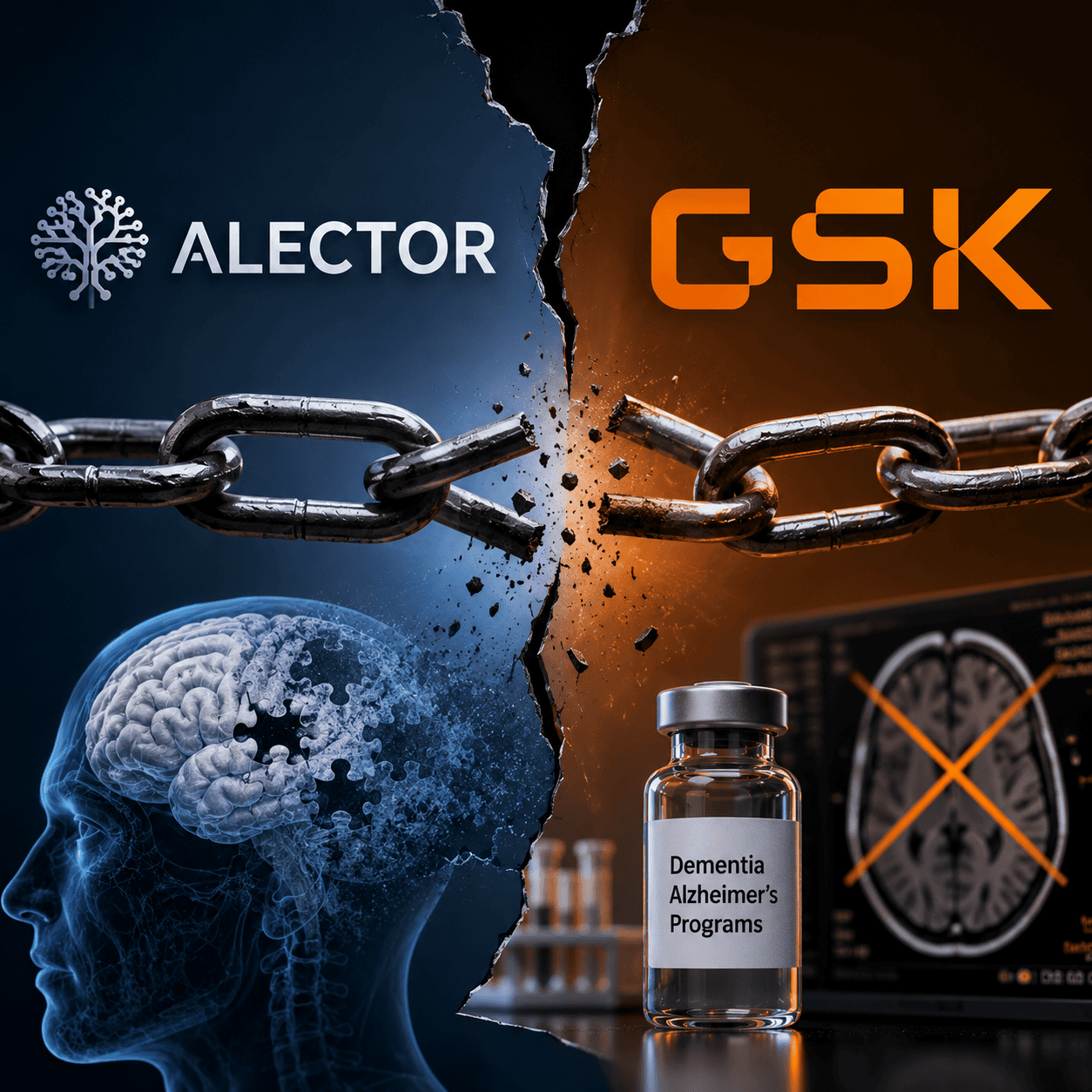
The decision to end a long-standing research collaboration between GSK and Alector marks more than the conclusion of a single partnership. It reflects the increasingly selective approach large pharmaceutical companies are taking toward neuroscience after years of costly clinical disappointments in dementia and Alzheimer’s disease.
Although Alzheimer’s remains one of the world’s largest unmet medical needs, recent years have demonstrated that scientific promise alone is no longer sufficient to sustain billion-dollar investments. Companies are now demanding stronger clinical validation, clearer biological mechanisms, and a more convincing probability of commercial success before committing additional capital.
For emerging biotechnology companies, this shift is particularly significant. Strategic partnerships have traditionally provided not only funding but also development expertise and commercialization capabilities. The loss of a major pharmaceutical partner therefore extends beyond financial implications, it can fundamentally reshape a company’s development strategy and investor confidence.
Why It Matters
- The neuroscience sector is entering a phase where capital allocation is becoming increasingly disciplined despite enormous unmet medical need.
- Large pharmaceutical companies are prioritizing late-stage, de-risked assets over early scientific hypotheses.
- Biotech firms developing neurological therapies may face greater pressure to demonstrate clinical proof-of-concept earlier in development.
- Investors are likely to reward programs supported by robust biomarkers, patient stratification, and differentiated mechanisms rather than broad platform stories.
- Partnership decisions increasingly reflect portfolio optimization rather than simply scientific merit.
Healthcare Insight Analysis
The end of this collaboration should not be interpreted as diminishing industry interest in Alzheimer’s disease. Instead, it highlights a structural evolution in how pharmaceutical companies evaluate innovation.
Over the past decade, neuroscience has transitioned from being viewed as an attractive frontier into one of the industry’s highest-risk therapeutic areas. Multiple late-stage failures have reinforced the reality that biological complexity, long clinical timelines, and uncertain regulatory outcomes significantly increase development risk.
At the same time, the emergence of disease-modifying therapies has changed competitive dynamics. Rather than pursuing broad exploratory programs, companies are concentrating resources on assets capable of demonstrating measurable clinical benefit supported by biomarkers and precision medicine strategies.
For biotechnology companies, this environment raises the standard for partnership discussions. Platform technologies alone may no longer justify large collaborations. Instead, pharmaceutical partners increasingly seek programs with compelling human data, validated targets, and a clearer path toward regulatory approval and reimbursement.
This trend also reflects broader portfolio management strategies across Big Pharma. As patent expirations approach and R&D budgets face increasing scrutiny, companies are reallocating capital toward therapeutic areas where development timelines, probability of success, and commercial returns are more predictable.
Market Implications
The conclusion of this partnership represents a broader signal rather than an isolated corporate event.
Expect pharmaceutical companies to become increasingly selective in neuroscience licensing, emphasizing late-stage opportunities with stronger clinical validation. Early-stage biotechnology firms may experience longer fundraising cycles and greater pressure to generate high-quality translational evidence before attracting strategic partners.
Meanwhile, investors are likely to differentiate more aggressively between companies with clinically validated assets and those relying primarily on promising preclinical science. Across the healthcare ecosystem, capital efficiency and execution quality are becoming just as important as scientific innovation itself.