
Key Development
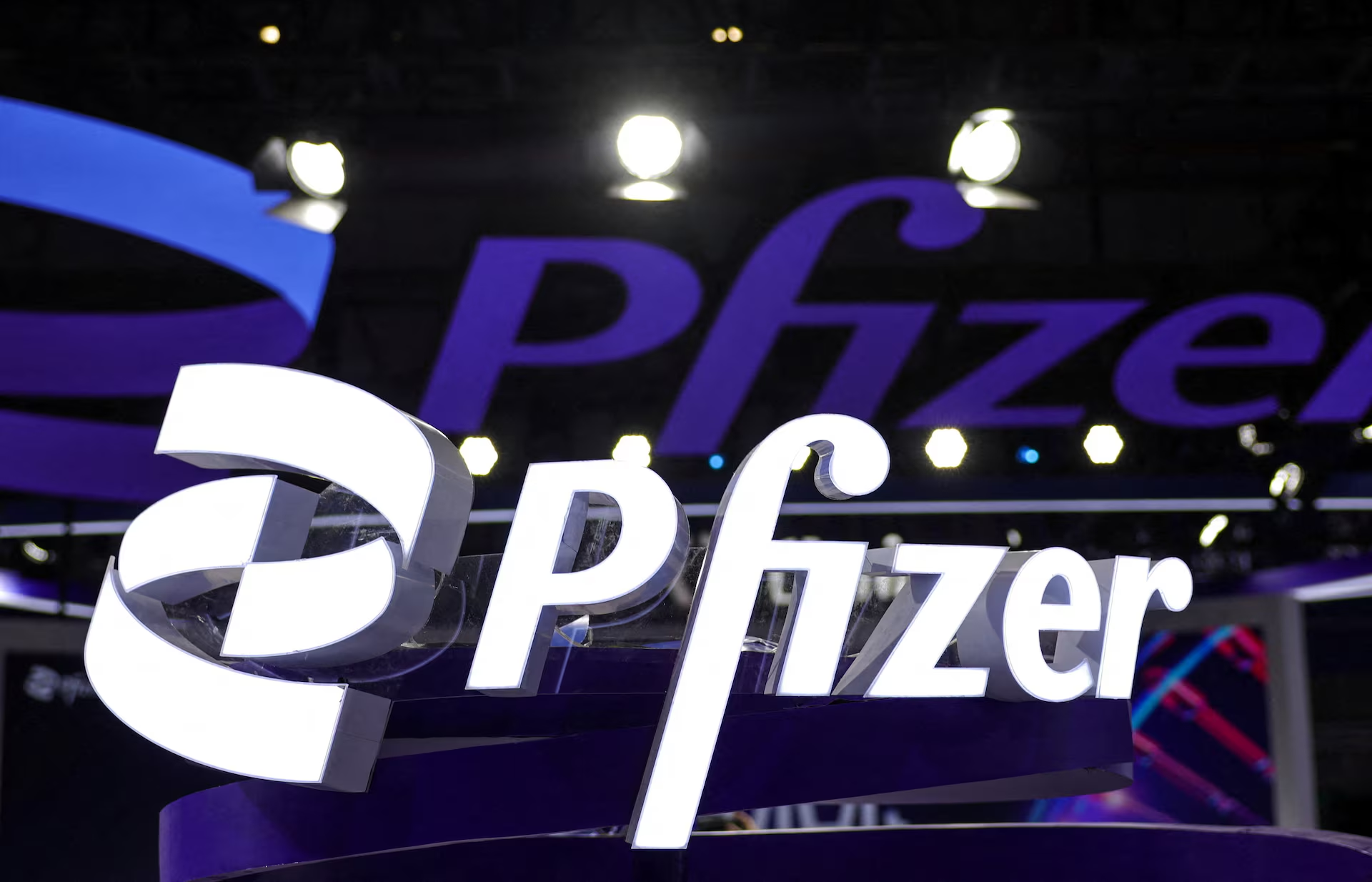
American biopharmaceutical giant Pfizer Inc. (NYSE: PFE) has officially released its Q2 2026 financial readouts, outperforming Wall Street estimates driven by resilient demand for its blood thinner Eliquis and newly acquired oncology assets. Concurrently, executive leadership announced an additional $2.5 billion cost-reduction program, raising its cumulative net savings target to $9.7 billion through 2029.
Q2 2026 Financial Highlights & Core Metrics:
-
Operating Performance: Adjusted diluted EPS reached $0.77 (beating consensus estimates by $0.09). Robust commercial performance prompted Pfizer to raise its full-year 2026 revenue guidance to $60.5 billion – $62.5 billion (up from $59.5 billion – $62.5 billion previously).
-
Impairment & GAAP Net Loss: Pfizer reported a GAAP net loss of $0.04 per share, primarily impacted by acquisition-related charges and a $3.8 billion non-cash impairment charge associated with sigvotatug vedotin (acquired via Seagen) following a Phase III trial failure in pre-treated non-small cell lung cancer.
-
R&D Capital Re-allocation: CEO Albert Bourla noted that SG&A expenses were reduced by 3% in H1 2026, allowing the company to increase R&D spending by 12% year-over-year.
-
Shift in M&A Strategy: Having completed large-scale acquisitions (Seagen for $43B, Metsera for $10B), Pfizer confirmed its remaining ~$6 billion in dealmaking capacity will focus strictly on targeted, bolt-on acquisitions across core therapeutic verticals.
Why It Matters
-
Eliquis and Padcev Expansion Offsets COVID-19 Revenue Decline: Global sales for Eliquis® (co-developed with Bristol Myers Squibb) expanded 21% to $2.43 billion (exceeding consensus estimates of $1.93 billion). Oncology therapy Padcev® grew 23% to $667 million, effectively mitigating declining demand for COVID-19 products.
-
Targeting the $150 Billion Obesity Market: Pfizer is prioritizing berobenatide (a once-monthly injectable candidate acquired via the $10B Metsera transaction), which demonstrated up to 12.3% body weight reduction in non-diabetic clinical cohorts, alongside early-stage amylin-based obesity candidates.
-
Navigating Loss of Exclusivity (LOE) Headwinds: Pfizer reaffirmed its commitment to maintaining dividend payouts, anticipating dividend growth resumption post-2028 following upcoming patent expirations. Full-year 2026 EPS guidance was reaffirmed at $2.80 – $3.00, absorbing a $650 million upfront licensing payment made to Innovent Biologics.
Healthcare Insight Analysis
From the perspective of Healthcare Insight, Pfizer’s Q2 2026 financial readouts illustrate a strategy focused on Operational Efficiency & Post-2028 Re-Acceleration.
Following the normalization of COVID-19 revenues, Pfizer encountered capital allocation constraints driven by looming patent expirations across legacy blockbusters. Implementing an additional $2.5 billion in cost reductions (targeting $9.7B in net savings) reflects strict fiscal discipline: trimming administrative and overhead expenditures to fund a 12% increase in internal R&D reinvestment.
However, Pfizer’s long-term growth trajectory hinges on maximizing return on invested capital (ROIC) from recent M&A:
-
Mitigating Seagen Pipeline Setbacks: Taking a $3.8 billion impairment on sigvotatug vedotin highlights the risks of late-stage oncology development. Pfizer is redirecting clinical efforts toward evaluating the asset in combination with Keytruda® (Merck) in first-line settings.
-
Clinical Execution Catalyst Requirements: Analysts at RBC Capital emphasize that transitioning from a restructuring narrative back to a growth story requires delivering positive late-stage clinical readouts for prostate cancer candidate mevrometostat and Metsera’s metabolic portfolio through 2026–2027.
Market Implications
-
Restoring Equity Investor Confidence: A 2.3% share price increase following the release underscores improving institutional sentiment regarding Pfizer’s cost discipline and commercial execution.
-
Driving Mid-Cap Biopharma Bolt-On Deals: Reserving $6 billion for bolt-on M&A will stimulate deal flow targeting early-to-mid-stage biotechs with validated Phase I/II clinical programs.
-
Heightened Competition in Monthly Obesity Modalities: Successful clinical advancement of berobenatide positions Pfizer as a direct competitor to Eli Lilly and Novo Nordisk in next-generation, extended-release weight management therapies.
Performance Ledger: Pfizer Q2 2026 Financial & Portfolio Metrics
| Financial Metric / Asset | Q2 2026 Readouts & Guidance | Strategic Significance |
| Eliquis® Sales | $2.43 Billion (+21% YoY; beat consensus) | Primary revenue driver offsetting COVID-19 product declines. |
| Padcev® Sales | $667 Million (+23% YoY) | Validates commercial execution across acquired Seagen assets. |
| Net Cost Savings Target | +$2.5B ($9.7B total target by 2029) | Trimming SG&A by 3% to fund a 12% increase in R&D. |
| 2026 Revenue Guidance | $60.5B – $62.5B (Raised from $59.5B) | Reflects commercial momentum across core biopharma portfolio. |
| 2026 EPS Guidance | $2.80 – $3.00 (Reaffirmed) | Reaffirmed despite absorbing $650M Innovent licensing fee. |
| Metsera Obesity Asset | Berobenatide (Once-monthly; 12.3% weight loss) | Core platform targeting the $150B obesity market. |