

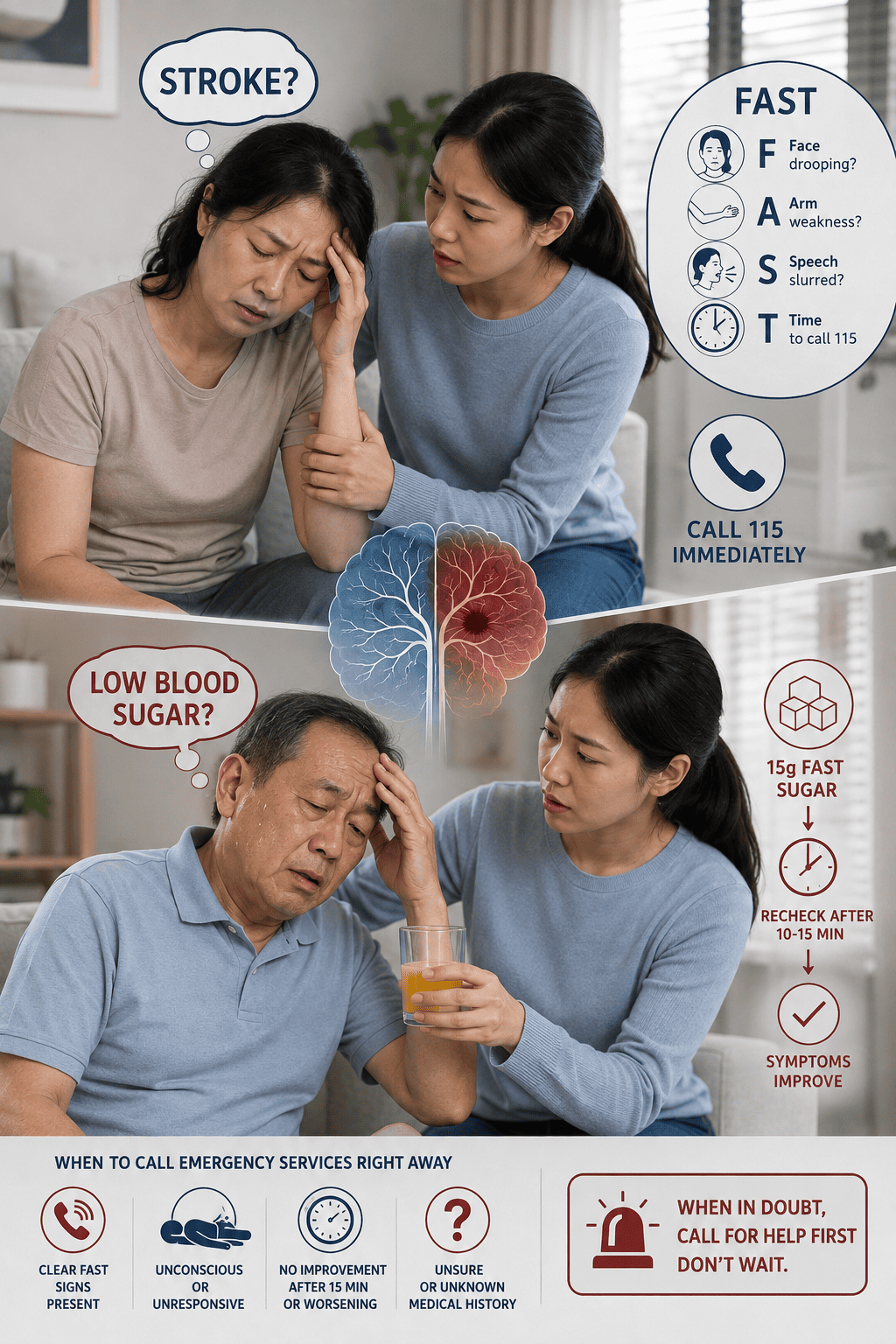
Someone suddenly becomes confused, slurs their words, or their limbs go weak or shaky — this could be a stroke, but it could just as easily be a hypoglycemic episode (low blood sugar). Early on, these two conditions can look remarkably similar, yet the correct response to each is completely different. Misjudging which one you’re dealing with — even briefly — can mean missing a critical treatment window, or applying the wrong first-aid response altogether.
So how do you tell them apart, and why does the distinction matter so much?
What Is a Stroke?
A stroke occurs when blood flow to the brain is suddenly interrupted — either by a clot blocking a vessel (ischemic stroke) or a ruptured blood vessel (hemorrhagic stroke). Deprived of blood and oxygen, brain cells begin to suffer damage within minutes, and symptoms typically appear suddenly, often affecting just one side of the body.
What Is Hypoglycemia?
Hypoglycemia occurs when blood glucose drops below the level the brain and body need to function normally — most commonly in people managing diabetes with insulin or blood-sugar-lowering medication, particularly after skipping a meal, exercising intensely, or taking too much medication. Since the brain relies almost entirely on glucose for fuel, it reacts almost immediately to a drop in blood sugar, producing neurological symptoms that can easily be mistaken for a stroke by bystanders.
Why the Two Are Easy to Confuse
Both conditions can present with:
- Confusion or disorientation
- Slurred or difficult speech
- Weakness or trembling in the limbs
- Dizziness or loss of balance
- In severe cases: loss of consciousness or seizures
This overlap is exactly why even family members can misjudge the situation in those first critical moments.
Key Differences to Watch For
| Factor | Stroke | Hypoglycemia |
|---|---|---|
| Onset | Sudden, usually without warning | Often has warning signs: intense hunger, sweating, shaking, rapid heartbeat |
| Symptom pattern | Usually one-sided (one side of the face, arm, or leg) | Usually affects the whole body evenly, not one-sided |
| Medical history | May have a history of heart disease or high blood pressure | Usually has a history of diabetes, on insulin or glucose-lowering medication |
| Response to sugar | No improvement | Typically improves noticeably within minutes of consuming sugar |
| Blood glucose reading (if available) | Usually within normal range | Usually below 70 mg/dL (3.9 mmol/L) |
Quick Check: The FAST Rule for Stroke
- F – Face: ask them to smile. Does one side droop or look uneven?
- A – Arm: ask them to raise both arms. Does one drift downward or feel weak?
- S – Speech: ask them to say a simple sentence. Is it slurred or hard to follow?
- T – Time: if any of these signs appear, note the time and call emergency services immediately.
The defining clue with stroke is that symptoms are usually one-sided — something rarely seen with hypoglycemia, which tends to affect the whole body more evenly.
If You Suspect Hypoglycemia, What Should You Do First?
If the person has a known history of diabetes, is still conscious, and can safely swallow, you can offer 15 grams of fast-acting sugar right away — for example, half a cup of regular soda, a few pieces of candy, or a tablespoon of sugar dissolved in water. If it is indeed hypoglycemia, symptoms typically improve noticeably within 10-15 minutes.
Important caution: never give anything by mouth if the person is unconscious, not fully alert, or showing signs suggestive of a stroke (one-sided weakness, facial drooping, slurred speech) — the risk of choking is too high. In these cases, call emergency services immediately instead.
When to Call Emergency Services Right Away
Call for emergency help immediately if:
- Clear FAST signs are present (facial drooping, one-sided weakness, slurred speech).
- The person is unconscious or unresponsive.
- Sugar was given but symptoms haven’t improved after 15 minutes, or are getting worse.
- You’re simply not sure of the cause, especially when symptoms are severe and the person’s medical history is unknown.
When in doubt, the safest rule is always: call for help first — don’t wait to be certain of the cause.
The Bottom Line
Stroke and hypoglycemia can look nearly identical in their first few minutes, but the correct response couldn’t be more different — one requires urgent hospital care, the other can often resolve quickly with a small amount of sugar. Understanding this distinction, especially the telltale one-sided symptoms of stroke, can help you respond faster and more appropriately in an emergency — a difference that can genuinely matter for the person involved.
This article is for general health information purposes only and does not replace diagnosis or treatment guidance from a qualified physician.