

Key Development
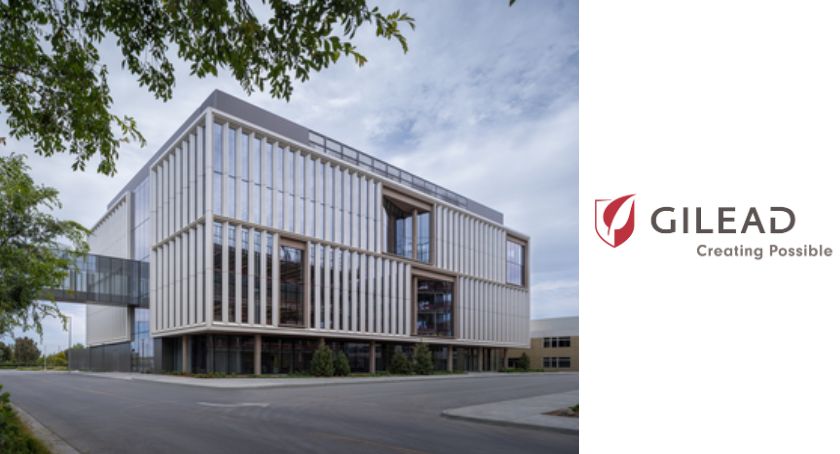
On September 8, 2026, research-based biopharmaceutical company Gilead Sciences Inc. (NASDAQ: GILD) marked the official opening of its new 182,000-square-foot Research Center located at its global headquarters campus in Foster City, California.
The multi-story facility expands integrated discovery and preclinical capabilities across three core scientific pillars: oncology, inflammatory disorders, and research data science:
-
Operational Architecture and Personnel Density: Designed with collaborative input from internal discovery teams, the five-story facility accommodates approximately 325 professionals, including 260 full-time laboratory scientists.
-
Modular Collaborative Design: The facility incorporates flexible laboratory neighborhoods, specialized cross-functional meeting spaces, and centralized technological instrumentation platforms designed to adapt as biological programs evolve. An elevated pedestrian bridge connects the center to an adjacent building to streamline the transit of scientific instrumentation and biological specimens, complemented by a central “Research Quad” designed for scientific exchange.
-
Sustainable Engineering: The building integrates all-electric systems, high-efficiency mechanical engineering, and drought-tolerant landscaping utilizing native California flora to support LEED Gold certification standards.
-
Executive Commentary: Daniel O’Day, Chairman and Chief Executive Officer of Gilead Sciences, stated: “We are in a moment of unprecedented opportunity in science and technology. Our new Research Center will help Gilead scientists make the most of that opportunity, delivering more breakthrough medicines faster. As part of our broader $32 billion investment in the United States, this new facility also reflects our long-term commitment to American innovation.”
-
Tripartite Foster City Campus Development Through 2030: The Research Center represents one of three capital projects anchoring Gilead’s broader $32 billion multi-year investment program across U.S. discovery, technical development, and domestic manufacturing:
-
New Research Center: Formally opened September 8, 2026.
-
Technical Development Center: Slated for mechanical commissioning in 2027.
-
Chess Biologics Facility: Broke ground in late August 2026, projected to enter clinical and commercial drug substance manufacturing operations in 2029.
-
Why It Matters
-
Integrating Computational Data Science with Wet-Lab Biology: A key operational feature of the facility is the physical co-location of research data scientists, biostatisticians, and computational biologists alongside bench scientists in oncology and immunology. This proximity integrates predictive machine learning models directly into target validation, compound screening, and early molecular optimization.
-
Capital Deployment Under the $32 Billion U.S. Investment Plan: Amid ongoing supply chain resilience discussions across the biopharmaceutical sector, Gilead’s $32 billion capital allocation through 2030 (projected to generate $43 billion in national economic value and support over 3,000 direct and indirect jobs) reinforces domestic biopharmaceutical innovation and technical capacity in the San Francisco Bay Area.
-
Expanding Beyond Antiviral Franchises into Oncology and Immunology: While maintaining its established leadership in antiviral therapeutics (HIV, viral hepatitis, COVID-19), Gilead continues to expand its clinical footprint in solid and hematologic oncology (via Trodelvy, Yescarta, Tecartus) and chronic inflammatory diseases. The new center provides the physical infrastructure needed to support its early-stage research pipeline.
Healthcare Insight Analysis
From the perspective of Healthcare Insight, the commissioning of Gilead’s 182,000-square-foot Research Center on September 8, 2026, illustrates The Convergence of Data Science with Wet-Lab Biology and Co-Located Campus Biomanufacturing.
The expansion highlights three central biopharmaceutical R&D dynamics:
-
Reconfigurable Laboratory Modules vs. Static Facilities: Implementing flexible laboratory neighborhoods allows research groups to reconfigure floor plans and utilities without costly renovations. This adaptability is essential as discovery programs shift across chemical modalities, spanning small molecules, antibody-drug conjugates (ADCs), and cell therapies.
-
Direct Application of In-House Computational Tools: As noted by Dr. Flavius Martin, Executive Vice President of Research, drug discovery increasingly relies on integrating diverse disciplines. Embedding data scientists directly within discovery teams helps bridge single-cell omics, real-world registry evidence, and automated screening readouts into actionable target validation.
-
Co-Location Synergy Across Discovery, Development, and Manufacturing: Co-locating discovery research, technical process development (2027), and clinical-scale biologics production (2029) on a single unified campus reduces technology transfer risks and shortens lead times from lead candidate selection to Phase 1 clinical supply.
Market Implications
-
Scientific Partnerships in AI-Driven Drug Discovery: Expanded data science infrastructure positions Gilead to pursue targeted research collaborations and licensing partnerships with external artificial intelligence and computational biology platforms.
-
Technical Talent Retention and Recruitment in the Bay Area: The facility provides modern laboratory space to support recruitment of PhD-level molecular biologists, bioinformaticians, and laboratory automation engineers in Northern California’s life sciences hub.
-
Competitive Positioning Across Solid Oncology and Immunology: Enhanced discovery infrastructure supports pipeline throughput as Gilead seeks to advance novel candidates into clinical-stage trials alongside competitors such as Roche, Novartis, AstraZeneca, and Pfizer.
Capital Project Summary Matrix: Gilead Sciences Research Center (Foster City Campus)
| Project Parameter | Technical Specifications & Operational Scope | Strategic Significance & Industry Context |
| Owning corporation | Gilead Sciences Inc. (NASDAQ: GILD) | Global corporate headquarters, Foster City, CA |
| Facility floor area | 182,000 Square feet (~16,908 m2), 5-story structure | Expands advanced discovery laboratory footprint |
| Operational workforce | ~325 Total personnel, including 260 bench scientists | Dedicated to specialized preclinical research |
| Primary therapeutic scope | Oncology, inflammation/immunology, and data science | Integrates computational biology with wet labs |
| Environmental certification | All-electric mechanicals, native landscaping, LEED Gold | Sustainable laboratory design and energy efficiency |
| Investment program context | Component of broader $32B U.S. investment through 2030 | Generates ~$43B in estimated economic value |
| Foster City campus roadmap | Research Center (2026), Tech Dev (2027), Biologics (2029) | Integrated campus from discovery to manufacturing |