

Key Development
A $300 million upfront payment for a candidate only entering Phase 1 suggests Novo Nordisk increasingly sees dosing frequency itself as a strategic battleground in obesity.
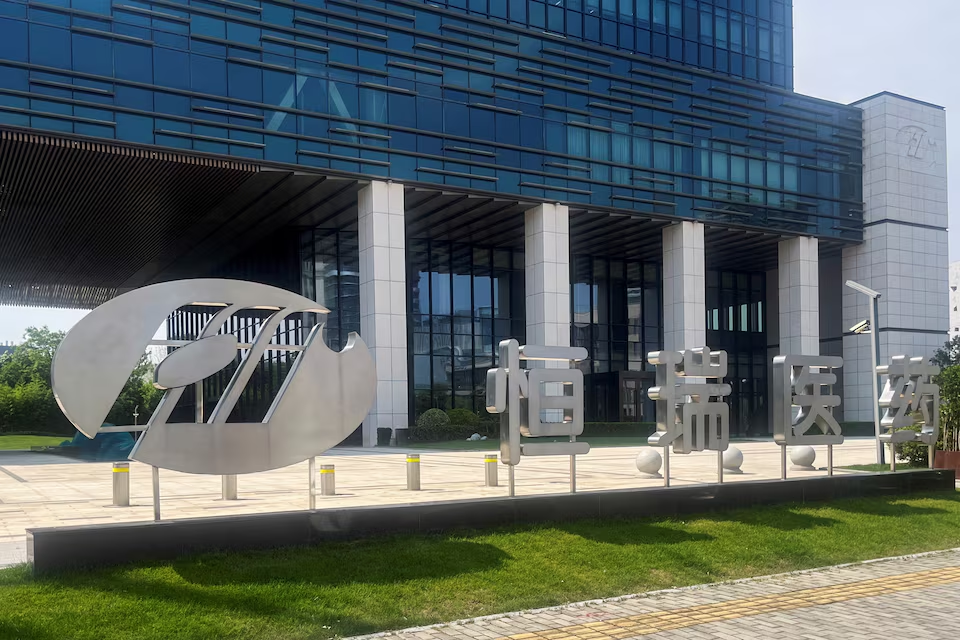
On September 29, 2026, Novo agreed to pay $300 million upfront to Jiangsu Hengrui Pharmaceuticals for development, manufacturing and commercialization rights to HRS-1596 outside mainland China, Hong Kong, Macau and Taiwan. Hengrui is eligible for up to another $2.3 billion in development, regulatory and commercial milestones, bringing potential transaction value to $2.6 billion.
HRS-1596 is an investigational oral metabolic therapy for weight management and type 2 diabetes that has received Chinese regulatory clearance to begin clinical development. Industry sources identify it as a dual GLP-1/GIP agonist with the potential for once-weekly oral dosing. That would create a materially different dosing proposition from Novo’s Wegovy pill and Lilly’s Foundayo, both currently once-daily oral therapies.
Why It Matters
- Once-weekly oral dosing could create a new convenience tier. If pharmacokinetics support durable exposure, patients could gain injection-like dosing frequency without injections.
- Novo is buying optionality exceptionally early. HRS-1596 has only recently been cleared for clinical trials in China; Hengrui’s public disclosure currently cites animal efficacy models rather than human results.
- This diversifies Novo beyond semaglutide, but not beyond incretin biology. HRS-1596 still relies on GLP-1/GIP pathways.
- Oral scale is now a corporate priority. At its 2026 Capital Markets Day, Novo said it intends to build capacity sufficient to serve ten times more people with oral GLP-1 therapies.
Healthcare Insight Analysis
Healthcare Insight believes it is too simplistic to frame the agreement as “Novo needs another obesity drug to catch Lilly.”
What Novo is acquiring is formulation and dosing optionality.
The first phase of the obesity market largely competed on one headline metric: magnitude of weight loss.
The next phase could compete across a broader product profile:
efficacy → route → dosing frequency → tolerability → persistence → cost.
Oral Wegovy and Foundayo have already demonstrated that pills can create another entry point into pharmacological obesity care. Drugmakers expect oral products to attract patients reluctant to use injectable treatments. Novo’s CEO has even suggested pills could potentially account for as much as half of the obesity market by 2030, although that represents a company scenario rather than an industry consensus forecast.
If once-daily oral therapy is the first step, once-weekly oral therapy could be the next.
The clinical challenge is substantial.
HRS-1596 must demonstrate that prolonged oral exposure can be achieved without sacrificing efficacy, predictability or tolerability. Weekly dosing is commercially attractive, but Phase 1 needs to establish whether its pharmacokinetic profile can sustain therapeutic levels while avoiding excessive peak exposure or unacceptable gastrointestinal adverse events.
That is why the $2.6 billion headline requires context.
Novo is not paying $2.6 billion today.
Only $300 million is upfront. The remaining value is contingent on development, regulatory and commercial success. The deal therefore allows Novo to secure early control of the global opportunity while keeping much of the program’s biological risk embedded in milestone economics.
The transaction also says something broader about Chinese pharmaceutical innovation.
HRS-1596 received Chinese clinical-trial authorization only this month, yet it has already attracted hundreds of millions of dollars upfront from the global leader that pioneered the modern GLP-1 obesity market.
That suggests external innovation from China is moving earlier in Big Pharma’s decision cycle.
Companies are increasingly willing to license assets before human proof-of-concept when the potential product profile — in this case, dual incretin pharmacology plus weekly oral dosing — is sufficiently differentiated.
For Novo, this is particularly important because diversification does not necessarily mean abandoning the biology that created Wegovy.
It can mean building multiple ways to access the same enormous market: injectable semaglutide, oral semaglutide, combination products, next-generation incretins and potentially long-duration oral therapies.
Market Implications
Novo Nordisk: adds another potential post-semaglutide growth option while remaining anchored in incretin biology.
Hengrui: retains Greater China economics while accessing Novo’s global obesity-development and commercialization infrastructure.
Eli Lilly: future competition for Foundayo may come not only from weight-loss efficacy, but from oral candidates with materially lower dosing burden.
Payers and providers: if weekly dosing improves persistence, value assessment may increasingly shift toward cost per persistently treated patient rather than cost per prescription.
ANALYTICAL MATRIX
| Dimension | HRS-1596 Today | Opportunity | Key Risk |
| Development | Entering Phase 1 | Rapid global program | No human data |
| Dosing | Potential once-weekly oral | Convenience differentiation | PK not validated |
| Biology | Incretin / GLP-1-GIP | Weight + glycemic effects | Still concentrated in incretin class |
| Deal economics | $300m upfront; $2.6bn potential | Significant global upside | Most value milestone-dependent |
| Innovation source | Hengrui / China | Faster external innovation | High early-stage attrition |
The next two signals are HRS-1596’s human pharmacokinetic profile and whether multiple-dose Phase 1 data genuinely support once-weekly oral administration.
If they do, the strategic significance will extend beyond another GLP-1 licensing deal. The obesity market may acquire a new convenience benchmark: pills that are not only effective enough to replace injections for some patients, but infrequent enough to remove the burden of daily treatment as well.