

Key Development
Patients may not need to choose between pills and injections for their entire obesity-treatment journey. Early real-world evidence suggests they can change route and continue losing weight.
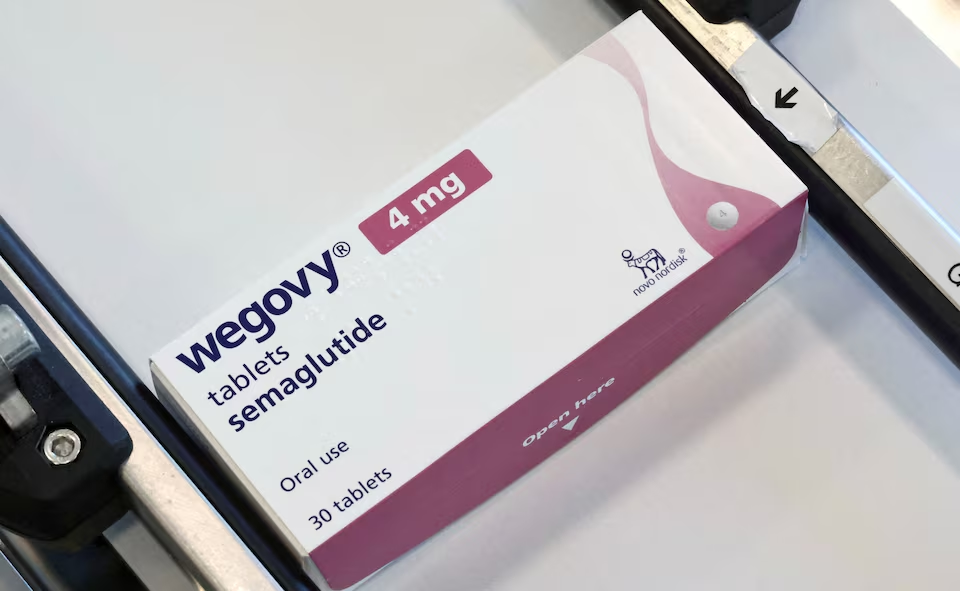
At EASD 2026, Novo Nordisk presented OCTANE, a 194-patient real-world study of adults with overweight or obesity who switched from injectable semaglutide or tirzepatide to once-daily oral semaglutide, the Wegovy pill. Over the following three months, participants lost an average 4.1% of body weight, or approximately 4.0 kg, from a mean switch-point weight of 100.5 kg. About 40.7% lost at least 5% of body weight, while the proportion with BMI ≥30 kg/m² fell from 87.1% to 65.5%.
However, OCTANE was a retrospective analysis using de-identified data from the Ro telehealth platform rather than a randomized trial. Patients did not need a specified duration of previous injectable treatment or documented prior weight loss, and inclusion in the final analysis required persistence on oral semaglutide throughout the three-month follow-up.
Why It Matters
- This does not show that the pill outperforms injections. There was no control group remaining on injectable therapy and no standardized comparison of pre- versus post-switch weight-loss rates.
- Switching route could become a treatment strategy in its own right. Patients may be able to move from injections to pills because of needle preference, lifestyle or convenience without necessarily losing therapeutic momentum.
- Oral obesity therapy is becoming commercially material. Reuters reported that oral therapies now account for roughly one-third of U.S. obesity prescriptions, while Novo says it captures more than 80% of new oral prescriptions. Those figures are company-reported rather than an independent market audit.
- The efficacy of oral semaglutide itself has been established separately in randomized trials. In OASIS 4, oral semaglutide 25 mg produced 16.6% mean weight loss at Week 64 among patients remaining on treatment, versus 2.7% with placebo.
Healthcare Insight Analysis
Healthcare Insight believes the strategically important number is not necessarily 4.1%.
The more interesting implication is that obesity care may be moving from:
“choose a pill or choose an injection”
toward:
“use the formulation that best fits each phase of long-term treatment.”
That matters because obesity is a chronic disease requiring sustained therapy.
A patient might prefer an injection during initiation, then want an oral formulation because of travel, injection fatigue or changing lifestyle. Another patient may begin with a pill but later move toward an injectable option if efficacy, adherence or disease severity makes that route more appropriate.
If patients can change route without resetting treatment progress, formulation flexibility becomes more than convenience.
It becomes a potential tool for improving long-term retention.
This could create a particularly useful franchise architecture for Novo.
Wegovy injection and Wegovy pill contain the same active molecule, semaglutide. That gives Novo the ability to keep patients inside one molecular and commercial ecosystem even as their preferred route changes.
In other words, the strategic competition may increasingly be about patient lifetime within the franchise, not merely which formulation wins the initial prescription.
But OCTANE does not establish that switching improves persistence.
Indeed, one of its most important design limitations is that patients had to remain on oral semaglutide without a gap greater than 30 days throughout follow-up to qualify for the analysis. People who discontinued early because of tolerability, dissatisfaction or other barriers are therefore not represented in the final cohort.
Novo itself notes possible selection bias, incomplete routine-care data, self-reported measurements and limited generalizability.
The transition was also not pharmacologically seamless. The mean interval between the last injectable prescription and oral semaglutide initiation was 36.8 days, reinforcing that this was a real-world switching pathway rather than a tightly controlled crossover trial.
This distinction matters because Reuters quoted Novo as saying some patients appeared to do better after moving to the pill. The study cannot establish that oral therapy caused a superior outcome to remaining on injection.
The stronger conclusion is narrower:
patients selected for and persistent with the switch continued to lose clinically meaningful weight over the next three months.
That is still strategically important.
The next phase of obesity-market differentiation may not be defined solely by who creates the largest maximum weight reduction. It may increasingly be determined by who can keep patients successfully treated when preferences, tolerability and life circumstances change.
Market Implications
Novo Nordisk: could develop semaglutide into a multi-formulation franchise that retains patients as route preferences evolve.
Eli Lilly: oral competition will increasingly include switching and maintenance strategies, not only efficacy comparisons.
Telehealth providers: become important infrastructure for titration, switching and longitudinal obesity management.
Payers: if flexible route options reduce discontinuation, cost per persistent patient may become more informative than cost per prescription.
ANALYTICAL MATRIX
| Dimension | OCTANE Signal | Opportunity | Limitation |
|---|---|---|---|
| Weight | -4.1% at three months | Continued momentum after switching | No comparator |
| Population | 194 prior injectable users | Real-world switching insight | Small, selected cohort |
| Persistence | Three-month pill persistence required | Potential continuity | Major selection bias |
| Formulation | Injectable → oral | Flexible treatment pathway | Long-term outcomes unknown |
| Commercial | Rapid oral-market growth | Franchise retention | Intensifying competition |
The next two metrics to watch are 12-month treatment persistence after switching and weight trajectories versus matched patients who remain on injectable therapy.
If both prove favorable, the Wegovy pill may become strategically more than an injection-free version of semaglutide. It could turn semaglutide into a treatment platform in which patients change formulation without having to leave the therapeutic journey.