

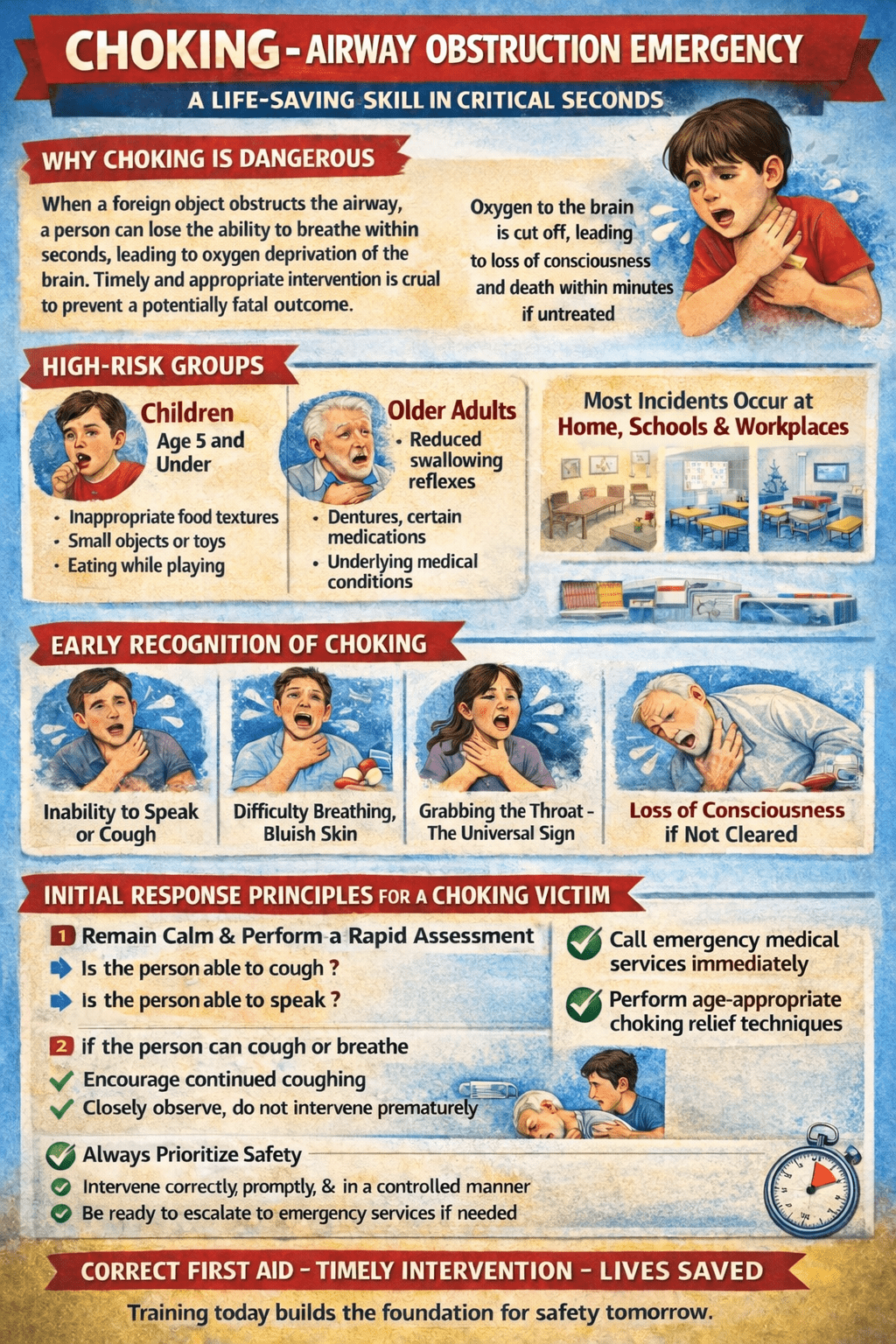
Choking is one of the most common medical emergencies in everyday life, yet it is often underestimated. When a foreign object obstructs the airway, a person can lose the ability to breathe within seconds, leading to oxygen deprivation of the brain and a potentially fatal outcome if timely and appropriate intervention is not provided.
High-Risk Groups
In first aid education and training, children and older adults are consistently identified as the populations at highest risk of choking.
- Children, particularly those under five years of age, are vulnerable due to inappropriate food textures, small objects or toys, and behaviors such as eating while playing.
- Older adults face increased risk as a result of reduced swallowing reflexes, weakened teeth or dentures, underlying medical conditions, and the effects of certain medications.
The majority of choking incidents occur at home, in schools, factories, or workplaces—environments where bystanders are often not adequately trained in first aid and emergency response.
Early Recognition – The Foundation of Effective Intervention
A person experiencing choking may present with the following signs:
- Inability to speak or cough
- Difficulty breathing, wheezing or high-pitched sounds, bluish discoloration of the lips or fingertips
- Grasping the throat – a classic and universal warning sign
- Loss of consciousness if the obstruction persists
Early recognition enables responders to make rapid and accurate decisions during life-critical moments.
Initial Response Principles for a Choking Victim
Remain calm and perform a rapid assessment
- Is the person able to cough effectively?
- Is the person able to speak?
If the person can cough or breathe
- Encourage continued coughing
- Closely observe and do not intervene prematurely
If the person cannot cough, cannot speak, or shows severe respiratory distress
- Call emergency medical services immediately
- Initiate first aid using age-appropriate choking relief techniques
Always prioritize safety
- Intervene correctly, promptly, and in a controlled manner
- Be prepared to escalate to emergency services if the condition does not improve
Actions NOT Recommended in a Choking Emergency
ü Do not perform blind finger sweeps or insert hard objects into the mouth or throat: This may push the foreign object deeper or cause additional injury.
- Do not slap the back or perform abdominal thrusts if the person is coughing effectively: This may worsen the airway obstruction
- Do not give water or additional food: This significantly increases the risk of complete airway blockage
- Do not delay action or adopt a “wait and see” approach: Choking is a time-critical emergency measured in seconds
Important: Choking relief techniques must be properly learned and practiced. Incorrect application may result in serious injury.
Choking First Aid – A Skill That Requires Training, Not Assumption
Techniques such as back blows and chest thrusts for infants, and the Heimlich maneuver for children and adults, have been proven to save lives. However, these are not skills to be learned through observation or hearsay, but through structured training and supervised hands-on practice.
Choking can happen to anyone, anywhere. Proactively equipping individuals with first aid knowledge and skills not only protects loved ones but also helps build safer environments in schools, workplaces, factories, and communities.
Correct First Aid – Timely Intervention – Lives Saved
Training today builds the foundation for safety tomorrow.