

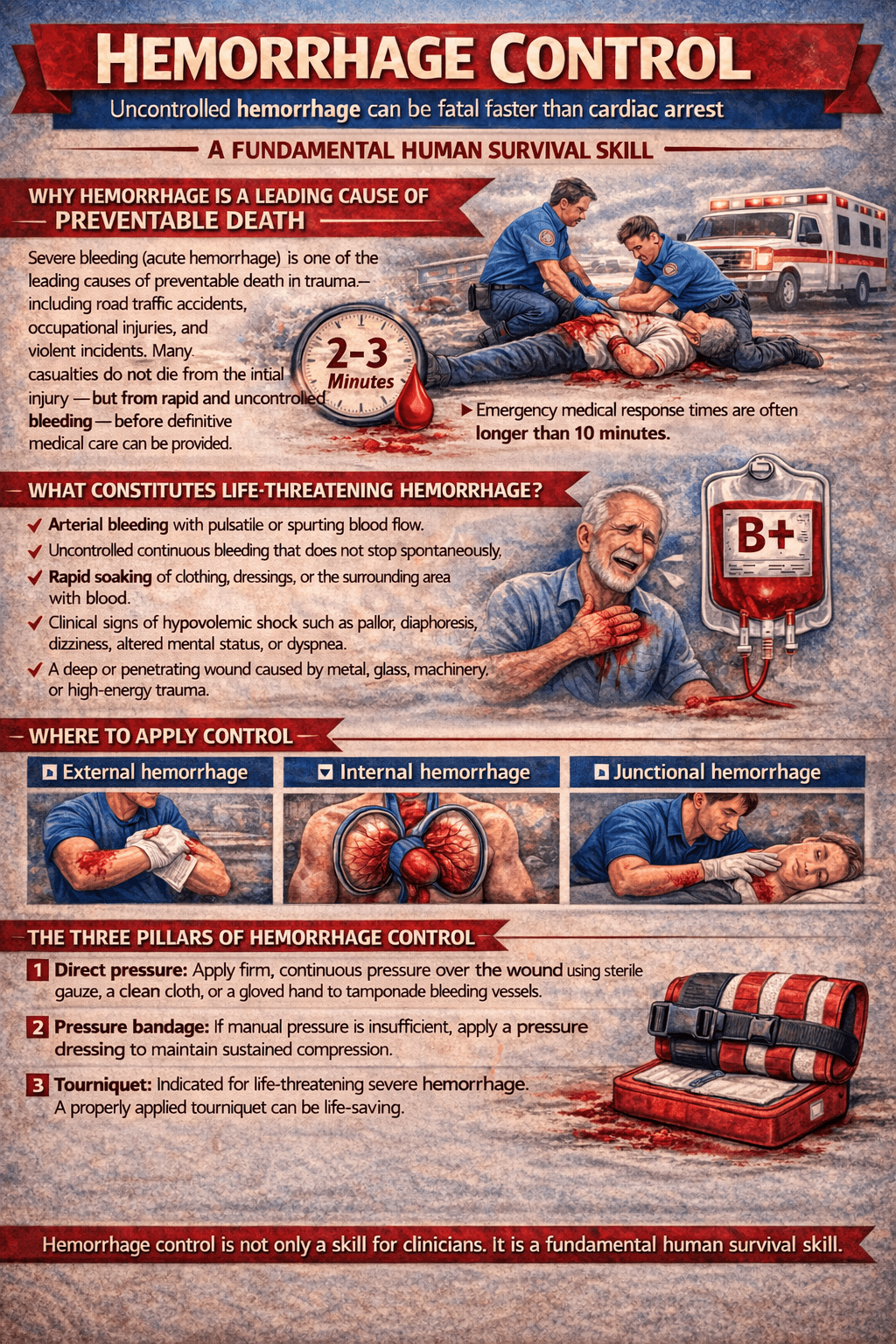
Severe bleeding (acute hemorrhage) is one of the leading causes of preventable death in trauma, including road traffic accidents, occupational injuries, and everyday incidents. Many casualties do not die from the primary injury itself, but from exsanguination — rapid and uncontrolled blood loss — before definitive medical care can be provided.
An adult can lose consciousness within 2–3 minutes if hemorrhage is not controlled. In contrast, emergency medical response times are often significantly longer. Therefore, early hemorrhage control at the scene is a critical determinant of survival.
What constitutes life-threatening hemorrhage?
Not all bleeding is clinically equivalent. Hemorrhage is considered life-threatening when one or more of the following are present:
- Arterial bleeding with pulsatile or spurting blood flow
- Uncontrolled continuous bleeding that does not stop spontaneously
- Rapid soaking of clothing, dressings, or the surrounding area with blood
- Clinical signs of hypovolemic shock such as pallor, diaphoresis, dizziness, altered mental status, or dyspnea
- A deep or penetrating wound caused by metal, glass, machinery, or high-energy trauma
These findings indicate that the patient is progressing toward hemorrhagic shock, a condition in which circulating blood volume is insufficient to maintain oxygen delivery to vital organs.
Why is hemorrhage so rapidly fatal?
Blood is essential for:
- Oxygen transport to the brain and myocardium
- Perfusion of vital organs
- Maintenance of systemic blood pressure
With acute blood loss:
- Intravascular volume decreases
- Blood pressure falls
- Tissue perfusion and oxygen delivery are compromised
- The patient progresses from compensated shock → decompensated shock → cardiac arrest
A particularly dangerous feature of hemorrhage is that: a patient may initially appear stable, then suddenly deteriorate and collapse as shock progresses.
Types of life-threatening hemorrhage
In trauma care, bleeding is classified into three major categories:
External hemorrhage: bleeding visible outside the body. Although easy to recognize, it can be rapidly fatal if uncontrolled.
Internal hemorrhage: bleeding into the thoracic cavity, abdominal cavity, or deep soft tissues. There may be pain, distension, bruising, or weakness, but no visible bleeding, making this type easy to miss.
Junctional hemorrhage: bleeding from areas such as the groin, axilla, or neck, where standard tourniquets cannot be applied.
These injuries require targeted wound packing and direct pressure.
The three pillars of hemorrhage control
Hemorrhage control is not wound cleaning — it is mechanical interruption of blood flow.
1. Direct pressure: apply firm, continuous pressure over the wound using sterile gauze, a clean cloth, or a gloved hand to tamponade bleeding vessels.
2. Pressure bandage: If manual pressure is insufficient, a pressure dressing is applied to maintain constant compression and allow the responder to attend to other priorities.
3. Tourniquet:Indicated for severe hemorrhage of the extremities or when bleeding cannot be controlled with direct pressure alone.
A properly applied tourniquet can be life-saving by occluding arterial blood flow to the injured limb.
Common errors in hemorrhage management
- Wiping or cleaning the wound instead of applying pressure
- Applying loose or ineffective bandages
- Removing dressings repeatedly to inspect the wound
- Avoiding tourniquet use due to fear of limb damage
- Allowing the patient to wait without active hemorrhage control
In reality: uncontrolled bleeding will not stop without adequate mechanical pressure.
Why hemorrhage control matters in workplaces and communities
Serious injuries can occur in factories, schools, hotels, shopping centers, and public events.
If even one or two individuals on site are trained in hemorrhage control, they can: prevent avoidable deaths, reduce the severity of injury and preserve vital time until emergency medical services arrive.
In modern trauma care, hemorrhage control is considered as critical as airway management and CPR.
Trauma is often unavoidable. However, death from uncontrolled hemorrhage is largely preventable — if someone nearby knows how to act.
Hemorrhage control is not only a clinician’s skill.
It is a fundamental human survival skill.