

Key Development
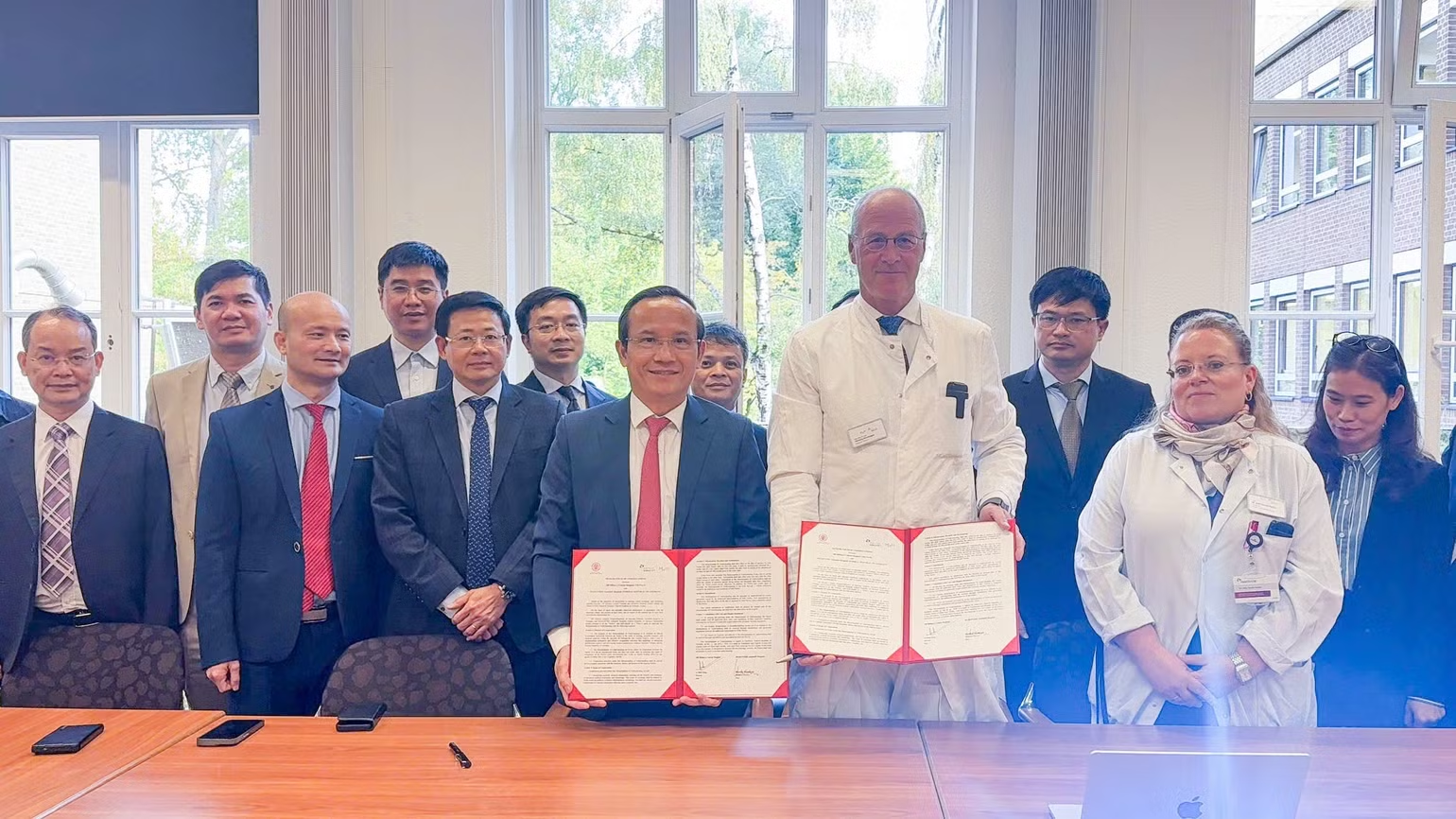
Vietnam’s Military Central Hospital 108 and DIAKOVERE Annastift in Hannover have established a formal orthopedic cooperation framework, but the structure of the agreement suggests an ambition beyond conventional short-term overseas training.
The partnership centers on three pillars: regular clinical consultations for complex cases; doctoral and continuing medical education; and joint research, including potential clinical trials and international publications. Physicians from Hospital 108 are also expected to participate more deeply in clinical activities with the German partner.
The more strategically interesting part occurred outside the operating theatre. The Vietnamese delegation also visited Hannover’s NIFE biomedical and implant research center, where work spans biomechanics, biomaterials, tissue engineering and implant development. Technologies presented included 12-camera gait analysis, dynamic artificial-joint testing, robotic systems that reproduce multi-axis joint movement and 3D technologies for personalized surgical instruments and implants.
Why It Matters
- Modern orthopedics is increasingly an engineering discipline as much as a surgical one.
- DIAKOVERE Annastift provides a mature joint-reconstruction environment and operates a certified maximum-care endoprosthetics center.
- NIFE supplies the translational bridge from biomaterials and biomechanics to preclinical implant validation.
- Joint trials could move Vietnamese hospitals up the value chain from technology users toward evidence-generating clinical sites.
- Patient-specific implants create localization opportunities, but only if local capabilities extend into design, testing, data and regulatory validation.
Healthcare Insight Analysis
Healthcare Insight believes the most valuable version of this collaboration is not:
Germany develops the technique → Vietnam learns it.
It is:
Vietnamese clinical problem → engineering question → biomechanical validation → clinical study → standardized treatment.
That represents a fundamentally different capability.
Traditional medical technology transfer usually takes a finished technique developed elsewhere and trains local surgeons to reproduce it.
A translational partnership begins earlier.
A difficult Vietnamese orthopedic case can generate research questions: Is an existing implant optimized for local anatomy? How does loading change after reconstruction? Can a patient-specific device reduce instability? Which surface reduces infection risk?
NIFE represents the type of infrastructure capable of investigating these questions.
Its work includes biodegradable implants, implant-associated infection, biomechanical testing, biocompatibility and bioactive surfaces, linking material science to clinically relevant implant performance.
If the MOU produces mainly workshops and observational training, its impact will remain primarily educational.
If it progresses toward shared protocols, joint registries, biomechanical studies and multicenter clinical trials, the strategic value changes materially.
Orthopedics is particularly suited to this model because many outcomes can be quantified:
alignment → gait → function → revision → implant survival.
That creates a measurable feedback loop connecting surgeon, engineer, hospital and medtech manufacturer.
Localization is another important opportunity.
Vietnam does not necessarily need to begin by manufacturing complete robotic systems or entire implant platforms.
Potentially higher-value entry points include local anatomical datasets, 3D surgical planning, patient-specific guides, biomechanical validation, implant-surface technology and clinical evidence generation.
This is how a healthcare system begins moving from medical-device purchaser to medtech development partner.
For manufacturers, that distinction matters.
A hospital capable of producing high-quality clinical data, testing designs against real local anatomy and participating in international research becomes more attractive not only as a customer, but as a development site.
The same applies to training.
A doctoral program linked to active research and clinical immersion transfers substantially deeper capability than short-duration CME because clinicians learn not only how to perform a procedure, but how to evaluate, investigate and improve it.
There is, however, an important boundary.
The agreement remains an MOU.
There is not yet public evidence that a joint clinical trial has started, a new implant has been co-developed or NIFE technology has been transferred into routine practice at Hospital 108.
The strategic thesis therefore remains to be executed.
Market Implications
Hospital 108: can strengthen its role as a tertiary orthopedic research center rather than competing only on surgical volume.
Medtech companies: collaboration could open opportunities in implants, biomechanics, 3D planning and personalized orthopedic solutions.
Medical education: PhD training, CME and clinical immersion offer a deeper model of capability transfer.
Investors and industry: hospital-based translational platforms could become important entry points for medtech localization in Vietnam.
ANALYTICAL MATRIX
| Dimension | Traditional Model | Emerging Model | KPI to Watch |
| Clinical care | Technique transfer | Joint complex-case review | Clinical outcomes |
| Training | Workshops | PhD + CME + immersion | Competency transfer |
| Research | Single-center studies | Joint trials/publications | Trial initiation |
| Medtech | Equipment purchasing | Co-validation | Local clinical evidence |
| Innovation | Import | Co-development | Prototype → trial |
The partnership should therefore not ultimately be judged by how many Vietnamese surgeons visit Germany.
A more meaningful benchmark is whether a clinical problem identified in Vietnam can move through the full cycle of biomechanics, engineering, validation and clinical research — and return as a better treatment, standard or product.
If that happens, the relationship would represent more than orthopedic technology transfer.
It would mark the beginnings of local orthopedic technology creation within Vietnam’s hospital ecosystem.