

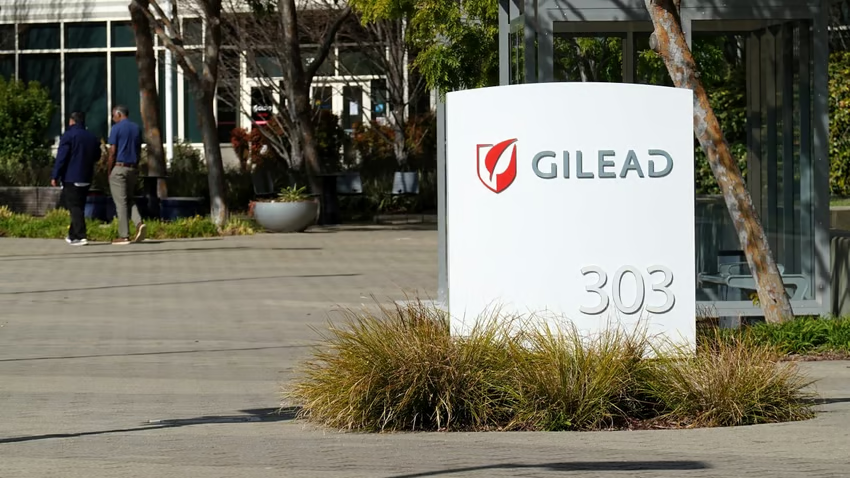
More than three years after Gilead Sciences’ targeted hepatitis D virus (HDV) candidate bulevirtide was turned down by the U.S. FDA due to manufacturing and delivery concerns, the therapeutic asset has redeemed its regulatory status by scoring a formal market clearance. Just prior to the Memorial Day holiday weekend, the regulatory body signed off on Hepcludex as the first available prescription treatment for chronic HDV infections within the United States. Granted under an accelerated approval framework, the entry inhibitor is indicated for adult cohorts presenting without cirrhosis or with compensated cirrhosis—a long-term hepatic complication characterized by continuous inflammation and progressive organ scarring.
The underlying clinical trial metrics, regulatory history, and epidemiological context defining the asset feature:
-
Pivotal Phase 3 Clinical Trial Data: The federal regulatory green light was anchored in statistical evidence derived from Gilead’s late-stage MYR301 clinical protocol. The data demonstrated that a continuous course of Hepcludex triggered statistically significant improvements in a combined virologic and biochemical response profile at the 48-week milestone compared to a control group assigned to delayed treatment.
-
Primary Endpoints and Response Rates: The primary endpoint within the MYR301 methodology tracked a combined response criteria, structurally defined as achieving undetectable systemic HDV RNA levels alongside the normalization of aminotransferase liver enzymes at week 48. Subjects assigned to the active Hepcludex arm achieved a combined response rate of 48% against a marginal 2% documented within the delayed intervention arm. However, Gilead caveated that absolute improvements in long-term, disease-related clinical outcomes have not yet been fully established within its current body of evidence, meaning the drugmaker will likely need to conduct a confirmatory trial to secure full U.S. approval.
-
Corporate Buyouts and Backend Bottlenecks: The biological formulation served as the central strategic asset underpinning Gilead’s €1.15 billion acquisition of German biotechnology firm MYR in late 2020, an investment designed to quickly expand the drug’s overseas commercial footprint. The therapeutic had previously captured a conditional endorsement in the European Union in 2020 before escalating to a full approval there in 2023. However, its initial U.S. regulatory filing was hit by an unexpected rejection in the fall of 2022 due to chemistry, manufacturing, and controls (CMC) flaws.
-
Epidemiological Risk Profiles: Chronic HDV infection represents the most aggressive variant of viral hepatitis, clinically correlated with a significantly elevated risk of rapid disease acceleration, liver failure, and all-cause mortality compared to managing a hepatitis B infection alone. Demographic estimates suggest that approximately 2% to 4% of chronic hepatitis B carriers in the U.S.—translating to a population of 40,000 to 80,000 individuals—are co-infected with the delta pathogen.
The manufacturing hurdles that previously stalled Hepcludex echo a separate supply-chain disruption experienced by Gilead around late 2021. During that period, 10 active clinical studies evaluating its HIV molecule lenacapavir (now approved as the ultra-long-acting PrEP option Yeztugo and HIV therapy Sunlenca) were placed on a regulatory hold. The pause was triggered by technical concerns that the internal drug solution was chemically incompatible with its borosilicate storage vials, potentially causing microscopic glass particles to shed into the medication. Gilead ultimately resolved the FDA hold in May of the following year by transitionally swapping its packaging architecture to aluminosilicate glass vials.