

Key Development
Vietnam’s pharmaceutical-industry gap increasingly sits between two very different layers: a relatively broad finished-drug manufacturing base downstream and a very thin pharmaceutical-chemical industry upstream.
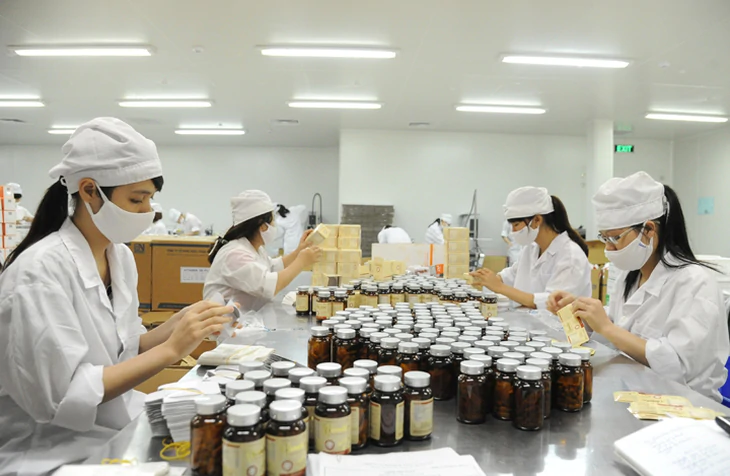
By 2026, Vietnam had approximately 245 pharmaceutical manufacturing facilities, including 26 plants meeting EU-GMP or equivalent standards. Domestic medicines account for roughly 60% of utilization by volume but only about 46% by value. In contrast, the Ministry of Industry and Trade has reported only six registered pharmaceutical-chemical manufacturers, three meeting WHO-GMP, while domestic inputs cover only about 5.2% of raw-material demand for modern medicines.
Policy now aims to connect those two ends of the value chain. Decision 270/QD-TTg targets domestic production equivalent to 20% of pharmaceutical raw-material demand by 2030, while Vietnam’s national pharmaceutical strategy targets domestic medicines at around 80% of utilization and 70% of market value.
Why It Matters
- Vietnam already has downstream demand, but that demand has not yet become an investable upstream signal. Drug manufacturers can still source established APIs internationally at competitive prices.
- API economics require scale. The Ministry of Industry and Trade describes domestic pharmaceutical-chemical producers as small, with relatively simple product portfolios and limited cost competitiveness against China and India.
- The 20% target will be difficult if pharma and pharmaceutical chemicals develop as separate industries. API producers need predictable volume; drugmakers require quality, cost and continuity.
- The strategic objective is value-chain upgrading, not import substitution alone. Vietnam’s national strategy explicitly aims to develop into a regional center for higher-value pharmaceutical production.
Healthcare Insight Analysis
Healthcare Insight believes the key question is no longer simply:
“Can Vietnam manufacture an API?”
It is:
“Which API can support an industrial business case?”
Commercial API production requires substantial capital, robust process chemistry, impurity control, environmental infrastructure, analytical capability and regulatory-grade documentation.
But none of those investments work economically if downstream pharmaceutical companies continue buying imported APIs because they remain materially cheaper.
The next phase of localization therefore needs to move from technology push to demand-backed industrialization.
Rather than selecting molecules first and finding customers later, Vietnam could prioritize APIs using three filters:
sufficient domestic demand + strategic health-security relevance + credible cost or technology competitiveness.
That creates a different development sequence:
pharma demand commitment → API capacity investment → process technology transfer → regulatory qualification → sustained commercial procurement.
The critical variable is offtake.
A multi-year purchasing commitment from one or several pharmaceutical manufacturers can be more valuable to an API project than a standalone investment incentive because it makes capacity utilization and cash flow more predictable.
This also explains why pharmaceutical sovereignty should not mean manufacturing every molecule locally.
Competing head-on with China or India in undifferentiated commodity APIs may destroy value rather than create resilience. Vietnam can instead concentrate on critical medicines, high-volume molecules, strategically relevant intermediates and technically differentiated products where domestic economics are more credible.
Infrastructure can also be shared.
Pharmaceutical-chemical clusters could centralize wastewater treatment, analytical laboratories, pilot-scale equipment, utilities and selected quality systems, reducing the capital burden for individual manufacturers.
Most importantly, procurement policy needs to reward more than the existence of local capacity.
The real objective should be commercial utilization of qualified domestic inputs.
A plant producing an API nobody purchases adds nominal capacity. A qualified API incorporated repeatedly into registered medicines creates an industrial value chain.
Market Implications
Pharmaceutical manufacturers: sourcing may gradually move from lowest-cost procurement toward dual sourcing and strategic local sourcing for selected critical inputs.
Chemical companies: opportunities extend upstream into intermediates, starting materials, solvents and fine chemicals rather than APIs alone.
Investors: committed offtake, utilization rates and process yield should matter more than headline production capacity.
Policymakers: incentives could become more effective when linked to commercial output and actual downstream adoption of locally manufactured inputs.
ANALYTICAL MATRIX
| Dimension | Current Gap | What Needs to Be Built | Better KPI |
| Downstream | 245 pharma facilities | Anchor customers | Committed API demand |
| Upstream | ~5.2% local modern-drug inputs | API/intermediate capacity | Capacity utilization |
| Economics | Imports often more competitive | Scale + offtake | Qualified cost/kg |
| Quality | API must enter drug dossiers | Qualification infrastructure | APIs commercially adopted |
| Policy | 20% target by 2030 | Demand-backed localization | Domestic procurement value |
If industry linkage stops at conferences and memoranda, Vietnam will create more connections.
If it connects demand, technology, capital, quality and procurement, it can create something far more durable: an investable pharmaceutical value chain.
The end goal is not simply an API labeled “Made in Vietnam.” It is an API manufactured in Vietnam that drugmakers repeatedly choose because its quality, economics and supply security make commercial sense.