

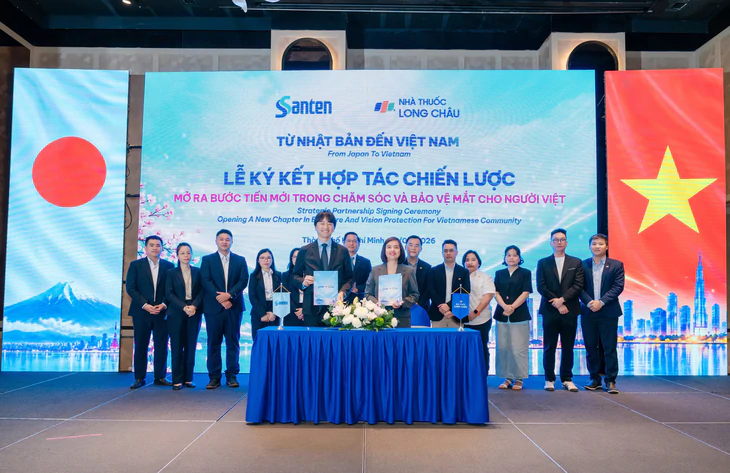
Key Development
Long Châu and Santen are moving beyond conventional product access toward a broader model built around eye-health education, screening, pharmacist capability and referral into specialist care.
On September 30, 2026, the companies announced an expansion of their strategic collaboration in Vietnam. Planned activities include multi-channel health education, community screening, pharmacist training and a “Doctor In Store” model that brings physicians into selected pharmacies for consultation and eye-health screening. Earlier in March, the partners had already launched a nationwide initiative focused on dry-eye screening and eye protection in digital-device environments.
Long Châu says its network now exceeds 2,700 pharmacies across 34 provinces and cities, supported by more than 22,000 healthcare professionals and over 36 million loyalty customers. These are company-reported figures, but they illustrate the strategic opportunity: retail pharmacy provides a population-access layer that specialist ophthalmology clinics cannot easily replicate at equivalent scale.
Why It Matters
- Eye care has a major access gap. WHO estimates at least 2.2 billion people globally live with near or distance vision impairment, and at least 1 billion cases could have been prevented or remain unaddressed.
- Global eye-health policy is moving closer to primary care. WHO’s integrated eye-care agenda emphasizes early detection, service coordination and stronger integration with primary healthcare.
- Santen is strategically aligned with this model. Its ophthalmology-focused portfolio spans glaucoma, dry eye, infection, allergy, myopia and retinal disease.
- Community pharmacy can address the pre-hospital gap. Many people initially self-manage mild eye symptoms or delay specialist consultation.
Healthcare Insight Analysis
Healthcare Insight believes the most interesting element is not distribution.
It is patient-acquisition architecture.
The traditional eye-care pathway often looks like:
symptom → self-management → worsening → specialist visit.
A pharmacy-based model could insert a new layer:
symptom/risk → pharmacy contact → structured screening or counseling → referral → ophthalmologist → treatment → follow-up.
That is strategically significant.
Conditions such as glaucoma can progress silently, while dry eye, allergy and refractive problems are frequently treated as minor complaints for long periods. A highly accessible pharmacy network could potentially convert part of that demand from unstructured self-medication into structured assessment and referral.
However, the boundary of the model matters.
A pharmacy should not become a substitute eye clinic.
Pharmacists can identify warning signs, reinforce adherence and route patients appropriately, but diagnosis of glaucoma, retinal disease and other sight-threatening conditions requires ophthalmologists and specialist diagnostic infrastructure.
Three capabilities will determine whether the partnership produces healthcare value.
The first is triage quality: standardized rules distinguishing symptoms suitable for community advice from those requiring urgent specialist evaluation.
The second is referral closure. Screening has limited value if patients identified as high risk never reach an ophthalmology service.
The third is clinical-commercial governance. When a specialist pharmaceutical company partners with a retail network that also sells healthcare products, screening criteria and clinical recommendations need to remain clearly separated from product promotion.
This is where data may become the partnership’s most valuable long-term asset.
A measurable pathway could track:
screened → abnormal result → referred → specialist attended → diagnosis → treatment.
That would provide something more powerful than an awareness campaign: real-world evidence on where Vietnamese patients drop out of the eye-care pathway.
The strategic fit with Santen is also broader than today’s initiatives.
The company is expanding beyond traditional symptomatic eye care into areas such as myopia progression control, with low-dose atropine already marketed in Japan and approved in the Philippines, while an application is under review in China.
That creates a potential future ecosystem spanning prevention, early identification, treatment access and long-term condition management.
Market Implications
Long Châu: continues its evolution from pharmacy retailer toward a broader healthcare-access platform.
Santen: gains a scalable disease-awareness and patient-access infrastructure beyond traditional physician promotion.
Eye hospitals and clinics: could receive more pre-screened patients, provided referral standards prevent unnecessary demand.
Pharma and medtech: successful execution could create templates for glaucoma risk identification, myopia management, retinal-health education and digital eye screening.
ANALYTICAL MATRIX
| Dimension | Current Signal | Opportunity | Key Risk |
| Access | >2,700 pharmacies reported | Bring eye care closer to communities | Uneven screening quality |
| Workforce | Pharmacist eye-health training | Earlier triage and education | Scope creep into diagnosis |
| Referral | Doctor In Store and screening | Earlier specialist connection | Patient drop-off |
| Pharma | Santen’s ophthalmology focus | Condition-management ecosystem | Commercial bias |
| Data | Large consumer touchpoint base | Population-level pathway insights | Privacy and fragmentation |
The most meaningful KPIs are not the number of screening events or consultations. They are referral completion, clinically significant detection rate and time from screening to specialist care.
If those outcomes can be demonstrated, this partnership could become more than a disease-awareness initiative. The pharmacy would not replace the ophthalmologist; it would become the front door that helps patients reach the right ophthalmologist earlier.