

Key Development
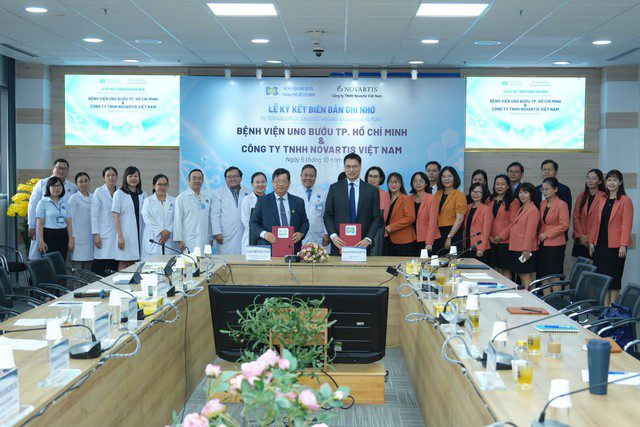
Ho Chi Minh City Oncology Hospital and Novartis Vietnam have signed a strategic MOU for 2026–2028, but the more important story is not another hospital–pharma collaboration. The partnership points toward a model in which a tertiary cancer center increasingly functions as a knowledge and coordination hub for a broader oncology network.
The program covers four areas: continuous medical education; strengthening the hospital’s role in training lower-level facilities; scientific exchange and clinical research in areas including breast and lung cancer; and patient-centered initiatives such as online counseling, patient clubs, side-effect management and cancer-awareness activities.
The operating context is significant. HCMC Oncology Hospital currently receives approximately 4,700–5,000 outpatient visits per day, with around 75% of patients coming from outside Ho Chi Minh City. Its second campus provides 1,000 beds and 18 operating rooms, yet hospital leadership says the next stage will emphasize quality, innovation and connectivity, rather than volume expansion alone. In 2025, the hospital reported more than one million visits, almost 40,000 surgeries, over 188,000 radiation fractions and more than 352,000 systemic-treatment cycles.
Why It Matters
- Tertiary-center congestion cannot be solved through infrastructure expansion alone. If patients throughout the region continue to travel to one specialist center for every part of their pathway, new capacity can rapidly fill again.
- Training can become a capacity intervention. Every follow-up visit, supportive-care episode or standardized treatment safely delivered locally reduces avoidable tertiary demand.
- Clinical-research capability creates dual value: access to innovation for patients and stronger research infrastructure for the health system.
- Patient education is moving closer to core care delivery, rather than remaining a peripheral communication activity.
Healthcare Insight Analysis
Healthcare Insight believes the most important strategic issue is a paradox:
The better a tertiary oncology hospital becomes, the more patients it can attract — and the more congested it can become.
A strong brand and advanced technology do not automatically create an efficient regional cancer system.
Without a redesigned referral architecture, increased tertiary capacity may simply generate more centralized demand.
The more scalable model is care segmentation.
Provincial and partner hospitals should progressively manage standardized elements of the pathway:
screening → diagnostic work-up → selected systemic therapy → supportive care → routine follow-up.
The tertiary center can then concentrate on higher-complexity activities:
complex surgery → advanced radiation → molecularly complex disease → multidisciplinary decisions → clinical trials.
That represents a shift from being a referral hospital to becoming an oncology network orchestrator.
The MOU is particularly relevant because HCMC Oncology Hospital already maintains formal functions around lower-level training, satellite oncology facilities and cancer registration. During 2026 it also entered professional collaborations with An Sinh Hospital and the Xuyen A General Hospital network. Taken together, these initiatives suggest a broader strategic direction: expand the network, not only the hospital.
The real test, however, will be whether collaboration changes where care actually occurs.
Traditional partnership KPIs — number of CME sessions, physicians trained or scientific meetings held — are insufficient.
A stronger measurement framework would track:
how many cases can subsequently be managed locally; appropriate referral rates; diagnosis-to-treatment time; share of patients receiving care closer to home; and whether complex cases reach the tertiary center at the right time.
This is also where governance matters in a pharmaceutical partnership.
Industry can contribute substantial value through medical education, clinical research infrastructure and patient support. But scientific programs need clear separation from promotional objectives so that training, referral criteria and patient education remain driven by evidence and health-system needs.
If that governance is strong, pharma can act not simply as a supplier of medicines, but as a contributor to system capability.
Market Implications
Tertiary hospitals: competitive strength will increasingly include network orchestration, not only in-house capacity.
Provincial and private hospitals: standardized pathways, teleconsultation and CME can allow them to retain more appropriate oncology care locally.
Pharma: partnership models may increasingly extend into research infrastructure, disease education and healthcare-capacity building.
Diagnostics and medtech: decentralization raises demand for pathology, molecular testing, imaging and interoperable digital systems outside major tertiary centers.
ANALYTICAL MATRIX
| Dimension | Current Signal | Opportunity | KPI to Watch |
| Congestion | 4,700–5,000 visits/day | Segment care by complexity | Referral rate |
| Patient origin | ~75% from outside HCMC | Care closer to home | Local-treatment share |
| Workforce | CME + lower-level training | Standardized capability | Cases managed locally |
| Research | Clinical-trial collaboration | Innovation access | Trial enrollment |
| Patient support | Counseling and education | Better navigation | Time-to-treatment |
If the collaboration produces only more meetings and training events, its system impact will remain limited.
If it helps move routine care toward capable local hospitals while concentrating complex care at the tertiary center, HCMC Oncology Hospital could create new capacity without putting every additional unit of capacity inside its own buildings.
That would mark the transition from a large cancer hospital to a regional oncology platform.