

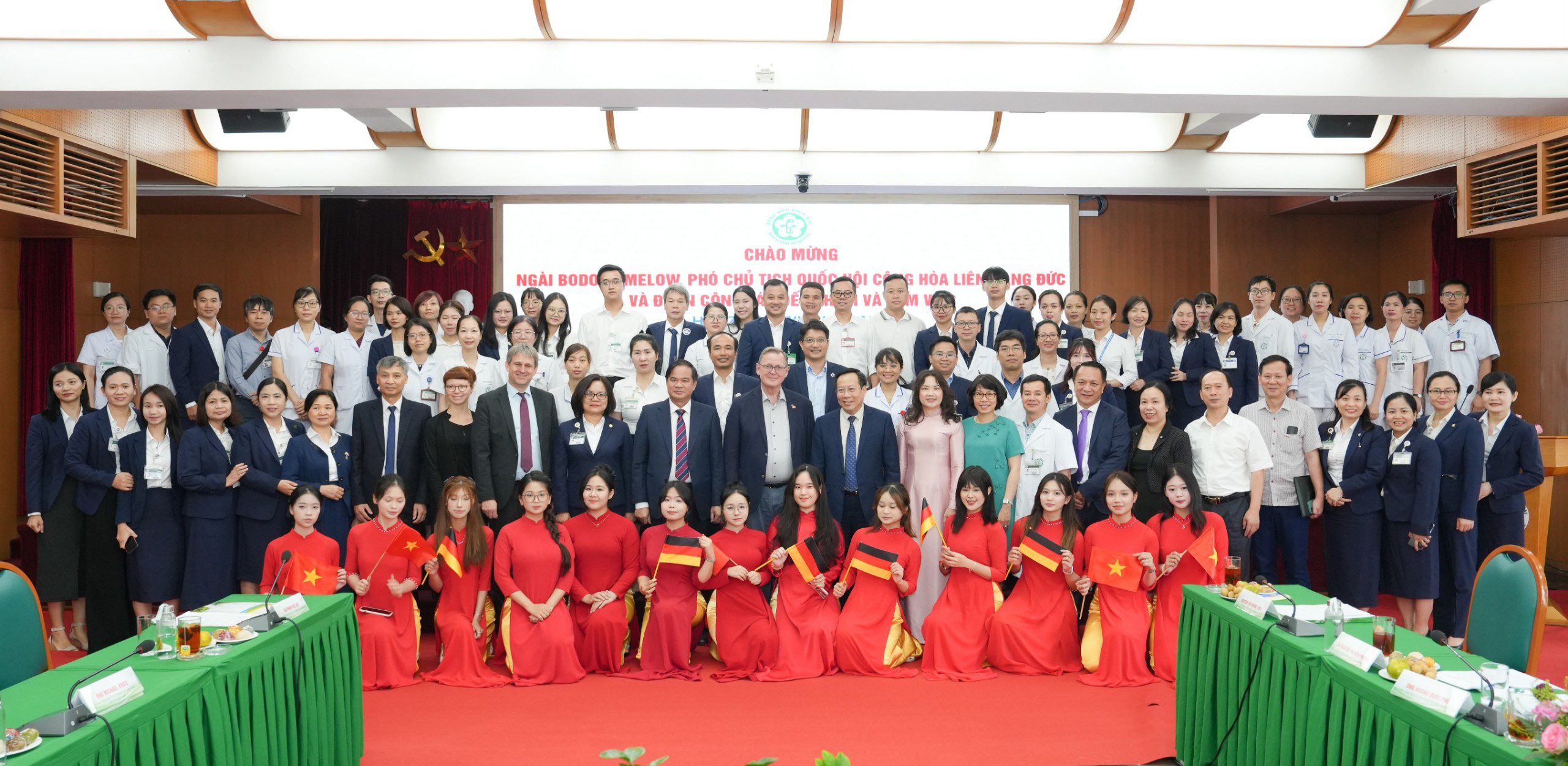
On the morning of June 17, 2026, Mr. Bodo Ramelow, Deputy President of the Federal Parliament (Bundestag) of the Federal Republic of Germany, led a senior delegation to visit and hold high-level bilateral talks at Bach Mai Hospital in Hanoi. Moving forward just one week after preliminary discussions in Berlin, the diplomatic summit establishes extensive healthcare integration frameworks between the two nations across nursing education, geriatric care, scientific research, and advanced medical technology transfer to address the global demographic shift toward an aging population.
The working session was directed by Vice Minister of Health Le Duc Luat, alongside German Embassy representatives including Mr. Michael Kratz (Counsellor for Economic Affairs and Climate Diplomacy) and Ms. Alexandra Westwood (Attache for Economic Affairs and Development Cooperation).
The documented dual-degree educational programs, geriatric nursing simulation centers, and high-tech medical transfer structures feature:
-
Standardizing Professional Qualifications and Structuring Dual-Degree Nursing Frameworks:
-
Dissolving Administrative Bottlenecks: Mr. Bodo Ramelow praised the medical training capacities of Vietnam and Bach Mai Hospital, noting that Germany’s accelerated aging demographic profile has driven a severe workforce deficit across long-term care institutions. Germany’s core objective is to align Vietnam’s training programs with the German professional registry, dissolving historical administrative barriers surrounding the cross-border validation of vocational certifications.
-
Dual-Degree Educational Matrices: The proposed cooperation models will establish a specialized geriatric nursing curriculum tailored to German healthcare standards directly within the Bach Mai Allied Health College. Upon graduation, students are projected to receive concurrent Vietnamese national diplomas and German vocational certificates, granting them legal eligibility to practice within long-term care facilities and clinical environments across Germany.
-
-
Human Resource Rotation Strategies and Specialized Institutional Infrastructure Layouts:
-
Rotational Employment Pipelines: Assoc. Prof. Dr. Dao Xuan Co, Director of Bach Mai Hospital, proposed a strategic mobility mechanism allowing Bach Mai nurses to study and work in Germany for a fixed 2-to-3-year tenure. Following this international clinical exposure, the specialized workforce will return to Vietnam to lead academic training, clinical mentorship, and knowledge transfer operations.
-
Simulation Infrastructure Investments: Bach Mai Hospital advanced proposals to evaluate the establishment of an institutional Geriatric and Long-Term Care Center modeled after German management systems, alongside building a joint Vietnam-Germany Geriatric Nursing Simulation Center at the Bach Mai Allied Health College to standardize clinical competencies.
-
-
Cross-Border Scientific Research Collaborations and High-Tier Medical Tech Transfers:
-
Advanced Surgical and Intensive Interventions: Beyond nursing frameworks, Bach Mai Hospital aims to expand technical alliances with German medical entities across high-acuity specialties, focusing heavily on robotic surgery, multi-organ transplantation, intensive care medicine, cardiology, and oncology.
-
Next-Generation Biomedical Science: The partners agreed to catalyze joint scientific trials and accelerate technology transfers within high-value biomedical matrixes, including genomic technologies, stem cell therapies, and advanced molecular biology, modernizing Vietnam’s tier-one terminal healthcare delivery networks.
-