

Key Development
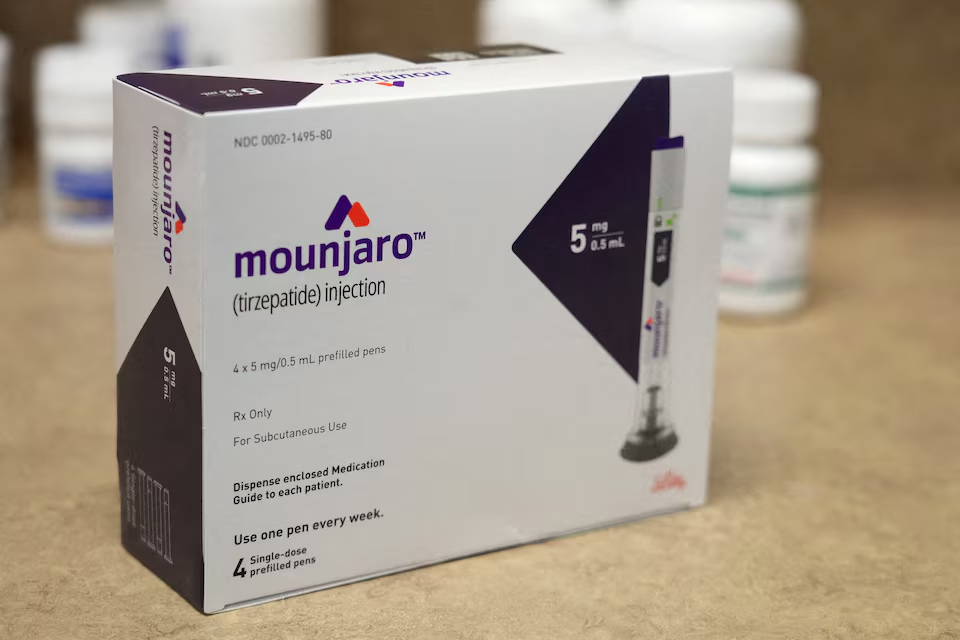
On August 28, 2026, the U.S. FDA approved an expanded indication for Eli Lilly’s Mounjaro® (tirzepatide) to reduce the risk of major adverse cardiovascular events (MACE), including cardiovascular death, non-fatal myocardial infarction and non-fatal stroke, in adults with type 2 diabetes at high cardiovascular risk. The decision moves Mounjaro beyond its original glucose-lowering proposition into cardiovascular risk management.
The approval was supported by SURPASS-CVOT, a Phase 3 cardiovascular outcomes trial involving 13,299 participants across 30 countries. Importantly, tirzepatide was not tested against placebo but against Trulicity (dulaglutide), a GLP-1 receptor agonist with established cardiovascular benefit. Tirzepatide met the primary non-inferiority objective for three-point MACE, with a hazard ratio of 0.92, although statistical superiority over dulaglutide was not established.
The label expansion also arrives when the franchise already carries substantial commercial momentum. Reuters reported that Mounjaro sales increased 91% to $9.94 billion in the second quarter of 2026, driven by strong global demand.
Why It Matters
- Mounjaro is no longer competing primarily on A1C reduction and weight loss. Cardiovascular risk reduction gives Lilly a harder clinical outcome around which to build therapeutic and economic value.
- SURPASS-CVOT sets a higher evidentiary bar than a conventional placebo-controlled CVOT. Tirzepatide was compared with an active GLP-1 therapy already known to provide cardiovascular protection.
- Cross-trial percentages require caution. Wegovy reduced MACE by 20% versus placebo in SELECT, while tirzepatide showed an approximately 8% lower relative rate versus dulaglutide. These figures should not be interpreted as evidence that one drug provides greater cardiovascular protection because the populations and comparators were fundamentally different.
- The Lilly–Novo Nordisk competition is shifting from weight loss toward outcomes, where cardiovascular, renal and other obesity-related complications may increasingly determine product differentiation.
Healthcare Insight Analysis
Healthcare Insight views this approval as part of a larger transition: tirzepatide is evolving from a diabetes treatment into a broader cardiometabolic risk-management asset.
Diabetes drugs were once differentiated largely by glucose lowering. Weight reduction subsequently became a major competitive metric. The next stage of the incretin market is likely to be defined by hard outcomes—heart attack, stroke, heart failure, kidney disease and mortality.
That transition has significant commercial consequences.
A medicine that can address glycemic control, body weight and cardiovascular risk creates a more powerful value proposition across endocrinology, primary care and potentially cardiology. It may also strengthen discussions with payers by shifting part of the economic argument from biomarker improvement toward prevention of costly downstream events.
However, cardiovascular labeling should not be confused with automatic reimbursement expansion. Pricing, budget impact, treatment duration and patient-selection criteria will remain central to payer decisions.
The scientific nuance is equally important. SURPASS-CVOT did not establish that tirzepatide was superior to dulaglutide for MACE-3. Events occurred in 12.2% of tirzepatide-treated patients versus 13.1% receiving dulaglutide, with the confidence interval around the hazard ratio crossing 1.0.
From a strategic perspective, however, Lilly may not need superiority over every existing GLP-1 to strengthen Mounjaro’s franchise. Demonstrating cardiovascular protection comparable to an established active therapy, while maintaining tirzepatide’s strong metabolic profile, substantially expands the drug’s clinical narrative.
Market Implications
For pharmaceutical companies, incretin competition is moving toward portfolio depth and outcomes evidence, rather than weight-loss percentages alone. Cardiovascular, renal, hepatic and other complication-focused trials will increasingly shape asset valuation.
For Lilly, the new indication strengthens Mounjaro’s lifecycle strategy and provides an evidence base that can support a broader cardiometabolic franchise spanning tirzepatide and future incretin molecules.
For payers and healthcare systems, the opportunity is potentially larger still: moving from treatment of metabolic parameters toward prevention of expensive cardiovascular complications.
The next decisive question therefore may not be which incretin produces the greatest weight reduction. It may be which platform can demonstrate the broadest improvement in long-term clinical outcomes at a cost healthcare systems are willing to sustain.