

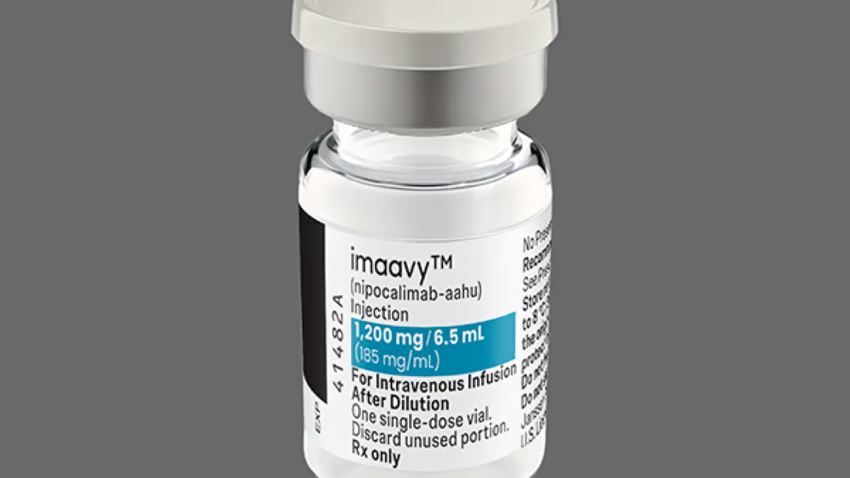
Johnson & Johnson (J&J) has unveiled positive data from its pivotal Phase 2/3 clinical trial, designated as the Energy study, evaluating its investigational monoclonal antibody, Imaavy. The clinical readout paves the logistical path for a landmark regulatory label expansion, positioning Imaavy to potentially become the first approved therapeutic intervention for warm autoimmune hemolytic anemia (wAIHA)—a life-threatening blood disorder that currently lacks approved targeted therapies.
The documented Energy trial metrics, immunoselective molecular mechanisms, and portfolio commercial forecasts feature:
-
Clinical Performance Readouts From the Energy Registration Trial:
-
Study Design Parameters: The trial randomized 115 participants under a strict 1:1:1 ratio to receive two varying doses of Imaavy or a placebo control arm. The primary clinical endpoint was rigorously defined as a minimum increase of 2 g/dL in hemoglobin (Hgb) from baseline, paired with an absolute Hgb concentration of at least 10 g/dL sustained for no less than 28 consecutive days without the deployment of rescue therapies or shifts in background treatment.
-
Efficacy and Fatigue Management: By Week 24, nearly two-thirds of the treated cohort achieved both co-primary targets, with the 30 mg/kg Imaavy infusion arm yielding three times as many responders compared to the placebo branch. Furthermore, improvements in patient-reported debilitating fatigue materialized as early as Week 2 and remained sustained through the valuation period, validating a key secondary objective alongside successful reductions in baseline corticosteroid reliance. The safety profile remained highly consistent with legacy myasthenia gravis data.
-
-
Immunoselective Mode of Action and Regulatory Milestones:
-
First-In-Class Regulatory Status: J&J has already submitted its supplemental biologics license application at the 30 mg/kg dosing threshold, securing an official FDA Priority Review designation in April 2026. This timeline positions the healthcare conglomerate as the first mover in the wAIHA landscape, addressing an urgent unmet need where patients historically relied on non-specific immunosuppressive regimens that failed to counter the underlying disease etiology.
-
Molecular Biology Framework: The therapeutic performance of Imaavy is driven by its “immunoselective approach.” Engineered as an FcRn blocker, the antibody selectively targets and neutralizes the pathogenic autoantibodies driving red blood cell destruction while intentionally preserving vital systemic immune functions. This protective capacity is highly relevant for wAIHA populations who frequently present with complex, severe comorbidities.
-
-
M&A Asset Origin and Macro Portfolio Projections:
-
Commercial Evolution: J&J originally onboarded Imaavy via its $6.5 billion corporate buyout of Momenta Pharmaceuticals in 2020. Institutional leadership has tagged the therapeutic asset with a long-term peak annual sales potential exceeding $500 million or more ($5 billion).
-
Competitive Landscape: Launched initially in April of last year, Imaavy arrived as the third FcRn blocker authorized within the generalized myasthenia gravis (gMG) market, following pioneering entries from Argenx (which logged $4.2 billion in Vyvgart sales for 2025) and UCB (which recorded 332 million euros for Rystiggo in 2025). To transcend the intense gMG competition, J&J is rapidly scaling Imaavy’s clinical utility, steering active Phase 3 fast-track pipelines across Sjogren’s disease, hemolytic disease of the fetus and newborn (HDFN), fetal neonatal alloimmune thrombocytopenia (FNAIT), and chronic inflammatory demyelinating polyneuropathy (CIDP), alongside Phase 2 trials in systemic lupus erythematosus and idiopathic inflammatory myopathy, following a strategic decision to terminate its combination program in rheumatoid arthritis.
-
Source: https://www.fiercepharma.com/pharma/jj-shows-results-trial-could-lead-rare-disease-expansion-imaavy