

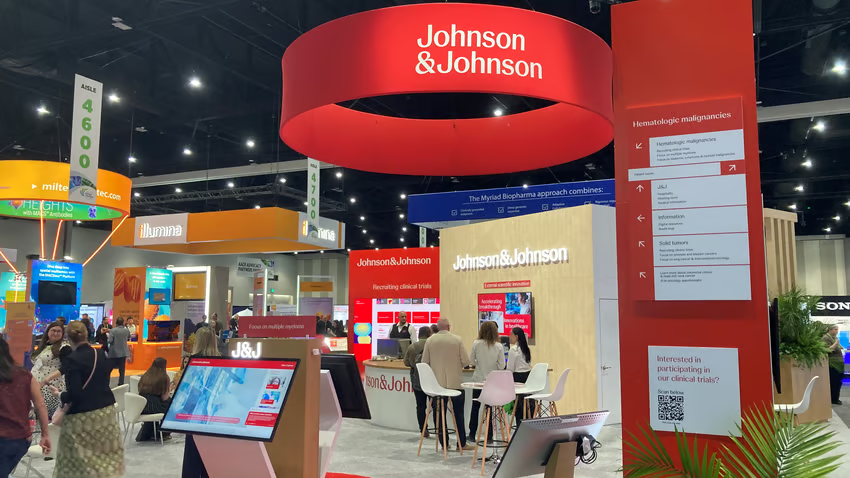
J&J solidifies oncology leadership in multiple myeloma as Talvey and Darzalex Faspro combo triumphs in early-stage trial
At a plenary session of the 2026 European Hematology Association (EHA) annual meeting in Stockholm, Sweden, Johnson & Johnson (J&J) presented ground-breaking Phase 3 data from its landmark MonumenTAL-3 study. The clinical readout validated the superior efficacy of introducing its proprietary GPRC5D-targeted bispecific antibody, Talvey, into combination regimens with the standard-of-care baseline drug, Darzalex Faspro, for patients presenting with relapsed or refractory multiple myeloma (RRMM) at earlier stages of the disease timeline. The results were concurrently published in the New England Journal of Medicine (NEJM).
The documented MonumenTAL-3 survival parameters, comparative bispecific pipeline designs, and macro portfolio commercial targets feature:
-
Survival Metrics and Clinical Efficacy Outlines of the MonumenTAL-3 Trial:
-
Study Design and Patient Profiles: The randomized phase 3 registration trial evaluated patients with relapsed or refractory multiple myeloma who had experienced failure on at least one prior line of systemic therapy. The protocol measured the performance of Talvey combined with Darzalex Faspro, administered with or without Bristol Myers Squibb’s Pomalyst (pomalidomide), benchmarked directly against the active control arm consisting of standard DPd triplet therapy (Darzalex Faspro, Pomalyst, and dexamethasone).
-
PFS and OS Survival Volatilities: After a median follow-up of 24 months, the Talvey-infused arms demonstrated a dramatic 72% reduction in the risk of disease progression or death, paired with a clinically meaningful 53% reduction in the risk of mortality compared to the DPd standard. The investigational triplet cohort (Darzalex-Talvey-Pomalyst) achieved an optimal progression-free survival (PFS) rate of 81.3%, while J&J’s standalone dual-combination arm (Darzalex-Talvey) posted a PFS rate of 77.6% (contrasted against a modest 51.2% generated by the baseline DPd control). Over the two-year tracking window, overall survival (OS) registered at 89.2% for the triplet arm and 87.9% for the doublet arm, outperforming the 79.1% baseline of the control group. Secondary targets including Overall Response Rates (ORR) and Minimal Residual Disease (MRD) negativity met statistical superiority.
-
-
Strategic Pipeline Shifts to Earlier-Line Therapeutic Interventions:
-
Clinical Significance: The MonumenTAL-3 study represents the first successful Phase 3 demonstration of superior PFS utilizing a GPRC5D-targeted bispecific antibody sequence within an earlier-line treatment architecture. Capitalizing on this victory, J&J confirmed it has submitted a formal label expansion application and is collaborating with international health authorities to fast-track market clearance.
-
The Tecvayli Structural Precedent: This strategic upward migration mirrors an identical victory achieved by J&J in March 2026, when the FDA cleared its sister bispecific combo, Tecvayli and Darzalex, for patients with RRMM following one prior line of therapy. The accelerated regulatory nod for Tecvayli was fast-tracked via an unsolicited FDA Commissioner’s National Priority Voucher (CNPV), granted after the drug combo established a 54% reduction in the risk of death over standard Darzalex and dexamethasone.
-
-
Asset Monetization and the Global Multi-Myeloma Monopoly Strategy:
-
Bispecific Product Differentiation: While both representing next-generation bispecific entities within J&J’s oncology franchise, Tecvayli precision-targets B-cell maturation antigen (BCMA), whereas Talvey operates uniquely as the first approved therapeutic agent targeting GPRC5D. Both molecules originally entered commercialization reserved strictly for heavily pre-treated, late-stage populations. Commercially, Tecvayli remains the primary revenue engine, pulling in $670 million in global sales for fiscal year 2025—bolstered by its earlier-line label expansion and a convenient biweekly dosing approval—while Talvey secured $463 million during the same fiscal cycle.
-
The $50 Billion Oncology Horizon: Multiple myeloma stands as the second most common hematological malignancy worldwide. J&J’s long-term macro strategy aims to embed an autonomous treatment regimen across every sequential line of multiple myeloma therapy by the end of the decade, establishing itself as the solitary biopharma entity commanding the full spectrum of therapeutic options for the disease. The operational nucleus of this ambition is anchored by Darzalex—which logged a record $14 billion in aggregate sales in 2025 across monotherapy and combination settings (including its subcutaneous version, Darzalex Faspro)—serving as the financial cornerstone for J&J’s corporate blueprint to deliver $50 billion in consolidated oncology-specific revenue by 2030.
-