

Key Development
A $6.5 billion API facility signals that Lilly no longer treats manufacturing as simply a downstream function supporting commercialization. Manufacturing itself is becoming part of competitive strategy.
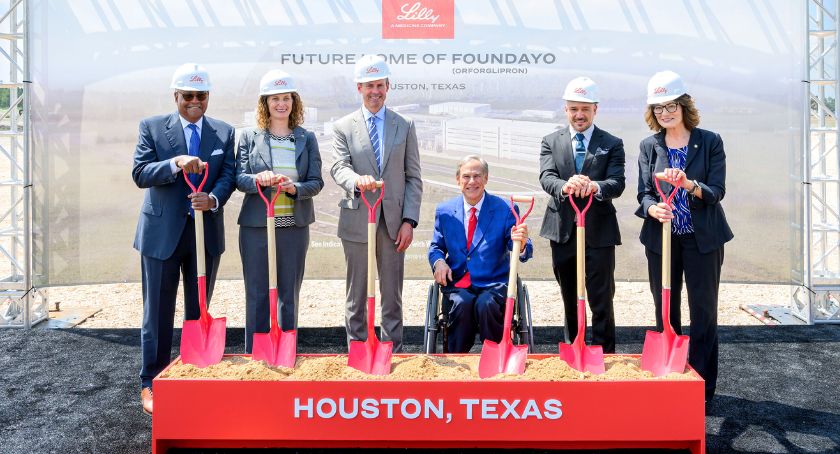
On September 21, 2026, Eli Lilly broke ground on a new manufacturing site in Houston, Texas. It is one of ten U.S. manufacturing locations announced by Lilly since 2020 and the fifth designated to produce active pharmaceutical ingredients. The project forms part of Lilly’s broader commitment of more than $50 billion in U.S. manufacturing investment since 2020.
A major role for Houston will be producing API for Foundayo (orforglipron), Lilly’s oral small-molecule GLP-1 therapy approved by FDA in April 2026 for chronic weight management. But Houston is not a single-product factory. Lilly says it will also manufacture other small-molecule medicines and advanced modalities, including oligonucleotides, while supporting more than 600 high-skilled jobs.
Why It Matters
- The pharmaceutical bottleneck is shifting from discovery toward industrial scale. A successful molecule cannot generate its full economic value unless the company can reliably manufacture sufficient volume at competitive cost.
- Foundayo changes GLP-1 manufacturing economics. Unlike peptide-based therapies, orforglipron is a synthetic small molecule. Lilly says small molecules use more established production technologies and can therefore be more readily scalable.
- This is an upstream API strategy. Bringing chemical-synthesis capabilities closer to home gives Lilly greater control over sourcing, production scheduling and supply resilience.
- Houston is designed around a portfolio, not a blockbuster. The facility can potentially support medicines across cardiometabolic disease, oncology, immunology, neuroscience and oligonucleotide therapeutics.
Healthcare Insight Analysis
Healthcare Insight believes the simplest interpretation — “Lilly needs another factory because weight-loss drugs are booming” — misses the larger strategy.
Foundayo was already FDA-approved and commercially available in the U.S. in April 2026, and Lilly is targeting a broader global rollout in 2027. Houston therefore is not necessary to produce the first commercial tablets.
It is being built for long-term scale, redundancy and portfolio optionality.
The most consequential part of the investment is its position in upstream chemistry.
A pharmaceutical company can increasingly discover molecules quickly and generate strong clinical data, yet still encounter a commercial constraint if API production cannot expand at the same speed.
That risk becomes larger for Lilly because the company is simultaneously scaling cardiometabolic medicines while investing in oncology, immunology, neuroscience and genetic medicine.
Its response is selective vertical integration.
Houston targets small-molecule API. Virginia will produce APIs supporting bioconjugates and large molecules. Other new sites focus on injectable medicines, devices and genetic therapies. Taken together, Lilly is constructing a manufacturing architecture organized by modality rather than one factory for every individual drug.
That distinction matters economically.
If Foundayo becomes a major global product, Houston provides additional scale. If obesity demand changes, the infrastructure can potentially serve other small-molecule programs. And if Lilly’s oligonucleotide portfolio matures, capacity for another advanced modality is already being established.
In that sense, $6.5 billion is purchasing flexibility as much as manufacturing volume.
But the strategy carries significant execution risk.
Greenfield pharmaceutical plants require massive fixed investment and long construction and validation cycles. When Lilly first announced Houston in September 2025, it expected the site to become operational within five years. Product mixes, demand forecasts and manufacturing technology can all evolve materially over that period.
For the economics to work, Houston therefore needs to become genuinely multi-product rather than a facility whose utilization depends primarily on one obesity franchise.
The workforce investment is equally revealing. Lilly is providing $12.5 million to support training pathways with San Jacinto College for technicians, operators, maintenance specialists and other advanced-manufacturing roles.
The message is clear: capital equipment alone does not create manufacturing resilience. Skilled labor is part of the infrastructure.
Market Implications
Lilly: deeper internal manufacturing capacity can reduce supply risk, improve scaling speed and create greater control as multiple pipeline assets approach commercialization.
CDMOs and API suppliers: Big Pharma reshoring and vertical integration could internalize some high-value manufacturing, while creating new demand for specialized capabilities that pharma companies still prefer to outsource.
Novo Nordisk and metabolic competitors: obesity competition will increasingly involve more than efficacy and price. The ability to supply tens of millions of patients across oral and injectable formats can influence market share.
U.S. states and education systems: life-science investment competition increasingly depends on workforce infrastructure. Tax incentives alone are insufficient without technicians, engineers and operators.
Two indicators now matter: how quickly Houston moves from construction into validated commercial production, and how much of its ultimate capacity is allocated to Foundayo versus other small molecules and oligonucleotides.
If Lilly successfully uses the facility across multiple product generations, Houston may illustrate a broader shift in pharmaceutical economics: manufacturing no longer sits behind innovation — manufacturing capacity itself can determine who converts innovation into revenue fastest.
Source: https://www.contractpharma.com/breaking-news/lilly-breaks-ground-on-6-5b-houston-manufacturing-site/