

Key Development
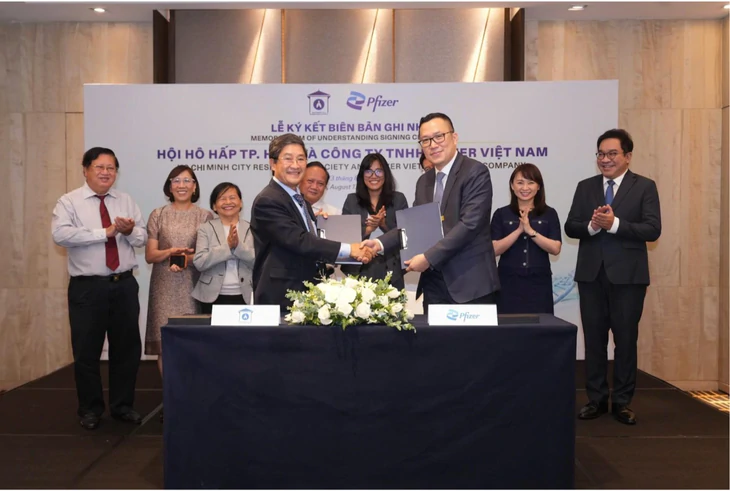
In response to epidemiological shifts across Vietnam, the Ho Chi Minh City Respiratory Society and Gia Dinh People’s Hospital have executed two separate three-year strategic Memoranda of Understanding (MoUs) with Pfizer Vietnam.
The non-commercial partnership focuses on advancing continuous medical education (CME), standardizing clinical workflows, enhancing early diagnostic precision, and scaling preventive counseling to address Vietnam’s growing “dual-disease burden”—characterized by escalating non-communicable diseases (NCDs) alongside ongoing challenges in managing complex infectious pathogens.
Core Strategic Pillars Across Agreements:
-
Collaboration with the HCMC Respiratory Society (President Assoc. Prof. Dr. Tran Van Ngoc):
-
Focuses on continuous medical education (CME) and updating clinical practice guidelines for chronic airway diseases, including Asthma and Chronic Obstructive Pulmonary Disease (COPD), alongside acute exacerbation management protocols.
-
Integrates risk-stratified preventive counseling into daily outpatient clinical workflows for physicians and nursing staff.
-
-
Collaboration with Gia Dinh People’s Hospital (Director Assoc. Prof. Dr. Nguyen Hoang Hai):
-
Expands internal medicine training (cardiovascular diseases, stroke, oncology) and infectious disease management, extending standardized practices across southern regional hospital networks.
-
Enhances Antimicrobial Stewardship (AMS) and antifungal management to address severe bloodstream infections and invasive fungal diseases.
-
-
Statutory Alignment & Academic Independence:
-
Program academic content is led independently by medical societies and hospital leadership based on scientific evidence, devoid of commercial product promotion.
-
Directly aligns with the national public health priorities outlined in the Law on Disease Prevention No. 114/2025/QH15 (effective July 11, 2026), anchoring a shift toward “proactive prevention centered around the patient.”
-
Why It Matters
-
Epidemiological Intersection of NCDs and Infectious Risks:
-
Non-communicable diseases currently account for 80% of all annual deaths in Vietnam.
-
Patients with underlying chronic comorbidities face elevated risks of severe outcomes during acute infections: COPD patients aged $>60$ years face a 4-fold higher risk of pneumococcal pneumonia; COPD patients aged $>50$ years face a 9.6 to 9.7-fold elevated risk of RSV-related hospitalization.
-
-
High Clinical Mortality from Sepsis & Invasive Fungal Infections: A prospective cohort study in Vietnam (2018–2020) documented an overall mortality rate of 52% among bloodstream infection patients with positive blood cultures. Concurrently, invasive fungal infections among immunocompromised, asthmatic, and COPD cohorts represent major critical care challenges.
-
Extrapulmonary Cognitive Decline in COPD: Approximately 32% of COPD patients exhibit cognitive impairment, reaching 56% upon advanced neuropsychological evaluation. Early diagnosis and comprehensive management are essential to prevent long-term cognitive deterioration.
Healthcare Insight Analysis
From the perspective of Healthcare Insight, the three-year strategic engagement between HCMC Respiratory Society, Gia Dinh People’s Hospital, and Pfizer Vietnam illustrates Public-Private Partnerships (PPP) in Dual-Disease Burden Management.
Metropolitan healthcare systems like Ho Chi Minh City reflect the “development paradox”: urbanization and demographic aging drive up long-term chronic healthcare expenditures, while hospital-acquired infections and antimicrobial resistance (AMR) compound the severity of chronic disease exacerbations.
This collaboration addresses three operational priorities:
-
Transitioning from Acute Triage to Proactive Outpatient Prevention: Equipping frontline healthcare professionals to deliver preventive immunization counseling (pneumococcal, influenza, RSV) and environmental risk management during routine visits, reducing acute ICU admissions.
-
Institutionalizing Antimicrobial Stewardship (AMS): Supporting clinical teams in optimizing antimicrobial and antifungal regimens, directly targeting the $52\%$ sepsis mortality baseline and limiting the emergence of multidrug-resistant pathogens.
-
Hub-and-Spoke Regional Knowledge Dissemination: Leveraging Gia Dinh People’s Hospital as an academic training hub to cascade standardized clinical pathways and case-based learning to lower-tier district facilities, mitigating referral bottlenecks at tertiary hospitals.
Market Implications
-
Expanding Adult & Comorbid Immunization Pathways: Elevated clinical focus on pneumococcal and RSV vulnerabilities in COPD and diabetic patients will support adult immunization adoption across hospital-affiliated clinics and vaccination centers.
-
Reinforcing Diagnostic Stewardship for Anti-Infectives: Heightened focus on severe sepsis management will encourage hospitals to institutionalize blood culture and fungal biomarker testing prior to broad-spectrum antimicrobial administration.
-
Expanding Non-Commercial Big Pharma Clinical Collaborations: Demonstrates a model for multinational pharmaceutical firms to partner with leading public hospitals through academic, non-promotional medical education programs in Vietnam.
Strategic Framework Matrix: Dual Burden Medical Collaboration (2026–2029)
| Focus Vector | Epidemiological Baseline & Initiative Targets | Clinical & Systemic Impact |
| Non-Communicable Disease (NCD) Burden | Causes 80% of total annual deaths in Vietnam | Prioritizes early detection & active prevention. |
| Pneumococcal Risk in COPD | 4x higher risk in patients aged $>60$ years | Embeds vaccine-preventable counseling in clinics. |
| RSV Hospitalization Risk in COPD | 9.6x – 9.7x higher risk in patients aged $>50$ | Improves recognition of viral respiratory triggers. |
| Bloodstream Infection Mortality | 52% mortality rate in positive blood cultures | Strengthens Antimicrobial Stewardship (AMS) protocols. |
| Extrapulmonary COPD Complications | 32% – 56% exhibit cognitive impairment | Broadens holistic management beyond airway symptoms. |
| Partnership Duration | 3 Years (2026 – 2029) | Independent academic CME & clinical capacity building. |