

Key Development
McKesson’s proposed investment in Option Care Health represents more than diversification into home healthcare. It signals a strategic move toward owning a larger portion of the infrastructure through which specialty medicines reach patients and become actual treatment.
On October 6, 2026, McKesson and private equity firm Clayton, Dubilier & Rice (CD&R) announced an agreement to acquire Option Care Health at $32.05 per share, representing approximately $5.8 billion in enterprise value.
CD&R is expected to hold approximately 51%, while McKesson will invest $1.4 billion for a 49% minority interest, with a framework allowing McKesson to acquire CD&R’s stake later. The transaction remains subject to regulatory and shareholder approvals and is expected to close in the first half of 2027.
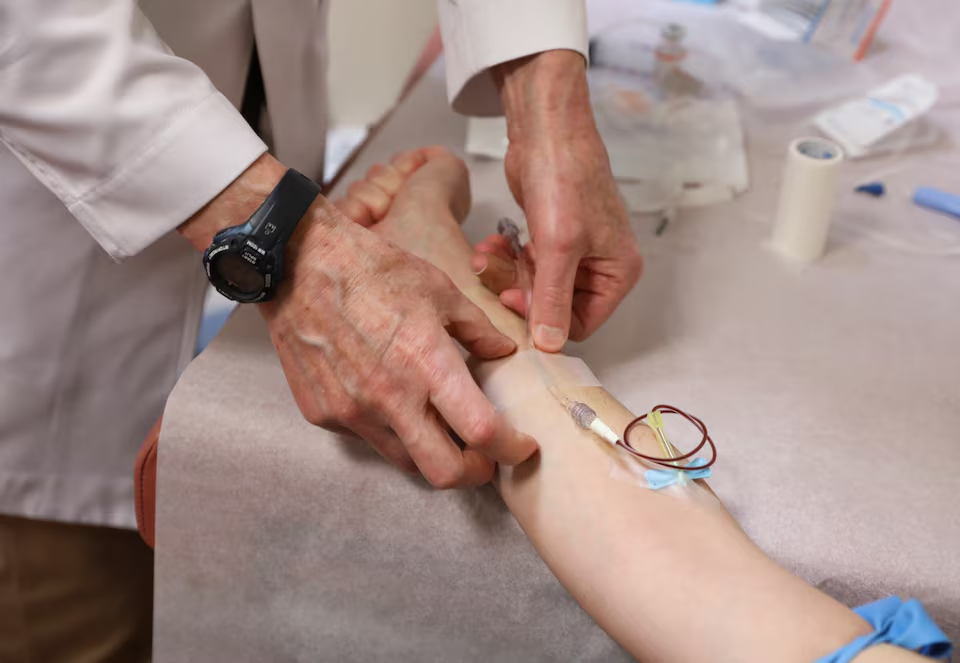
Option Care Health operates one of America’s largest independent home and alternate-site infusion platforms. It served more than 315,000 patients in 2025, generating approximately $5.65 billion in annual revenue through a network supporting complex infusion therapies outside traditional hospital settings.
Why It Matters
- Care delivery is shifting beyond hospitals. Suitable infusion treatments can increasingly be administered in homes and ambulatory facilities.
- Specialty medicines require service infrastructure. Complex biologics depend on nursing, patient coordination, safety monitoring and payer authorization.
- McKesson is moving further downstream. The company can participate in treatment delivery rather than pharmaceutical distribution alone.
- Site-of-care economics are becoming commercially important. A 2026 observational study found hospital outpatient infusion costs were 41.9% higher than alternative sites in the analyzed population, without a corresponding improvement in measured short-term safety outcomes.
Healthcare Insight Analysis
Healthcare Insight believes the most valuable asset in this transaction is not simply Option Care Health’s network of infusion locations.
It is the ability to connect pharmaceutical distribution with patient treatment pathways.
Traditional drug distribution generates value through procurement scale, inventory management, logistics and reliable product availability.
Specialty pharmaceuticals require a more complex operating model.
A patient receiving an infused biologic may need benefits verification, clinical eligibility assessment, nursing coordination, medication preparation, infusion monitoring and ongoing follow-up.
That creates a broader value chain:
Drug distribution → patient onboarding → site-of-care selection → infusion delivery → monitoring → treatment continuity.
Option Care Health gives McKesson a direct strategic position within that chain.
Three implications stand out.
First, site-of-care economics could become a competitive advantage.
Moving clinically appropriate infusion treatments from higher-cost hospital settings to home or ambulatory facilities may reduce certain facility and operating expenses.
However, lower costs are not automatic. Drug acquisition prices, reimbursement contracts, nursing resources, transport requirements and clinical monitoring all influence the actual cost per treatment episode.
The opportunity is not simply to move infusion outside hospitals.
It is to identify which patients and therapies can be managed safely and economically in each setting.
Second, specialty-drug commercialization increasingly depends on treatment infrastructure.
Biologics, immunology therapies and treatments for rare diseases create demand for reliable administration networks.
For manufacturers, successful commercialization increasingly requires more than formulary access and product distribution.
A medicine cannot generate its intended clinical or commercial value if patients encounter delays in authorization, administration or treatment continuity.
A scaled infusion platform could therefore strengthen relationships among drug manufacturers, payers, providers and patients.
Third, McKesson may be extending its competitive moat beyond pharmaceutical logistics.
The company already has extensive specialty-distribution capabilities. Option Care Health contributes clinical infrastructure, infusion expertise and relationships with insurers and health systems.
Together, these assets could create an operating ecosystem that is more difficult to replicate than a distribution network alone.
But vertical integration also creates governance questions.
If a pharmaceutical distributor holds a significant stake in a treatment provider, referral decisions, product selection and payer arrangements must remain clinically appropriate and commercially transparent.
The acquisition should not be assumed to produce better outcomes or lower costs simply because the supply chain becomes more integrated.
Those benefits must be demonstrated.
Market Implications
Pharmaceutical manufacturers: specialty-drug access may depend increasingly on infusion infrastructure and patient-service coordination.
Hospitals: clinically appropriate infusion volume could migrate toward lower-cost community settings, potentially releasing capacity for more complex care.
Payers: site-of-care optimization may become a stronger contracting priority, alongside patient safety and quality assurance.
Investors: value creation may increasingly depend on recurring clinical services, payer relationships and longitudinal patient management rather than distribution volume alone.
ANALYTICAL MATRIX
| Dimension | Strategic Opportunity | Key Risk | KPI to Watch |
| M&A | Downstream expansion | Transaction approval | Deal closing |
| Specialty pharma | Better therapy access | Payer dependence | Treatment initiation |
| Site of care | Lower-cost delivery | Patient selection and safety | Cost per episode |
| Operations | National clinical network | Staffing and capacity | Infusion utilization |
| Governance | Integrated service model | Conflicts of interest | Quality outcomes |
The transaction raises a fundamental question for the healthcare industry:
Will future value belong primarily to companies that distribute the most medicines, or to those that can ensure complex therapies reach the right patients, in the right setting, at a sustainable total cost?
If McKesson and Option Care Health successfully demonstrate the economics and clinical quality of that model, the transaction could represent an important step in the evolution from pharmaceutical distribution toward integrated specialty-care infrastructure.