

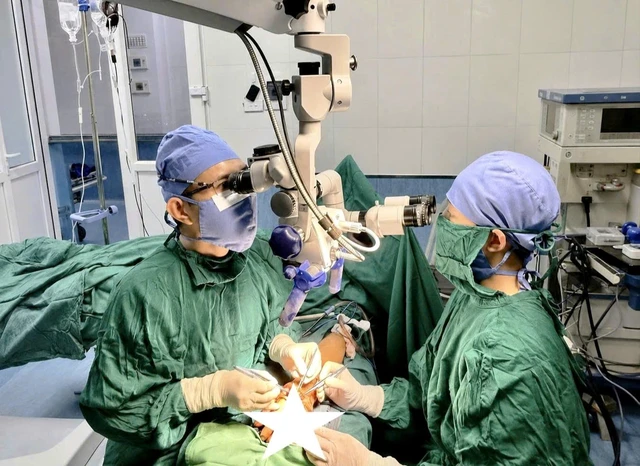
The Nghe An Hospital for Trauma and Orthopedics has achieved a significant medical milestone by successfully executing a free SCIP (Superficial Circumflex Iliac Perforator) flap transfer under a surgical microscope to reconstruct a patient’s hand. The operation marks the first time this advanced, highly specialized microsurgical technique—historically restricted to major central‑level national institutions—has been mastered and implemented within Nghe An province.
The documented clinical case profile, anatomical advantages of the SCIP flap, and institutional microsurgical capabilities feature:
-
Clinical Presentation and Surgical Interventions:
-
Patient Condition: A 25-year-old male patient presented with severe cicatricial contracture in the first-second digital web space of his left hand, a long-term sequela stemming from a severe crushing hand injury sustained eight months prior. The chronic contracture severely restricted the motor functions of his hand, preventing basic gripping and daily labor activities.
-
Surgical Strategy: The surgical team initiated the procedure by releasing the scar contracture. Because the release generated an extensive soft-tissue defect, clinicians deployed a free SCIP flap transfer utilizing microvascular anastomosis. Post-operative evaluations confirmed excellent blood perfusion within the transferred tissue and immediate restoration of the digital web space architecture, creating the baseline structural foundation for localized functional rehabilitation.
-
-
Anatomical Attributes and Clinical Benefits of the SCIP Flap:
-
Technical Mechanism: The SCIP technique harvest a specialized skin flap from the patient’s inguinal (groin) region alongside its sustaining vascular pedicle, driven by the perforator branches of the superficial circumflex iliac artery, to seal the targeted peripheral defect.
-
Anatomical Synergy: The primary clinical advantage of the SCIP flap lies in its inherent, natural thinness, which precisely mirrors the intricate anatomical contours of the human hand. This structural compatibility optimizes both functional mobility and long-term aesthetic outcomes for the upper extremity. Furthermore, the donor site experiences minimal secondary morbidity and low complication rates, reducing overall surgical trauma for the patient.
-
-
Institutional Microvascular Expertise and Regional Healthcare Impact:
-
The Nghe An Hospital for Trauma and Orthopedics functions as the leading specialized institution for musculoskeletal trauma and microsurgery within the North Central region of Vietnam. The facility has historically established routine proficiency in complex emergency interventions, such as the successful replantation of completely severed limbs, which requires precision stitching of microscopic blood vessels and nerve tracts measuring only a few millimeters.
-
The institutional expertise accumulated from emergency limb salvage operations provided the technical foundation for the surgical staff to master complex reconstructive microsurgery. This localized expansion of medical capacity ensures regional patients receive immediate, advanced care, minimizing permanent functional deficits and optimizing long-term recovery metrics.
-