

Key Development
Nearly 94% of Novo Nordisk’s 2025 revenue came from diabetes and obesity. That concentration explains why investors are asking a company transformed by Wegovy to demonstrate that it can eventually grow without relying on the franchise that created its extraordinary success. Novo generated DKK309.1 billion in 2025 sales; diabetes and obesity contributed DKK289.5 billion, while rare disease generated DKK19.6 billion.
Ahead of Novo’s September 21 Capital Markets Day, investors and analysts interviewed by Reuters are pushing CEO Mike Doustdar for clearer medium-term financial targets and a roadmap beyond semaglutide. Novo shares have fallen more than 70% from their peak, while LSEG estimates Eli Lilly’s Zepbound could outsell Wegovy by more than $7 billion this year. At the same time, major semaglutide patent expirations are approaching in the early 2030s.
Pipeline events have made that debate more urgent. CagriSema failed to demonstrate non-inferiority to tirzepatide in the REDEFINE 4 head-to-head trial, although Novo continues development and has submitted the therapy in the US. Separately, ziltivekimab failed to reduce major cardiovascular events in the Phase 3 ZEUS study.
Why It Matters
- This is concentration risk, not merely competitive risk. Losing obesity share to Lilly matters. Having most of the company’s economics tied to diabetes, obesity and GLP-1-related franchises matters more.
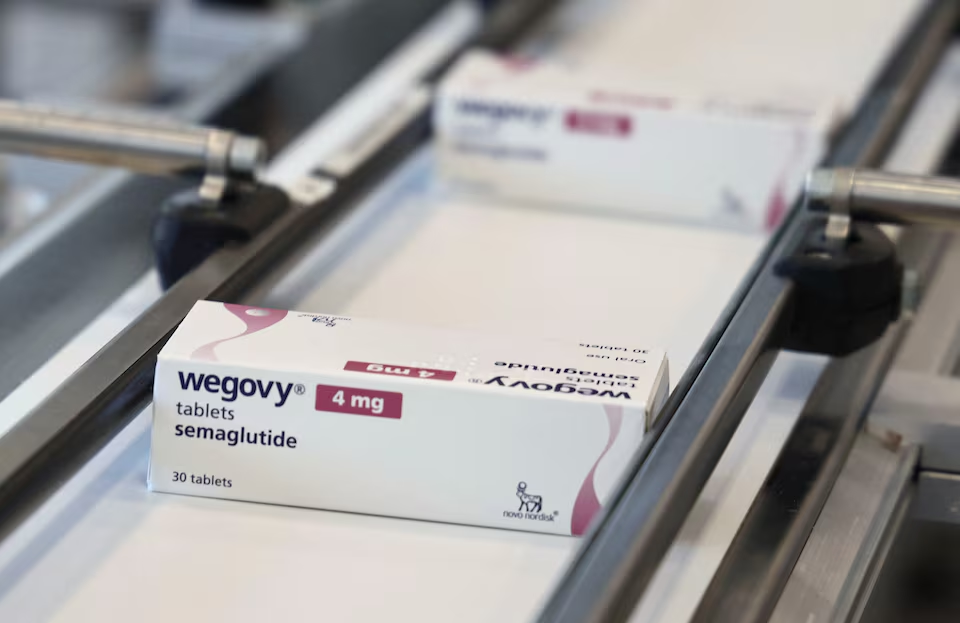
- The Wegovy pill buys time; it does not remove the patent cliff. Strong uptake can defend Novo’s near-term franchise, but oral Wegovy is still semaglutide. Commercial success therefore extends the molecule rather than diversifying away from it.
- Next-generation obesity is not necessarily diversification. Zenagamtide has advanced into Phase 3 and may become an important asset, but it remains part of the same broader cardiometabolic and weight-management ecosystem.
- Rare disease is not yet large enough to function as a third engine. The segment generated DKK19.6 billion in 2025, roughly 6% of group sales, despite a pipeline including denecimig, etavopivat and zaltenibart.
Healthcare Insight Analysis
Healthcare Insight believes the market may be asking the wrong question when it asks: “What replaces Wegovy?”
The more useful question is: “What can still grow if obesity pricing, semaglutide patents and GLP-1 competition all move against Novo at the same time?”
That is the difference between product diversification and economic diversification.
CagriSema, zenagamtide, cagrilintide and future incretin therapies could all become valuable medicines. Yet if much of the portfolio remains exposed to the same obesity market, similar payer decisions and related biological mechanisms, Novo retains substantial portfolio correlation.
Semaglutide demonstrates why concentration can initially be extraordinarily powerful.
Novo has leveraged the same molecule across diabetes and obesity while generating evidence spanning cardiovascular, kidney and liver disease. In 2025, Ozempic alone generated DKK127.1 billion. Novo’s GLP-1 diabetes portfolio generated DKK152.2 billion, alongside DKK82.3 billion from obesity care.
That creates enormous commercial efficiency — but also makes the succession problem unusually large.
This is why investor calls for acquisitions beyond obesity deserve attention. Novo does not need to become a broadly diversified pharmaceutical conglomerate simply for the sake of diversification. Buying unrelated assets at inflated prices could destroy rather than protect value.
But the company does need at least one meaningful growth platform with different clinical risk, payer exposure, patent timing and competitive dynamics from GLP-1 obesity.
Cardiovascular disease appeared capable of becoming part of that architecture, but the ZEUS failure weakened the case. Rare disease is strategically credible but still comparatively small. As a result, business development — licensing and disciplined bolt-on acquisitions — may now matter more than during the era when internal innovation around semaglutide was sufficient to drive exceptional growth.
There is another strategic tension. Doustdar has been cutting weaker programs and tightening organizational focus. That discipline is valuable. Yet excessive focus around cardiometabolic science could reinforce precisely the concentration investors want reduced.
Novo therefore faces a delicate capital-allocation problem: protect the world’s most valuable metabolic franchise without spending so much defending it that the company fails to build what comes next.
Market Implications
Novo: investors are likely to look beyond the strength of the obesity pipeline toward medium-term targets, M&A criteria and evidence that capital is being allocated to genuinely independent growth platforms.
Eli Lilly and obesity competitors: benefit if Novo remains forced to devote disproportionate resources to defending its core franchise. A more acquisition-oriented Novo, however, could raise competition for attractive biotech assets.
Biotech and investors: cardiovascular, rare disease and adjacent chronic-disease platforms could receive greater strategic attention if Novo decides to build a genuine third growth pillar.
Payers: stronger Novo–Lilly competition may improve negotiating leverage in obesity, but lower net pricing also intensifies the financial consequences of Novo’s concentration.
The two most important signals are how much R&D and dealmaking capital moves outside diabetes and obesity, and whether Novo establishes measurable medium-term targets that show declining dependence on semaglutide economics.
Novo’s strategic challenge is therefore not to abandon obesity. It is to use the cash generated by obesity to build a company that can still compound when obesity is no longer pharma’s easiest growth story.