
Key Development
Pennsylvania has confirmed 1,286 measles cases across 42 counties in 2026, reinforcing concerns about the return of a highly contagious, vaccine-preventable disease in the United States. Beyond the outbreak itself, the figures expose a structural weakness in preventive healthcare: even an established, highly effective vaccine cannot protect communities if immunization coverage and disease surveillance are insufficient.
According to the Pennsylvania Department of Health’s October 19 update, the state recorded 26 additional cases since October 16, bringing cumulative measles-related hospitalizations to 247 and state-confirmed associated deaths to five. Only four reported cases involved vaccinated individuals, representing less than 1% of the total.
At the national level, the CDC had reported 4,410 measles cases as of October 15, 2026. Pennsylvania also began receiving specialized epidemiological support from the CDC on October 19, including disease modeling and vaccination-impact analysis. State authorities issued additional clinical guidance concerning measles exposure and infection during pregnancy.
Why It Matters
- High vaccine efficacy does not guarantee population protection, particularly when geographic or community-level immunization gaps persist.
- Measles outbreaks create measurable hospital burdens, extending beyond the number of reported infections.
- Localized vaccine coverage is a critical public-health indicator, because statewide averages can conceal vulnerable communities.
- Disease surveillance and outbreak modeling are becoming essential capabilities, supporting faster and more targeted interventions.
- Preventive healthcare requires sustained public confidence, not simply increased vaccination demand after outbreaks emerge.
Healthcare Insight Analysis
Healthcare Insight believes Pennsylvania’s measles outbreak demonstrates a fundamental challenge facing mature healthcare systems.
The availability of proven medical technology does not guarantee successful public-health outcomes. The decisive variable is whether that technology reaches enough people, in the right places, before transmission accelerates.
Measles is especially relevant to this distinction.
It spreads efficiently among susceptible populations and can cause serious complications, particularly in vulnerable patients.
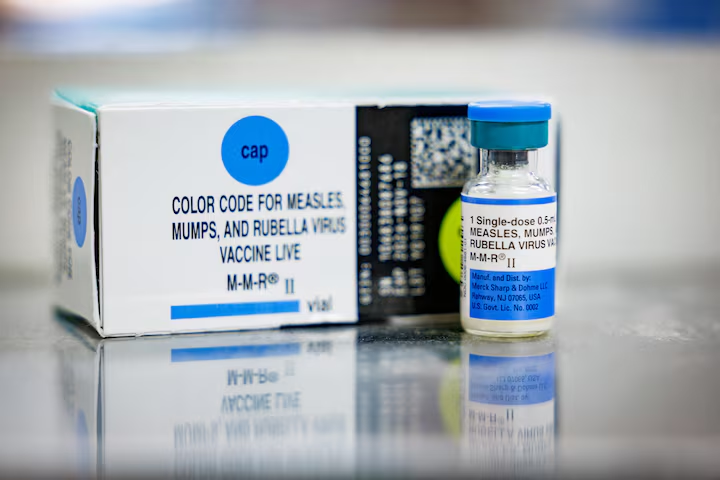
The two-dose measles, mumps and rubella (MMR) vaccine provides approximately 97% protection against measles, making vaccination one of the most effective preventive measures available.
Yet effective vaccination at the individual level and adequate immunity at the population level are not identical.
Vaccine efficacy → vaccine access → actual uptake → local immunity → transmission control.
Any weakness in this sequence can create opportunities for outbreaks.
1. Geographic concentration matters more than statewide averages
Public-health systems frequently measure immunization coverage across broad populations.
But a relatively strong statewide average can coexist with communities where vaccination levels are insufficient to prevent transmission.
This creates a geographic mismatch.
High coverage in one county does not automatically protect an under-vaccinated population in another.
The reported spread across 42 Pennsylvania counties demonstrates why outbreak management must operate below the state level.
Public-health resilience is determined not only by average coverage, but by the size and distribution of immunity gaps.
For regulators, the practical implication is to connect vaccine registries with local epidemiological surveillance and targeted outreach.
2. Hospitalization figures expose the economic cost of preventable disease
Pennsylvania’s 247 reported hospitalizations are particularly important.
They represent roughly 19% of confirmed cases, although this crude proportion should not be interpreted as a general hospitalization risk for all measles infections.
The figure reflects reported cases and hospitalizations within this specific outbreak.
Nevertheless, the operational implications are substantial.
Hospitals may require isolation capacity.
Healthcare workers need infection-control protection.
Contact investigations consume staff resources.
Outpatient services can face disruption.
Vulnerable patients need specialized assessment.
The economic burden therefore extends beyond direct treatment.
Vaccination gaps → disease transmission → hospital utilization → public-health expenditure → system-wide productivity losses.
For healthcare executives, outbreak prevention is not only a population-health priority.
It is also a capacity-management and financial-risk issue.
3. Epidemiological intelligence is becoming a strategic investment
The deployment of a CDC Epidemic Intelligence Service officer reflects the increasing importance of analytical capabilities during outbreaks.
Pennsylvania’s response includes approximately 300 state health personnel, among them 60 disease investigators.
The CDC’s technical support will include near-term case projections, disease-burden modeling and evaluation of vaccination effectiveness.
These tools can help determine where interventions are most urgently needed.
However, forecasting alone does not stop transmission.
Models must be connected to vaccination access, contact tracing and timely public communication.
The operational value chain becomes:
case detection → local risk assessment → epidemiological modeling → targeted vaccination → measurable outbreak control.
4. The vaccine market must be evaluated through coverage, not short-term demand
Outbreaks can temporarily increase interest in MMR vaccination.
For manufacturers, distributors and vaccination providers, this may require additional inventory coordination and service capacity.
But higher vaccine demand during an outbreak is not equivalent to sustained improvement in immunization coverage.
The relevant indicators are the number of eligible individuals reached, completion of recommended doses and the reduction of geographic coverage gaps.
For investors, this distinction matters.
A temporary increase in orders does not automatically indicate structural market expansion.
The sustainable opportunity lies in stronger immunization infrastructure and reliable delivery of existing vaccines.
Market Implications
Vaccine manufacturers: may experience demand fluctuations but should prioritize supply reliability and coordination with public-health programs.
Hospitals and healthcare systems: need stronger isolation, infection-control and emergency workforce arrangements during outbreaks.
Vaccination providers and pharmacies: can contribute through eligibility assessment, convenient immunization access and accurate communication.
Public-health authorities: should focus on community-level coverage, timely surveillance and targeted interventions rather than statewide averages alone.
Healthcare investors and healthtech companies: may find opportunities in immunization registries, epidemiological analytics and connected public-health infrastructure.
ANALYTICAL MATRIX
| Dimension | Current Signal | Opportunity | Key Risk |
| Disease burden | 1,286 cases across 42 counties | Targeted outbreak control | Continued transmission |
| Hospital utilization | 247 hospitalizations | Improve preparedness | Capacity and cost pressure |
| Vaccination | MMR approximately 97% effective after two doses | Close immunity gaps | Uneven coverage |
| Surveillance | CDC epidemiological assistance | Better outbreak forecasting | Delayed intervention |
| Vaccine market | Potential outbreak-driven demand | Strengthen routine immunization | Temporary demand spikes |
Pennsylvania’s measles outbreak is not primarily a story about the failure of vaccine science. It is a warning about what happens when effective prevention does not achieve sufficient population reach.
The next priority is to close local immunity gaps, improve disease intelligence and ensure that vaccination access remains reliable before outbreaks occur.
For the pharmaceutical and healthcare industries, the most valuable opportunities may therefore lie beyond developing new products.
They may lie in strengthening the systems that deliver proven interventions consistently.
The broader industry signal is clear:
the next competitive advantage in preventive healthcare will be defined not by vaccine availability alone, but by the ability to convert vaccination capacity into sustained community protection.