

Key Development
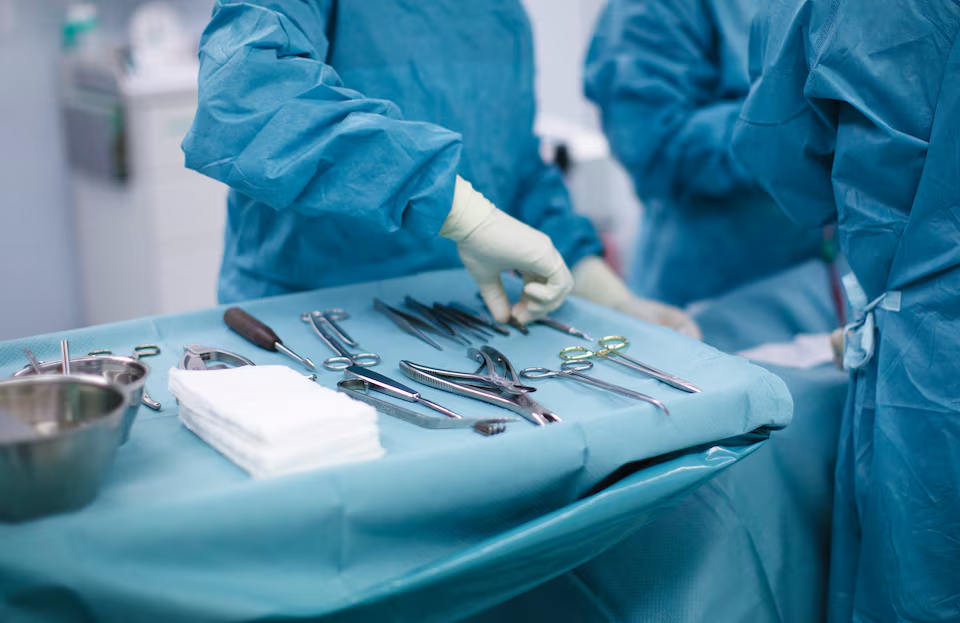
STERIS has agreed to acquire Xodus Medical for $2.1 billion, adding a fast-growing surgical-consumables portfolio to an operating-room ecosystem that already spans sterilization, surgical tables, instruments, workflow technology and equipment service.
Xodus is expected to generate approximately $245 million of revenue in 2026 and has been described by STERIS as a double-digit-growth specialty surgical-products business. The transaction will be funded primarily with debt and is expected to close by December 31, 2026, subject to customary approvals.
The company is best known for the Pink Pad patient-positioning platform, but its portfolio also includes positioning systems, electrosurgical accessories, laparoscopic lens-cleaning products and other single-use operating-room safety products. That product mix differs strategically from much of STERIS’ traditional capital-equipment base.
STERIS expects approximately $300 million in cash tax benefits, reducing the economic net purchase price to roughly $1.8 billion.
Why It Matters
- Consumables create a more recurring revenue stream. Sterilizers and surgical tables are replaced over multi-year cycles; single-use products are replenished with every procedure.
- STERIS already has deep OR distribution. Xodus products can potentially ride an installed commercial network covering sterile processing, operating rooms and ambulatory surgery centers.
- Patient positioning is becoming a defined safety category. Xodus markets its platforms around preventing sliding, nerve injury and hospital-acquired pressure injuries during complex surgery.
- The deal increases STERIS’ exposure to procedure volume, rather than hospital capital expenditure alone.
Healthcare Insight Analysis
Healthcare Insight believes the strategic core of the acquisition is business-model diversification inside the same surgical workflow.
STERIS already occupies multiple steps surrounding surgery:
decontamination → sterilization → OR infrastructure → surgical instruments → equipment service.
Xodus adds something economically different:
products consumed during the procedure itself.
That matters because capital equipment and consumables behave differently.
Capital equipment generates large-ticket sales but is exposed to budget approvals, replacement cycles and hospital capex constraints.
Consumables follow another logic:
procedure happens → product is used → inventory must be replaced.
As surgical volumes grow, consumable revenue can rise without requiring a hospital to approve another multimillion-dollar equipment purchase.
The acquisition therefore expands not just STERIS’ product range, but its revenue capture per procedure.
Consider a robotic or minimally invasive surgical case. The hospital may already rely on STERIS for surgical tables, sterile-processing systems, instrument reprocessing, room integration and service. Adding Xodus creates another monetizable layer through patient-positioning and safety products.
The more categories a supplier owns around the same workflow, the closer it becomes to a perioperative platform company rather than an equipment manufacturer.
That model is particularly relevant as surgery continues moving toward ambulatory settings. STERIS itself highlights approximately 11,200 U.S. ambulatory surgery centers and a growing outpatient procedural base, environments where standardized workflow, small footprints and predictable per-case economics matter.
Xodus also brings an attractive form of clinical adjacency.
Its Pink Pad and PinkProtect products are positioned around patient stability and pressure-injury prevention, while the newer Hot Pink Pad extends the company into temperature management.
That creates the potential for STERIS to bundle:
equipment + positioning consumables + warming + sterile processing + service.
Such bundling can strengthen sales efficiency and deepen hospital relationships.
However, the valuation raises the execution bar.
At approximately $245 million of expected 2026 revenue, the headline $2.1 billion consideration implies roughly 8.6× revenue, before accounting for tax benefits.
STERIS is therefore paying for more than current sales.
The valuation embeds expectations around growth, margins, intellectual property, distribution leverage and cross-selling.
The central investment question is whether Xodus can grow faster inside STERIS than it could independently.
If STERIS can place Xodus products across its existing hospital and ASC customer base, the deal could convert a specialized surgical-safety company into a much broader global consumables franchise.
If cross-selling is weak, the purchase multiple will look substantially harder to justify.
Market Implications
STERIS: increases recurring consumables exposure and reduces dependence on capital-equipment cycles.
Hospitals: broader vendor bundling can simplify procurement but may also increase supplier concentration.
Surgical medtech: positioning, warming and patient-safety disposables are becoming strategic product categories rather than peripheral accessories.
Investors: the critical KPIs will be post-deal organic growth, cross-selling penetration, margins and earnings accretion.
ANALYTICAL MATRIX
| Dimension | Xodus Contribution | Strategic Value | Key Risk |
| Revenue model | Consumables | More recurring revenue | High acquisition multiple |
| OR presence | Positioning and safety | Deeper workflow ownership | Integration |
| Distribution | Specialty portfolio | Global cross-selling | Channel execution |
| Procedure exposure | Per-case consumption | Volume-linked growth | Surgical-volume sensitivity |
| Competitive moat | IP + specialized products | Broader OR platform | Product substitution |
The strategic question is therefore not simply how many additional products STERIS has acquired.
It is how much recurring revenue and workflow dependency STERIS can capture from every procedure performed inside its installed ecosystem.
If cross-selling works, Xodus could help STERIS evolve from a leading sterilization and surgical-equipment supplier into a company increasingly positioned to capture the economics of the operating room itself.