

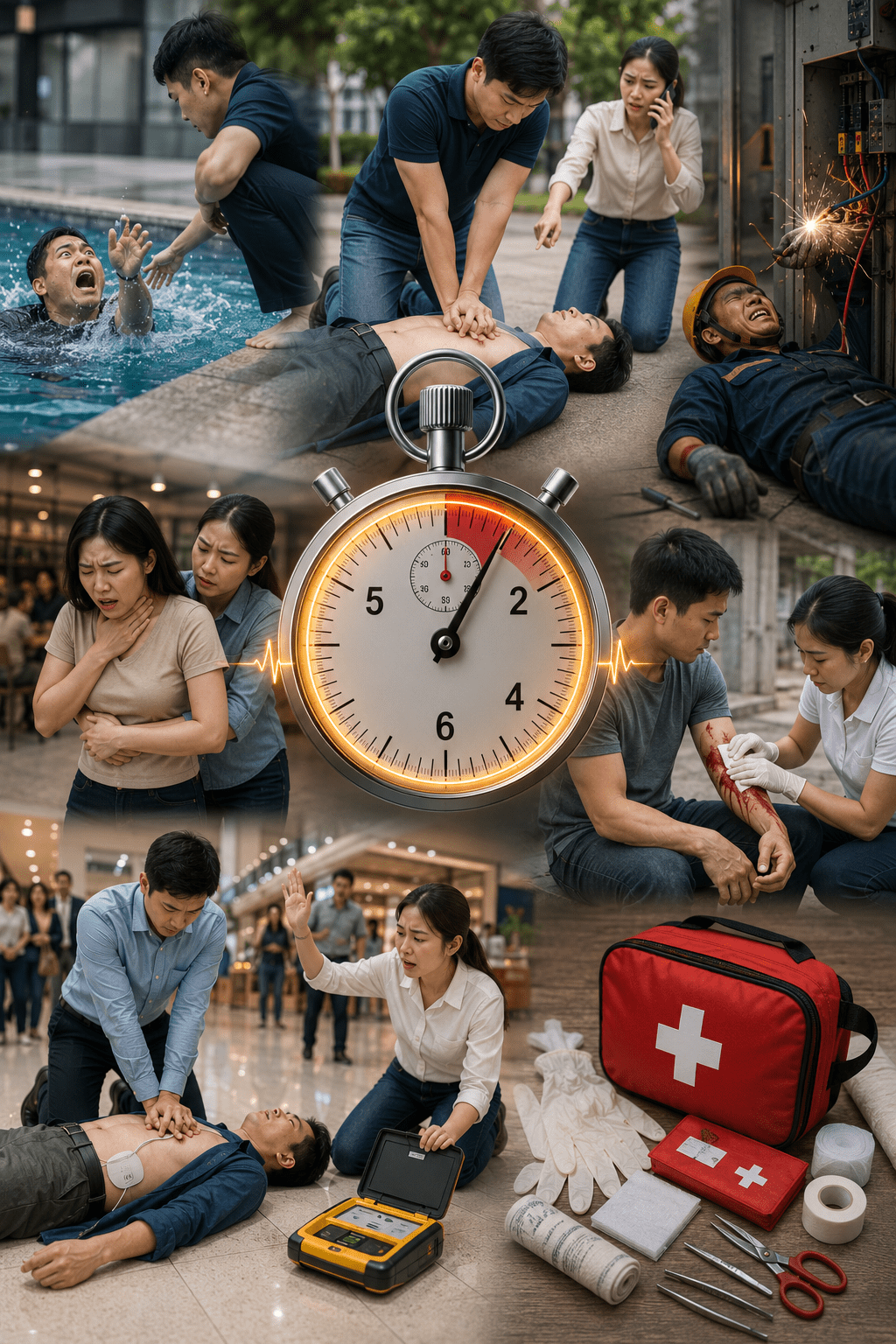
The first few minutes can make the difference between life, death, and lasting disability.
Every day, emergencies such as sudden cardiac arrest, drowning, electric shock, airway obstruction, and serious trauma can occur anywhere — at the workplace, school, shopping centers, or right inside our own homes.
In those situations, the time before professional emergency responders reach the scene is often the most critical period. This is when first aid knowledge and skills prove their value, because those first minutes can determine a victim’s chance of survival and recovery.
What Are the 4–6 Golden Minutes?
The “4–6 golden minutes” is a concept used to highlight the importance of early intervention in cardiac arrest or respiratory arrest. The brain is the body’s highest oxygen consumer, yet it has very limited oxygen reserves. When the heart stops or breathing ceases, the oxygen supply to the brain drops almost immediately.
Without timely intervention:
- Consciousness can be lost in approximately 8–10 seconds after the heart stops.
- The brain begins to suffer from severe oxygen deprivation.
- After approximately 4–6 minutes of complete oxygen deprivation, brain cells may begin to sustain irreversible damage.
- The risk of death and neurological deficits rises rapidly with time — for every minute without CPR or AED, the chance of survival decreases by approximately 7–10%.
What Happens as Each Minute Passes?
0 – 4 Minutes: The Golden Window
This is when the chance of saving the victim is highest. If the victim is discovered early, emergency services are called promptly, and proper first aid is provided, the chances of recovery can improve significantly.
4 – 10 Minutes: Rising Risk of Brain Damage
The brain continues to be deprived of oxygen. While resuscitation measures can still maintain a chance of survival, the risk of lasting neurological deficits increases with every passing minute.
After 10 Minutes: Risk of Irreversible Damage
The likelihood of full recovery drops sharply. Even if the heart is restarted, the victim may still face severe brain injury or multi-organ failure.
The Chain of Survival
In modern emergency medicine, resuscitation experts use the concept of the “Chain of Survival” to describe the sequence of interventions that maximize a victim’s chance of surviving cardiac arrest (per the AHA 2020 guidelines).
- Early recognition of the emergency and activation of emergency services
- Early cardiopulmonary resuscitation (CPR)
- Rapid defibrillation (AED) when indicated
- Advanced resuscitation by medical personnel
- Post-resuscitation care
- Recovery (functional and neurological rehabilitation)
Note: AHA 2020 added a 6th link — “Recovery” — to optimize neurological function and quality of life after circulation is restored. There are also two separate chains: one for out-of-hospital cardiac arrest and one for in-hospital cardiac arrest.
First Aid — A Skill for Everyone, Not Just Healthcare Workers
Many people assume that emergency response is the job of doctors and paramedics. In reality, most serious emergencies occur outside of hospitals, where the first person to reach the victim is an ordinary bystander — a colleague, family member, teacher, security guard, or office worker.
Basic skills that can be learned and practiced include:
- Recognizing cardiac arrest and respiratory arrest.
- Calling emergency services correctly.
- Performing CPR.
- Managing airway obstruction (choking).
- Drowning first aid.
- Controlling severe bleeding.
In an emergency, what matters is not who arrives last — but who knows what to do in those first critical minutes.
Equipping yourself with first aid knowledge today is preparing for the emergencies of tomorrow. Every person trained in first aid is one more chance at life for the community. Because sometimes, the person who saves a life is not a doctor or paramedic — it is the one standing closest, who knew what to do in those golden minutes.