

Key Development
A design capacity of 100–120 million doses a year is easy to communicate. It is not the same thing as vaccine capability. The more consequential question is how much of the manufacturing, quality and regulatory process Vietnam will be able to operate independently once production begins.
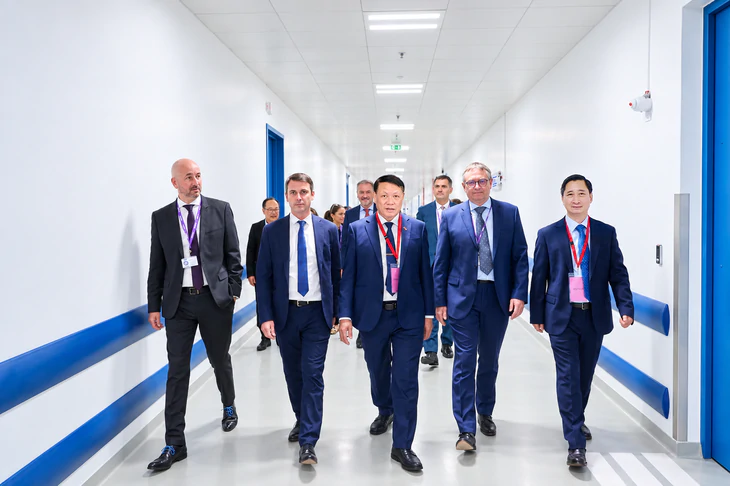
On September 11, 2026, Vietnam’s Deputy Minister of Health Do Xuan Tuyen and a Vietnamese delegation visited Sanofi’s vaccine manufacturing facility in Neuville-sur-Saône, France. The visit followed the Sanofi–VNVC Joint Declaration on next-generation vaccine manufacturing in Vietnam. Three categories have been prioritized: a six-in-one vaccine containing an acellular pertussis component, seasonal influenza vaccine and meningococcal vaccine. Sanofi’s Neuville facility currently produces source materials associated with vaccines included in the cooperation plan.
VNVC says the first phase of its Vaccine and Biologics Manufacturing Facility represents an investment of more than VND2.5 trillion, with planned capacity of 100–120 million doses annually. The implementation roadmap discussed by the Ministry targets construction completion in 2027, equipment installation and initial production in 2028, and commercialization of the first two to three products in 2029. These remain forward targets, not guaranteed regulatory or commercial outcomes.
Why It Matters
- Technology transfer matters more than localization alone. Filling or finishing a vaccine locally provides one degree of supply autonomy. Mastering the biological process, validation, analytical controls and manufacturing know-how provides something much more strategic.
- Vietnam has the demand base to support scale. A population above 100 million, combined with public immunization and a sizeable private vaccination market, creates a structural demand platform. Vietnam also added HPV and pneumococcal disease to the mandatory-vaccine framework under its expanded immunization policy from July 2026, reinforcing the move toward broader life-course prevention.
- Quality capability must develop alongside manufacturing. Sanofi says approximately 70% of vaccine manufacturing time is dedicated to quality testing. Building physical production without equivalent analytical and regulatory capability would therefore leave a major dependency unresolved.
- Health security and commercial opportunity are converging. Successful localization could improve supply resilience while also giving Vietnam a potential platform for regional vaccine manufacturing.
Healthcare Insight Analysis
Healthcare Insight’s view is that the market risks focusing too heavily on the most visible asset: the factory.
In vaccines, the factory is largely the hardware. The defensible capability sits deeper — in biological-process control, raw materials, variability management, aseptic operations, cold-chain integrity, quality assurance, batch release, regulatory documentation and experienced technical teams.
Sanofi provides a useful benchmark for the complexity involved. The company says its vaccine network supplies roughly 1.3 million doses every day. Its Modulus facilities in Neuville and Singapore are designed to manufacture up to four vaccines or biologics simultaneously, with production changeovers reduced to as little as 7–10 days.
A less visible development in Vietnam may therefore be as important as the VNVC factory itself.
In June 2026, Sanofi and Vietnam’s National Institute for Control of Vaccines and Biologicals signed a three-year cooperation agreement covering scientific exchange, continuous professional training and the transfer of advanced vaccine-testing techniques.
Vietnam is consequently attempting to build two layers at once: manufacturing capability through VNVC, and regulatory-quality capability through its national control system.
If both mature together, the outcome would be more strategically meaningful than conventional contract manufacturing. Vietnam would be building an ecosystem capable not only of making vaccines, but also of evaluating and releasing them to acceptable standards.
There is, however, an important caveat. Current announcements identify priority vaccines and an intended manufacturing roadmap, but they do not fully disclose how deep the transfer will run for each product, which production stages will ultimately occur domestically, or how much upstream input will remain imported. Those details will determine whether “made in Vietnam” eventually becomes Vietnamese vaccine capability rather than simply local production capacity.
Market Implications
VNVC and domestic manufacturers: the greatest value will come if the partnership creates technical teams, quality systems and manufacturing platforms reusable across additional vaccines, rather than capabilities locked to three individual products.
Sanofi: the company gains a locally scaled partner while deepening its position in Vietnam’s vaccine ecosystem across manufacturing, training and quality-control collaboration.
Competing vaccine companies: localization and technology partnerships may increasingly become competitive variables alongside portfolio strength, pricing and distribution.
Government and payers: the upside is stronger supply security and potentially broader access. The risk is building capacity that remains dependent on imported critical inputs or operates below economic utilization.
Two signals matter most from here: the actual depth of technology transfer for each vaccine, and whether the first Vietnam-produced batches progress toward the international manufacturing standards the project is targeting, including WHO-GMP, EU-GMP or comparable requirements.
Vaccine self-reliance should therefore not be measured by factory size. A better test is simpler: when the foreign experts leave the room, can the domestic system manufacture, test, troubleshoot, improve and expand the platform on its own?