

Key Development
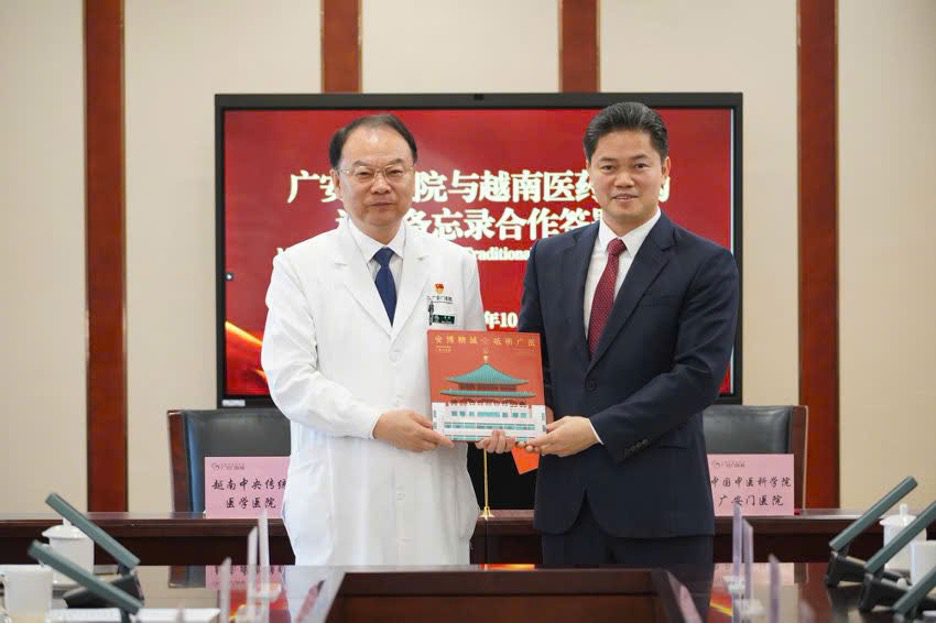
Vietnam’s Ministry of Health has advanced cooperation with major Chinese healthcare institutions through a series of high-level meetings in Beijing on October 15–16, 2026. The strategic significance extends beyond bilateral engagement: Vietnam is seeking access to clinical expertise, traditional medicine research, professional training and hospital management capabilities that could strengthen its domestic healthcare ecosystem.
A central outcome was the signing of a 2026–2031 Traditional Medicine Cooperation Action Plan with China’s National Administration of Traditional Chinese Medicine. Vietnamese healthcare institutions also signed cooperation arrangements with Guang’anmen Hospital, which handles approximately 5.2 million outpatient visits annually, covering professional exchanges, research and specialized training.
Separately, the Vietnam Academy of Traditional Medicine signed a memorandum of understanding with Beijing University of Chinese Medicine. Discussions with Peking Union Medical College Hospital focused on advanced clinical services, multidisciplinary care, digital transformation and artificial intelligence. These arrangements establish cooperation frameworks, but no specific investment value or technology-transfer volume was announced.
Why It Matters
- Vietnam is expanding international partnerships beyond equipment procurement, toward clinical expertise and institutional capabilities.
- Traditional medicine cooperation could support higher-value pharmaceutical research, particularly botanical standardization and evidence-based product development.
- Hospital–university integration offers a model for workforce development, connecting education, research and clinical practice.
- AI and digital healthcare cooperation may improve operational capabilities, provided implementation addresses data governance and interoperability.
- The economic value of cooperation depends on measurable outcomes, not the number of agreements or institutional visits.
Healthcare Insight Analysis
Healthcare Insight believes the cooperation signals an important transition in Vietnam’s healthcare development strategy.
The next phase of international healthcare cooperation should be judged not by how many agreements are signed, but by how much domestic capability those agreements create.
Access to advanced healthcare knowledge does not automatically produce stronger hospitals or pharmaceutical industries.
Training must translate into competency.
Research must generate reproducible evidence.
Technology must fit clinical workflows.
Hospital partnerships must support service delivery.
Scientific knowledge must produce measurable outcomes.
The value chain is therefore:
international partnership → knowledge transfer → institutional adoption → clinical validation → scalable healthcare value.
Traditional medicine represents a particularly relevant opportunity.
Vietnam possesses medicinal plant resources and established traditional practices, but building competitive pharmaceutical products requires more than access to historical formulations.
Botanical materials need authentication, chemical characterization, quality control, safety evaluation and appropriate clinical evidence.
Traditional knowledge may identify research opportunities. Scientific validation determines whether those opportunities become credible healthcare products.
Cooperation with Chinese research institutions could strengthen this development pathway.
For Vietnamese pharmaceutical manufacturers, the potential opportunity includes higher-quality herbal preparations, standardized ingredients and more sophisticated research capabilities.
However, international collaboration does not automatically establish intellectual property ownership, manufacturing rights or commercial viability.
Those elements require project-specific agreements and regulatory evaluation.
The hospital dimension is equally important.
Guang’anmen Hospital’s substantial outpatient activity offers experience in operating large-scale clinical services, while Peking Union Medical College Hospital provides a reference point for multidisciplinary care and research-oriented hospital management.
But successful adoption requires localization.
A hospital operating model that performs well in China cannot simply be transferred unchanged into Vietnam’s financing, workforce and referral systems.
The same principle applies to digital transformation.
AI tools and clinical information systems may support productivity, but their value depends on validated applications, data quality, privacy protections and staff adoption.
For policymakers and hospital executives, the essential metrics should include:
professionals trained → competencies demonstrated → protocols implemented → clinical outcomes improved → operating efficiency achieved.
These indicators distinguish meaningful capability transfer from diplomatic activity.
The strategic challenge is therefore to convert broad cooperation frameworks into funded projects, accountable institutions and measurable results.
Market Implications
Vietnamese pharmaceutical companies: may gain research and development opportunities in standardized herbal medicines, botanical ingredients and quality-controlled formulations.
Hospitals: could strengthen specialist training, multidisciplinary services and operational management through institutional partnerships.
Medical universities: may expand simulation-based education, clinical research and professional competency assessment.
Healthtech and medical device companies: could benefit from future digitalization and clinical technology projects, although commercial contracts have not been announced.
Healthcare investors: should monitor actual technology transfer, intellectual property arrangements, funding commitments and evidence of operational improvement.
ANALYTICAL MATRIX
| Dimension | Current Signal | Opportunity | Key Risk |
| Bilateral cooperation | 2026–2031 action plan | Long-term institutional programs | Limited implementation |
| Traditional medicine | Research and hospital partnerships | Standardized botanical products | Weak clinical evidence |
| Healthcare workforce | University MOU and training discussions | Advanced clinical competencies | Limited local adoption |
| Hospital management | PUMCH knowledge exchange | Better integrated care | Institutional mismatch |
| Digital healthcare | AI and digitalization discussions | Higher operational productivity | Data and execution risks |
Vietnam is not simply expanding its network of international healthcare partners. It has an opportunity to turn those relationships into a stronger domestic healthcare production and knowledge system.
The greatest value will come when training produces better clinical practice, research generates validated products and technology improves measurable hospital performance.
For healthcare leaders, international cooperation should therefore be treated as a capability-building investment rather than an end in itself.
The broader industry signal is clear:
Vietnam’s healthcare competitiveness will increasingly depend on its ability to absorb, validate and commercialize knowledge—not merely access it.