

Key Development
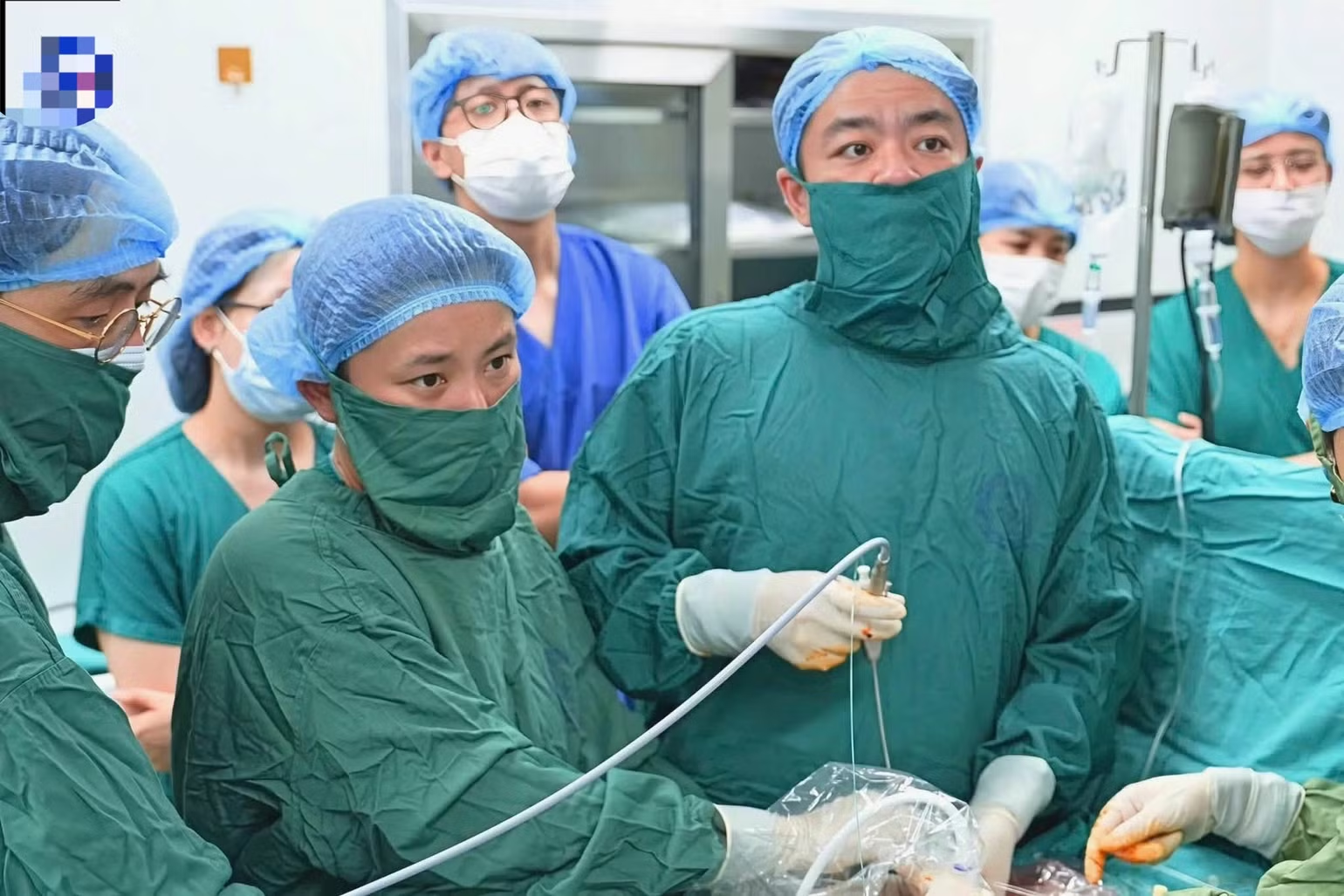
On September 26, 2026, Vietnam’s National Hospital of Obstetrics and Gynecology reported the country’s first technically successful fetoscopic endoluminal tracheal occlusion (FETO) procedure for a fetus with severe congenital diaphragmatic hernia.
FETO involves placing a small balloon inside the fetal trachea. Temporary airway occlusion traps pulmonary fluid, creating mechanical stimulation that encourages the underdeveloped lungs to grow before birth.
The procedure is not experimental in the global sense. In the randomized TOTAL trial published in the New England Journal of Medicine, FETO performed at 27–29 weeks in fetuses with isolated severe left-sided congenital diaphragmatic hernia increased survival to NICU discharge from 15% with expectant care to 40%. The trade-off was substantially higher rates of preterm prelabor rupture of membranes and preterm delivery.
Why It Matters
- Vietnamese fetal medicine is moving from diagnosis toward treatment. Prenatal imaging increasingly determines not only prognosis, but eligibility for an intervention before birth.
- FETO is evidence-based but highly selective. The severe-disease TOTAL trial showed a survival benefit, while the companion moderate-disease trial did not demonstrate a statistically significant improvement in its main survival outcomes and still increased prematurity.
- Technical success is only the beginning of the care pathway. Balloon retrieval, preterm-delivery management, neonatal ventilation, pulmonary-hypertension treatment and postnatal diaphragmatic repair remain critical.
- The procedure reflects deliberate capability-building. Earlier in 2026, the hospital’s fetal-medicine program had identified FETO as a priority technique for technology transfer and advanced training.
Healthcare Insight Analysis
Healthcare Insight believes the strategically important milestone is not simply that a balloon was successfully positioned inside a fetal airway.
It is that Vietnam is beginning to assemble a care pathway that previously existed only in a limited number of highly specialized fetal-surgery centers.
This distinction matters because fetal intervention cannot be scaled like a conventional medical device.
Patient selection itself requires sophisticated capability. Prognosis in congenital diaphragmatic hernia depends on factors including fetal lung size, liver herniation, associated abnormalities and sometimes fetal MRI. In the severe TOTAL trial, eligibility included an observed-to-expected lung-to-head ratio below 25%.
The procedure therefore sits inside a much larger clinical architecture:
advanced prenatal diagnosis → risk stratification → fetal intervention → balloon retrieval → neonatal intensive care → pediatric surgery → long-term follow-up.
The competitive advantage is not the balloon.
It is the multidisciplinary system surrounding the balloon.
That includes maternal-fetal medicine specialists, fetal imaging, anesthesiology, neonatology, genetics, pediatric surgery and teams capable of emergency balloon removal if labor begins unexpectedly.
This also changes the scaling question.
Vietnam should not necessarily aim for every major maternity hospital to perform FETO. A more rational model may be a small number of high-volume fetal-therapy referral centers, connected to a much broader prenatal-screening and referral network.
The international trial experience supports that caution. TOTAL required participating fetal-surgery centers to perform at least 36 fetoscopic procedures annually and to have completed at least 15 FETO procedures before recruiting participants. The authors explicitly cautioned against generalizing outcomes to centers without extensive fetoscopic expertise and reliable balloon-removal capability.
For the healthcare system, this creates an interesting inversion.
A provincial hospital does not need to perform fetal surgery to participate meaningfully in fetal therapy. Its value may instead come from early detection, standardized severity assessment, teleconsultation and rapid referral to a national center.
If that network functions well, a procedure used in relatively few pregnancies can still improve outcomes across a much larger population.
Market Implications
Tertiary hospitals: fetal medicine can evolve into a high-complexity service line integrating advanced ultrasound, fetal MRI, genetics, NICU and pediatric surgery.
Medtech: the opportunity extends beyond fetoscopes to balloons, access devices, fetal monitoring, imaging and neonatal respiratory technology.
Training: procedural volume, simulation and multidisciplinary team readiness will create more defensible capability than equipment ownership alone.
Health systems: a hub-and-spoke fetal-therapy network may generate better quality and economics than broadly distributing a low-volume, high-risk procedure.
ANALYTICAL MATRIX
| Dimension | Current Signal | Strategic Opportunity | Key Risk |
| Procedure | First reported Vietnamese FETO | Establish fetal-surgery capability | One case does not prove program outcomes |
| Evidence | Survival benefit in severe left CDH | Meaningful benefit in selected fetuses | PPROM and prematurity |
| Ecosystem | Expanding fetal-medicine center | National referral hub | Diluting experience across too many centers |
| Medtech | Increasing technical complexity | High-value specialist market | Operator- and system-dependent outcomes |
| Access | Domestic intervention now possible | Reduce overseas referral burden | Highly centralized access |
The two most important metrics after this milestone are not simply how many FETO procedures Vietnam performs, but survival to hospital discharge among appropriately selected fetuses and program-level rates of PPROM and preterm birth.
If those outcomes remain strong as experience grows, this will represent more than one technical first. Vietnamese fetal medicine will have moved from seeing disease before birth to building a system capable of changing its trajectory before birth.