

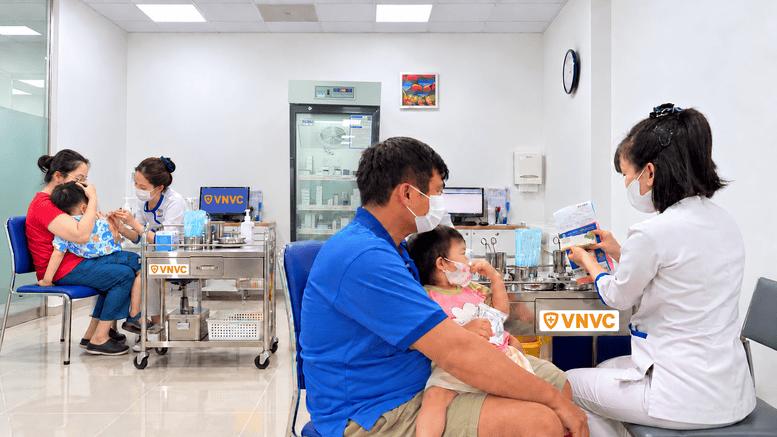
Key Development
Less than three weeks after Vietnam began deploying its first licensed EV-A71 vaccine, VNVC said it had administered more than 100,000 doses through nearly 300 vaccination centers across 31 provinces and cities, while providing nearly VND3 billion in support to families registering for full vaccination schedules. The rollout began on September 25, 2026, roughly six months after the Ministry of Health authorized Envacgen.
Envacgen is an inactivated EV-A71 vaccine authorized for children aged two months to under six years. Vietnam’s Drug Administration identifies Medigen Vaccine Biologics as the manufacturer. A randomized Phase 3 study conducted in Taiwan and Vietnam reported 96.8% efficacy against EV71-associated disease, with solicited adverse events broadly similar between vaccine and placebo groups.
The strategically important signal is therefore not only vaccine efficacy. It is execution: regulatory authorization was followed by national-scale distribution within months, and rapid uptake within weeks.
Why It Matters
- EV71 vaccination adds a new prevention layer against one of the pathogens most strongly associated with severe neurological hand-foot-and-mouth disease.
- Commercial execution is part of vaccine effectiveness at the system level. Cold-chain capacity, inventory management and geographic availability determine whether an approved product reaches children.
- The nearly VND3 billion support program reduces an access barrier, but it remains a private-sector support mechanism rather than population-wide public financing.
- EV71 protection is not equivalent to universal HFMD protection. Multiple enteroviruses cause hand-foot-and-mouth disease, making pathogen-specific surveillance essential.
Healthcare Insight Analysis
Healthcare Insight believes this launch illustrates a broader principle:
in vaccines, distribution infrastructure is part of the product.
The relevant value chain is:
approval → procurement → cold-chain → local availability → first dose → series completion.
Break any link, and even a highly effective vaccine produces limited population impact.
This makes VNVC’s reported delivery of more than 100,000 doses within slightly more than two weeks strategically meaningful.
Its competitive asset is not simply access to Envacgen. It is a private prevention platform consisting of physical vaccination sites, refrigerated logistics, inventory systems, reservation capability and the ability to activate consumer demand quickly.
The next question, however, is much harder:
Will rapid uptake translate into measurable reduction in disease burden?
Dose count alone cannot answer that.
A stronger real-world measurement framework would follow:
dose one → completed schedule → EV71 infection → hospitalization → severe neurological disease.
This distinction is especially important because HFMD is a syndrome caused by multiple enteroviruses.
Envacgen targets EV-A71. Therefore, total HFMD incidence could remain substantial even if vaccination successfully reduces severe EV71 disease.
The correct post-launch outcome is not simply:
“Did all HFMD fall?”
It is:
“Did EV71-attributable illness, hospitalization and severe complications fall among vaccinated populations?”
That makes virological surveillance part of the commercial and public-health architecture.
If circulating strains change over time, policymakers need to know what proportion of serious disease remains vaccine-preventable. Strong vaccination infrastructure without strong pathogen surveillance can make impact difficult to interpret.
The economics are equally relevant.
A nearly VND3 billion support program can reduce friction during market introduction and encourage full-course completion. But private-pay vaccination can still create access differences by income, geography and household willingness to pay.
The long-term strategic question is therefore whether EV71 vaccination remains predominantly a premium private prevention product or develops enough real-world health-economic evidence to support broader financing models.
For manufacturers, this matters well beyond one vaccine.
A market where regulatory approval can be converted quickly into large-scale national uptake becomes more attractive for future vaccine launches. Vietnam could increasingly serve not only as a commercial endpoint, but as an important early Southeast Asian market for new preventive technologies.
Market Implications
VNVC: its competitive moat increasingly lies in vaccination infrastructure and execution rather than vaccine portfolio alone.
Manufacturers: a scalable private vaccination network can materially shorten the path from authorization to real-world uptake.
Public health authorities: monitoring should increasingly separate total HFMD from EV71-specific severe disease.
Payers and policymakers: hospitalization and severe-disease reductions will be central to determining whether broader financial support is justified.
ANALYTICAL MATRIX
| Dimension | Current Signal | Opportunity | KPI to Watch |
| Regulation | Approved March 2026 | First-mover EV71 prevention | Post-market safety |
| Rollout | >100,000 doses in >2 weeks | Rapid scale | Series completion |
| Access | Nearly 300 centers | Broad geographic reach | Access equity |
| Clinical evidence | Strong Phase 3 EV71 efficacy | Reduce severe disease | EV71 hospitalization |
| Public health | HFMD has multiple causes | Target severe EV71 burden | Serotype surveillance |
If the story ends at 100,000 doses, this is a successful commercial launch.
If those doses translate into fewer severe EV71 cases, fewer hospitalizations and broad enough coverage among vulnerable children, it becomes something more important: a meaningful population-health intervention.
Vietnam’s next EV71 challenge is therefore no longer vaccine availability. It is converting availability into completed vaccination, equitable coverage and measurable disease reduction.