

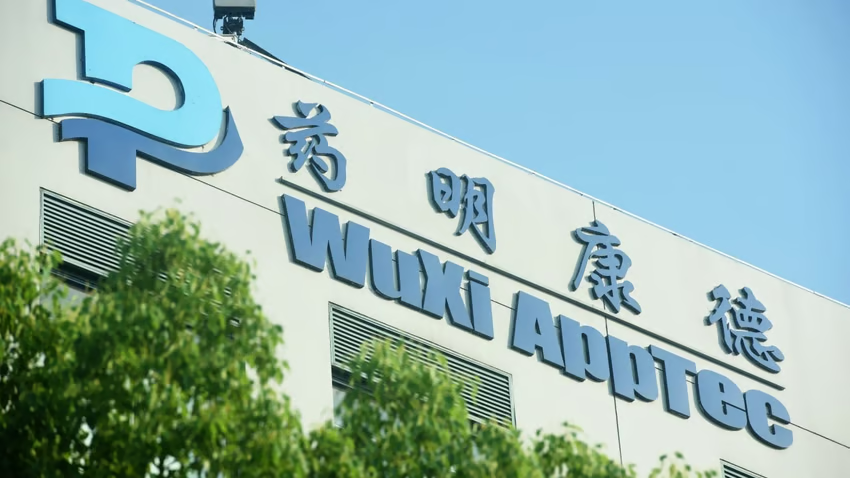
Chinese CDMO WuXi AppTec has once again entered the crosshairs of the United States government after being added to the U.S. Department of Defense’s (DoD) newly updated Section 1260H roster of “Chinese military companies”. The Pentagon asserts that the corporation is indirectly owned and affiliated with China’s civilian asset regulatory bodies, defense administration arms, and the People’s Liberation Army (PLA). Inclusion on the 1260H list automatically designates WuXi AppTec as a “biotechnology company of concern” under the statutory provisions of the Biosecure Act, triggering severe restrictions on U.S. federal procurement and grant allocations involving its equipment or services.
The documented corporate defense arguments, statutory grandfather exemptions, and macroeconomic market implications include:
-
Corporate Refutations and Legal Remedies Pursued by WuXi AppTec:
-
Executive Responses: A spokesperson for WuXi AppTec stated that its placement on the blacklist and the alleged basis for the designation were “clearly a mistake,” adding that the firm will take immediate actions to correct this erroneous designation. The company maintains that it does not meet the statutory criteria for designation as a “Chinese military company,” emphasizing that it is not owned, controlled, or affiliated with any PRC military or government entity, provides zero services to the PLA, and has no association with military-civil fusion programs.
-
Operational Compliance Profile: In an open letter to customers signed by its joint CEOs, the firm clarified that it has never been placed on any government sanctions list and that none of its executive or board members possess military or political party affiliations. Furthermore, in 2025, WuXi AppTec passed more than 50 inspections by government regulators and hundreds of independent customer audits with zero critical findings.
-
-
Grandfather Exemptions and Corporate Mitigation Strategies:
-
The Five-Year Grandfather Clause: Because WuXi AppTec was newly designated to the blacklist, it will be covered under a systematic five-year grandfather clause. This legal buffer protects any existing commercial contracts inked before the effective date of the ban through 2031, empowering biopharma clients to fulfill pre-existing obligations and recalibrate supply chains without immediate operational disruption.
-
U.S. Infrastructure Expansion Plan B: Financial analysts at Jefferies highlighted WuXi AppTec’s operational “plan B” as it continues its domestic U.S. infrastructure expansion tear to hedge against an unfavorable policy environment. The CDMO’s greenfield manufacturing campus in Delaware is operationally expected to become functional by the end of this year, with further physical expansions slated for 2027.
-
-
Financial Performance and Structural Market Shifts:
-
Market Reactivity and Revenue Benchmarks: The U.S. blacklist announcement sent WuXi AppTec shares down 2.62% in Shanghai trading on Tuesday. Financially, the CDMO is still projecting total consolidated revenues of 51.3 billion to 53 billion yuan ($7.6 billion to $7.8 billion) for full-year 2026, buoyed by a 28% revenue surge recorded over the first quarter of this year. In fiscal year 2025, the firm generated full-year revenues of 45.5 billion yuan.
-
Supply Chain Displacements: Jefferies analysts consider the immediate operational impact to be minimal, noting that large multinational pharma companies still prefer China-based manufacturing due to high cost-efficiency. However, retaining commercial relationships with a designated company while simultaneously securing U.S. federal funding poses a substantial regulatory burden on biopharma clients. On a competitive note, analysts emphasized that WuXi AppTec’s blacklisting hands a structural win to India-based contract research, development, and manufacturing organizations (CDMOs)—particularly within the small molecule and peptide segments—a regional market estimated by Jefferies to scale to a $6.9 billion market size by 2030.
-