

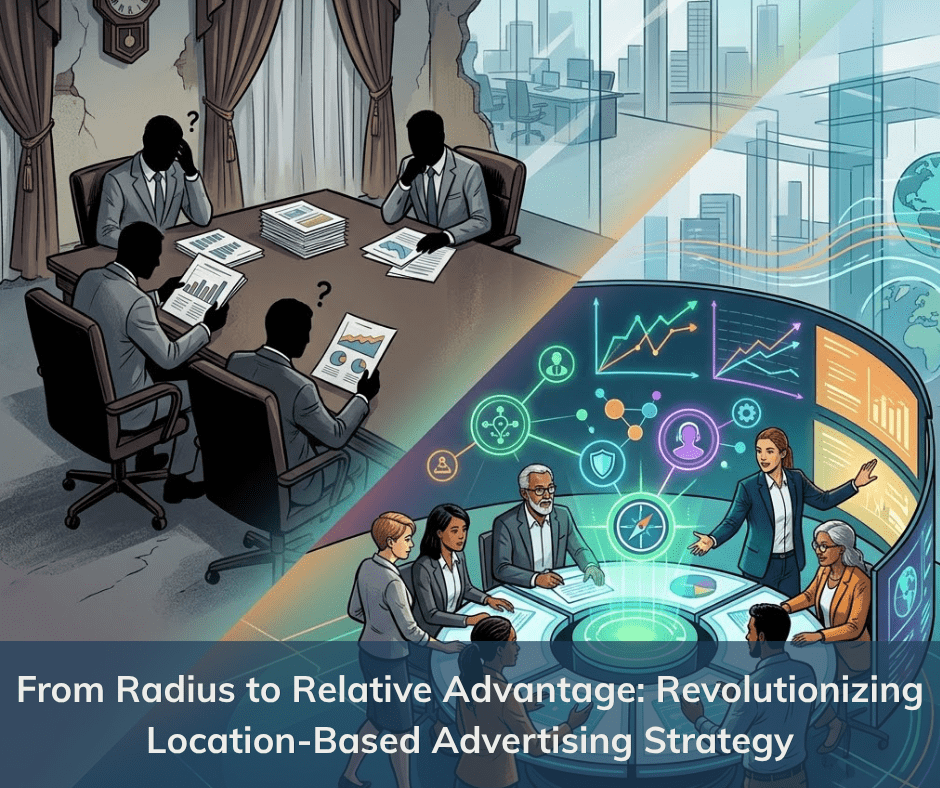
The Current State: The Obsolescence of “Circle-Drawing” Logic Despite location-based advertising expenditures reaching $57 billion in 2025, most marketers still rely on a primitive tactic: drawing a radius around a store and targeting everyone within. However, a comprehensive six-year study across multiple retail sectors reveals that sheer physical proximity is not the optimal metric for ad effectiveness. Instead, “relative proximity to competitors” emerges as the decisive factor in consumer behavior.
I. The Theory of Relative Proximity The research demonstrates that consumers do not respond to ads simply because they are near your store. They respond because they are closer to you than to your rival.
-
The New Target Segment: Customers who live far from your focal store (e.g., over 6 miles) but remain relatively closer to it than to a competitor represent the most persuadable group. Traditional radius-based strategies consistently overlook this high-potential segment.
-
Budget Optimization: Prioritizing geographic areas where your business holds a locational advantage over rivals yields significantly higher conversion rates than general proximity targeting.
II. The “Billboard Effect” and the Donut Strategy The relationship between distance and ad effectiveness follows an inverted U-shaped pattern rather than a linear decline.
-
The Inner Blind Spot: Customers in the immediate vicinity often show weaker responses because they are already exposed to the brand through daily physical encounters (the “billboard effect”). For them, additional advertising is redundant.
-
The Golden Zone: Peak effectiveness occurs at moderate distances (roughly 4 to 14 miles). In this band, travel costs are manageable, but customers require a “nudge” to trigger a store visit.
III. Tailoring Strategy by Ad Type and Lifestyle
-
Promotional Ads: Most effective when targeted at customers in close absolute proximity, as low travel costs make time-limited discounts highly actionable.
-
Brand-Building Ads: Should focus on moderate distances to serve as reminders and build latent intent for those spatially predisposed to visit but lacking a prompt.
-
Workplace Targeting: Beyond home locations, identifying a customer’s daytime (work) location opens opportunities to reach commuters — a segment frequently missed by home-only strategies.
IV. Executive Roadmap for Implementation
-
Incorporate Competitor Locations: Overlay rival store locations onto targeting maps to prioritize regions where you are the closer option.
-
Test Distance Bands: Move away from uniform campaigns. Run holdout experiments by distance rings to verify the responsiveness of “inner” versus “moderate” zones.
-
Differentiate Spatial Rules: Apply tighter geofences for promotional campaigns and broader reach for brand-building messages.
-
Demand Granular Data: Push advertising platforms to support household or block-group level targeting rather than broad zip codes, which often obscure critical spatial patterns.
Source: https://hbr.org/2026/03/a-better-strategy-for-location-based-advertising?ab=HP-latest-text-2