

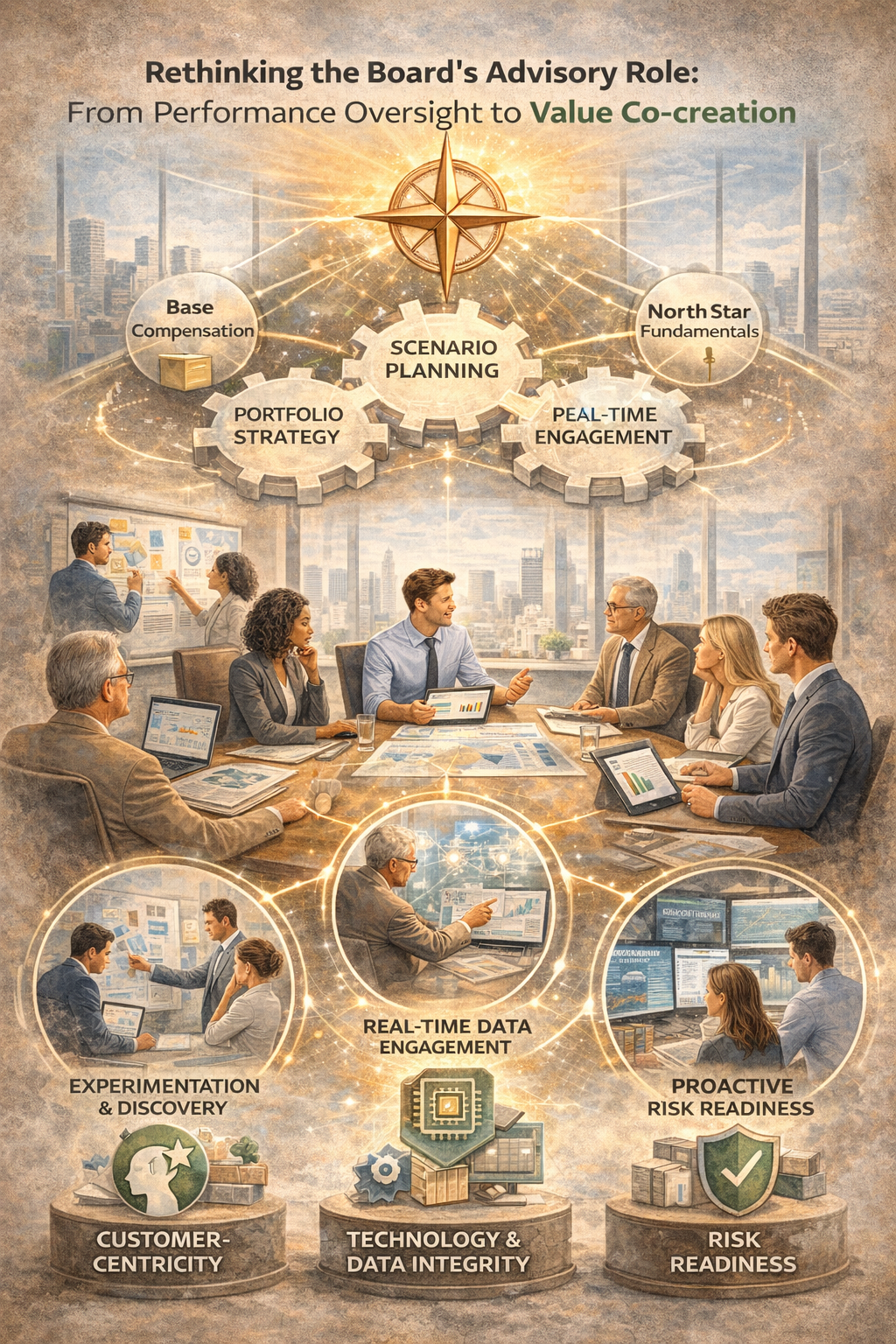
The Competency Paradox in a Disruptive Era Data from the AlixPartners Disruption Index reveals a stark contradiction: while 87% of CEOs believe their Boards possess the requisite expertise, 72% report increasing difficulty in setting strategic priorities amidst disruptive forces. This disconnect suggests that traditional governance structures are becoming obsolete. To effectively support the CEO, Boards must evolve from a “certifying” entity into a strategic partner that actively engages in complex problem-solving.
Pillars of the Governance Mindset Shift
1. Abandoning Linear Thinking in Planning In an uncertain world, traditional forecasting and voluminous board books often assume a straightforward path to growth. This tends to push Boards into the trap of critiquing plan variances.
-
Shift to Scenario-Based Modeling: Instead of putting management on the defensive, Boards should encourage dynamic scenario planning and debate alternate futures.
-
Interactive Data Engagement: Utilizing real-time simulation models to test strategic assumptions helps CEOs discern priorities more effectively than reviewing static PowerPoint slides.
2. Adopting a Portfolio Approach to Strategy Rather than committing solely to a single, high-risk long-term plan, Boards should help CEOs manage strategy as a diversified portfolio.
-
Experimentation and Discovery: Encourage placing multiple smaller bets to create strategic options. This allows the organization to “fail fast” and learn from unsuccessful investments without catastrophic consequences.
-
After-Action Reviews: Transform investment outcomes into organizational intelligence, ensuring that failures serve as learning opportunities to refine future priorities rather than occasions for blame.
3. Fortifying the “North Star” Fundamentals The Board acts as a strategic compass, ensuring the CEO remains focused on three critical pillars:
-
Customer-Centricity: Look beyond quantitative metrics (like NPS) to explore the qualitative “pain points” of customers through direct dialogue.
-
Technology and Data Integrity: Emphasize that solid data management is the bedrock of innovation. AI leaders are twice as likely to have modernized legacy systems compared to laggards.
-
Proactive Risk Readiness: Move away from passive threat cataloging toward “response readiness.” By monitoring supply chains and competitor movements in real-time, Boards can shift from guessing the future to stress-testing the organization’s operational agility and resilience.
Source: https://hbr.org/2026/03/boards-need-to-rethink-how-they-advise-ceos?ab=HP-latest-text-1