

Key Development
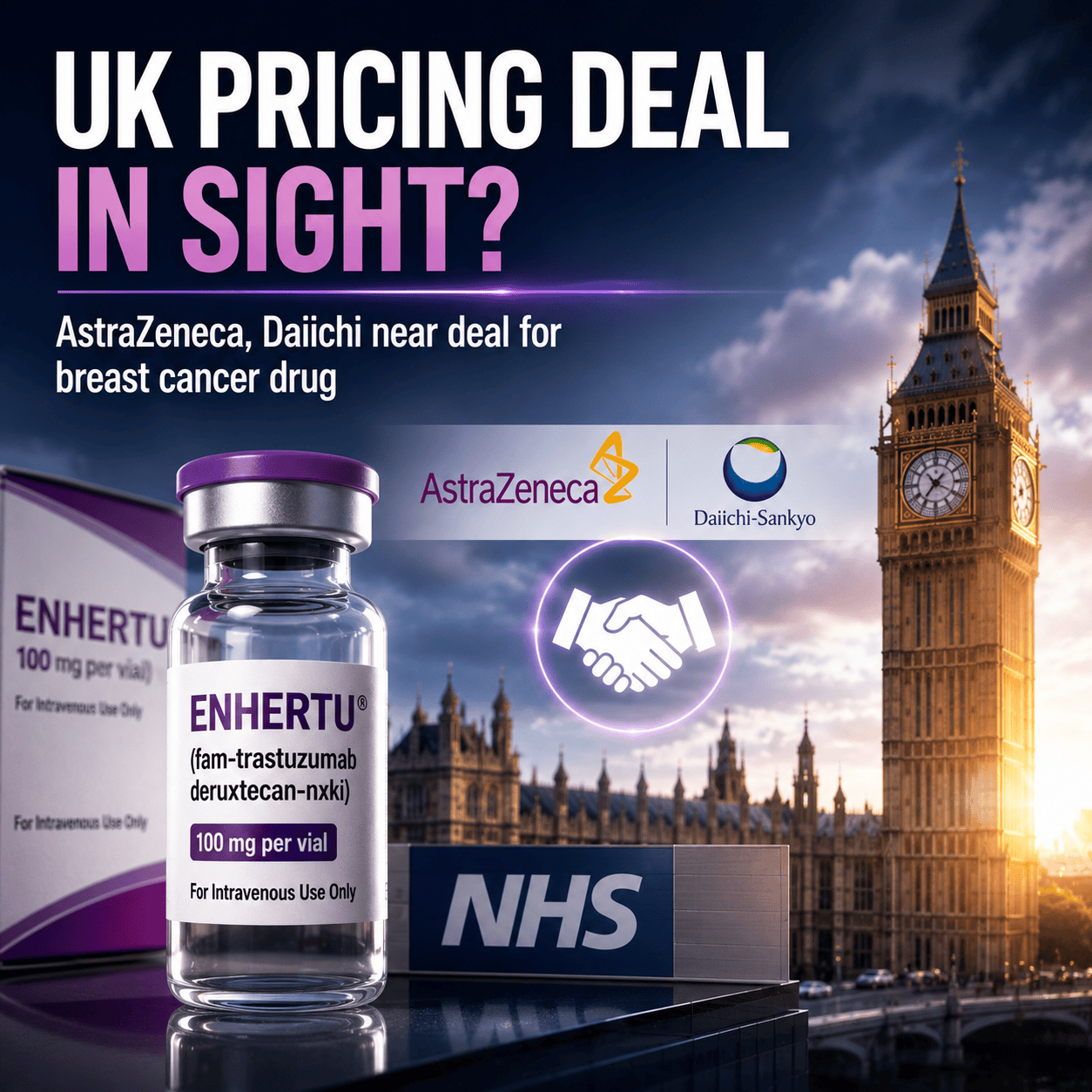
AstraZeneca and Daiichi Sankyo are reportedly close to reaching a pricing agreement with the United Kingdom’s National Institute for Health and Care Excellence (NICE) that could allow Enhertu to become available through the National Health Service (NHS) for eligible patients with HER2-low metastatic breast cancer. The discussions follow previous decisions by NICE to withhold reimbursement after concluding that the therapy did not meet the country’s cost-effectiveness threshold. Negotiations remain ongoing and no final agreement has been announced.
The development is significant because Enhertu is already approved in dozens of markets worldwide and is widely recognized as one of the most important antibody-drug conjugates (ADCs) in oncology. Despite strong clinical evidence and broad international adoption, reimbursement in the UK has remained constrained by pricing considerations rather than regulatory approval or clinical performance. Recent changes in the UK’s health technology assessment methodology, together with renewed commercial discussions, appear to have reopened a pathway toward broader patient access.
Beyond the immediate negotiations, the case reflects a broader evolution in how innovative cancer therapies are evaluated. Market access is increasingly determined through a balance between clinical benefit, long-term healthcare value, and budget sustainability rather than efficacy alone.
Why It Matters
- The commercial success of breakthrough oncology therapies increasingly depends on reimbursement negotiations rather than regulatory approval alone.
- Health technology assessment agencies such as NICE are becoming more influential in determining how quickly innovative medicines reach patients.
- The outcome of the Enhertu negotiations may influence pricing expectations for future antibody-drug conjugates and other high-cost precision oncology therapies.
- Pharmaceutical companies are placing greater emphasis on demonstrating real-world value, long-term outcomes, and economic impact alongside clinical efficacy.
- The case highlights the growing tension between accelerating medical innovation and maintaining financially sustainable healthcare systems.
Healthcare Insight Analysis
Enhertu represents more than a successful oncology product. It reflects how the commercial landscape for innovative medicines is changing.
Over the past decade, oncology has entered a period of unprecedented scientific progress. Antibody-drug conjugates, cell therapies, precision medicines, and targeted biologics are delivering meaningful improvements in survival across multiple cancers. Yet these advances are also placing increasing pressure on healthcare budgets worldwide.
The negotiations in the United Kingdom demonstrate that regulatory approval is no longer the final hurdle for innovative medicines. Market access has become a second stage of competition where manufacturers must prove not only that a therapy works, but also that it delivers sufficient value relative to its cost. This shift is fundamentally changing commercialization strategies across the pharmaceutical industry.
For companies developing next-generation oncology products, clinical superiority alone may no longer guarantee broad adoption. Future success will increasingly depend on generating robust health economic evidence, negotiating innovative reimbursement models, and demonstrating measurable improvements in patient outcomes within constrained healthcare budgets.
The implications extend beyond Enhertu. Antibody-drug conjugates have become one of the fastest-growing segments in oncology, attracting billions of dollars in licensing agreements and acquisitions over the past several years. As more ADCs enter the market, pricing negotiations are likely to become one of the industry’s most important competitive differentiators.
Market Implications
For pharmaceutical companies, the negotiations reinforce the importance of integrating market access strategies much earlier in drug development. Clinical excellence remains essential, but reimbursement planning, health economic modelling, and value-based pricing are becoming equally important drivers of commercial success.
For investors, the outcome could provide an important signal for the broader ADC market. A successful agreement would demonstrate that even premium oncology therapies can secure reimbursement when supported by flexible pricing strategies and evolving health technology assessment frameworks. That precedent may benefit future launches across the rapidly expanding ADC pipeline.
For healthcare systems, the discussions reflect a broader challenge facing developed markets. Governments must continue encouraging pharmaceutical innovation while ensuring that public healthcare systems remain financially sustainable. Increasingly, reimbursement decisions will shape not only patient access but also where pharmaceutical companies prioritize future investment and commercialization efforts.
Ultimately, the debate surrounding Enhertu is not simply about the price of one cancer medicine. It reflects a fundamental transformation in global healthcare, where the ability to demonstrate economic value has become almost as important as the ability to demonstrate clinical benefit.