

Key Development
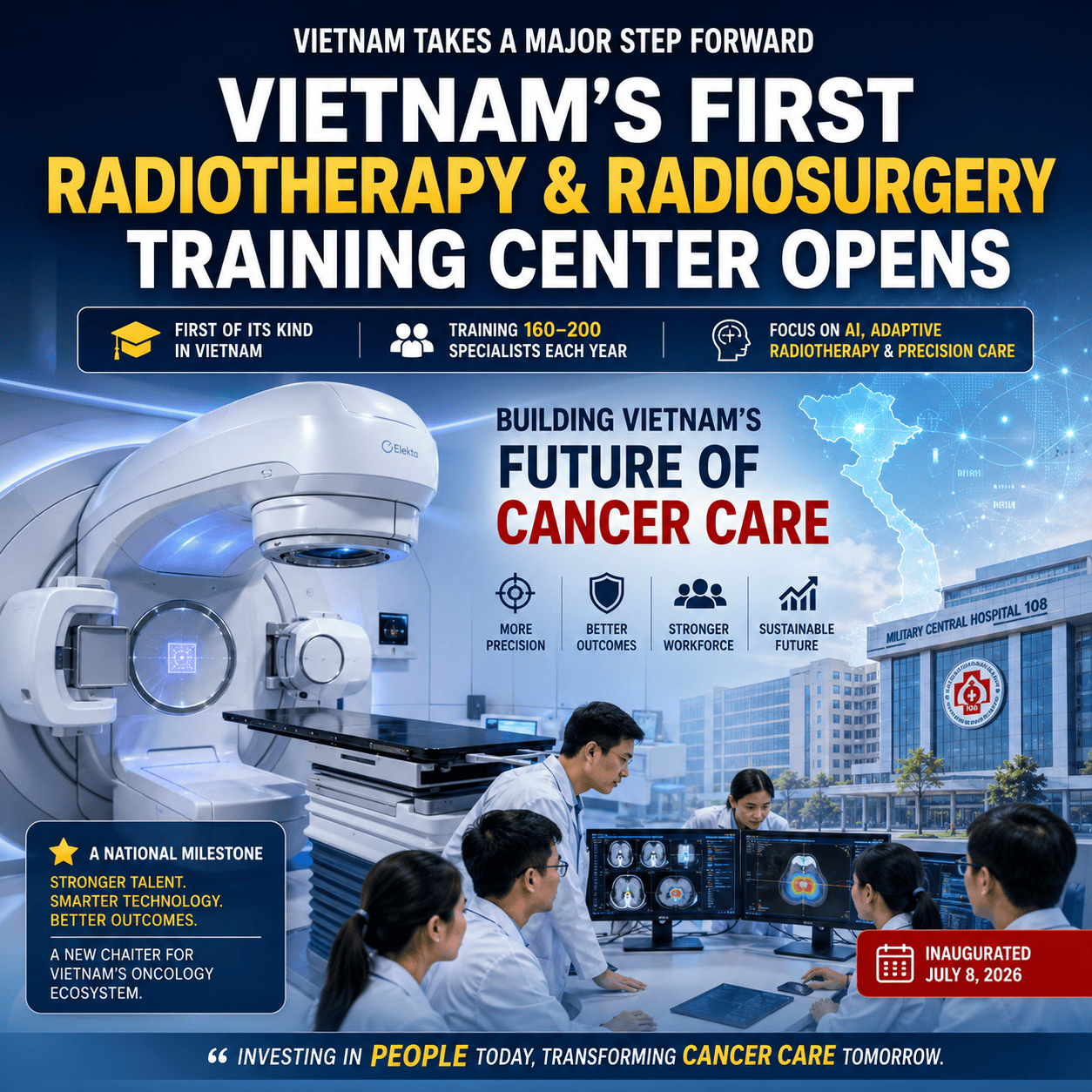
Military Central Hospital 108 officially inaugurated Vietnam’s first dedicated Radiotherapy and Radiosurgery Training Center on July 8. According to the hospital, it is the first facility of its kind in Vietnam and only the second in Southeast Asia, marking an important milestone in the country’s effort to strengthen cancer care capacity.
The center is expected to train between 160 and 200 radiation oncology professionals each year, including radiation oncologists, medical physicists, and radiotherapy technologists from hospitals across Vietnam. Beyond education, it will also serve as a national platform for clinical research in advanced radiotherapy, with programs focusing on artificial intelligence assisted treatment planning, adaptive radiotherapy, and stereotactic radiosurgery.
Its first training course began immediately after the inauguration and focuses on advanced breast cancer radiotherapy using RapidArc technology. The program aims to improve treatment precision while reducing radiation exposure to critical organs such as the heart and lungs.
More importantly, the initiative reflects a strategic shift in Vietnam’s cancer care priorities. Rather than emphasizing the acquisition of additional radiotherapy equipment, the program recognizes that the country’s most pressing constraint is the availability of highly trained professionals capable of delivering increasingly sophisticated cancer treatment.
Why It Matters
- Vietnam is formally recognizing that the future of cancer care depends as much on human capital as on medical technology. Without qualified specialists, investments in advanced radiotherapy systems cannot achieve their full clinical value.
- Establishing one of only two dedicated training centers in Southeast Asia strengthens Vietnam’s position within the region’s oncology ecosystem and creates opportunities for future collaboration in education, research, and specialist training.
- A standardized national training program can reduce variations in treatment quality between hospitals and support more consistent adoption of international clinical practices across the country.
- The emphasis on artificial intelligence, adaptive radiotherapy, and precision treatment reflects Vietnam’s transition from expanding basic treatment capacity to building capabilities for next generation oncology.
- A sustainable talent pipeline also creates the foundation for future investment in advanced radiotherapy equipment, treatment planning software, and digital oncology solutions.
Healthcare Insight Analysis
The most important development is not the opening of a new training center. It is the recognition that workforce capability has become one of the defining factors shaping the future of cancer care.
Across many emerging healthcare systems, investment has traditionally focused on expanding physical infrastructure. Governments purchase linear accelerators, imaging systems, and treatment equipment, expecting workforce capacity to develop alongside these investments. In practice, the opposite often occurs. Advanced equipment remains underutilized because there are not enough trained specialists to operate it, optimize treatment planning, or maintain consistent clinical quality.
Military Central Hospital 108 is addressing this challenge from a different direction. By building a national training platform before pursuing broader technological expansion, Vietnam is strengthening the human infrastructure required to support long term growth in oncology services. This approach improves not only access to treatment but also the quality, consistency, and safety of care delivered across different hospitals.
The initiative also reflects a broader transformation taking place across Southeast Asia. As populations age and cancer incidence continues to rise, healthcare systems are moving beyond expanding treatment capacity toward improving clinical capability. Future competitiveness will increasingly depend on the ability to develop highly specialized healthcare professionals who can fully utilize advanced technologies, integrate artificial intelligence into clinical workflows, and participate in multidisciplinary cancer care.
Market Implications
For medical technology companies, the establishment of a national radiotherapy training center represents more than an educational initiative. It is an early indicator that demand for advanced treatment platforms is likely to become more sophisticated over the coming years. As clinicians gain expertise in adaptive radiotherapy, stereotactic radiosurgery, and AI assisted treatment planning, hospitals will require equipment and software capable of supporting these increasingly complex clinical workflows.
For healthcare investors and private hospital groups, the emergence of a standardized national training pipeline reduces one of the most significant barriers to expanding oncology services. Access to qualified specialists has historically constrained growth in many developing healthcare markets. A larger and more consistent workforce creates opportunities for both public and private providers to expand cancer treatment capacity with greater confidence.
The broader significance extends beyond oncology. Vietnam’s investment demonstrates that strengthening healthcare systems is no longer defined solely by building hospitals or purchasing equipment. Increasingly, sustainable healthcare development will depend on whether countries can build the specialized workforce required to transform advanced medical technology into better patient outcomes. That may prove to be one of the country’s most important healthcare investments over the next decade.