

Key Development
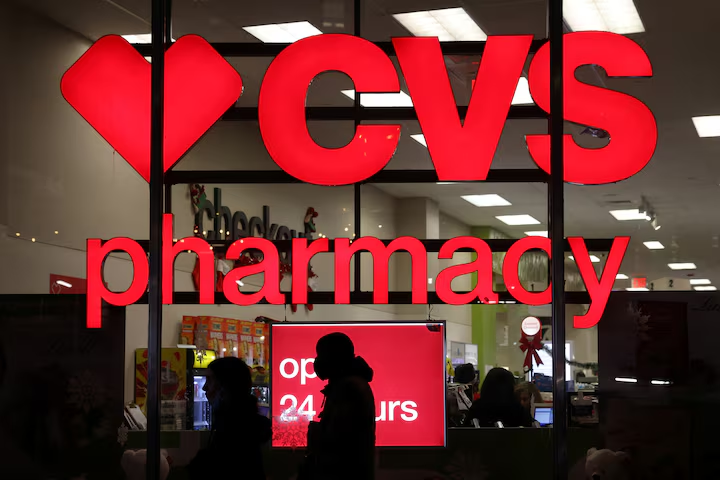
CVS Health has agreed to pay $315 million to resolve U.S. Department of Justice allegations that its pharmacies unlawfully dispensed opioids and other controlled substances and subsequently sought reimbursement from Medicare and other federal healthcare programs for many of those prescriptions. The allegations cover conduct between October 2013 and December 2025. CVS has denied wrongdoing, and the settlement does not constitute a determination of liability.
The more consequential element may be the operational obligations accompanying the payment. CVS’ agreement with the DEA requires additional mechanisms for reporting suspected unlawful dispensing, proactive monitoring of pharmacy dispensing patterns and formal processes to evaluate prescribers suspected of inappropriate prescribing.
The DOJ also alleged that staffing practices, performance metrics and incentive compensation contributed to an environment in which pharmacists could struggle to respond adequately to prescription red flags. That moves the case beyond litigation and into a broader question of governance across large-scale retail pharmacy networks.
Why It Matters
- The $315 million payment is not the largest strategic issue. The longer-term impact lies in embedding more compliance controls across billions of prescription transactions.
- Accountability is moving beyond individual pharmacists toward enterprise systems. Staffing, workflows, incentives and data infrastructure are increasingly viewed as part of patient safety.
- Controlled-substance compliance is becoming a data problem. Identifying suspicious prescribers or dispensing patterns increasingly requires real-time analytics.
- The exposure extends beyond drug-dispensing regulation. Invalid prescriptions reimbursed by government programs can also create False Claims Act risk.
- The implications extend across retail pharmacy. Walmart reached a separate $50 million federal opioid settlement in August 2026, reinforcing the broader enforcement trend.
Healthcare Insight Analysis
The CVS case illustrates an important evolution in regulatory thinking: compliance is no longer simply a control function sitting behind pharmacy operations; it is becoming part of the operating architecture itself.
Scale makes this especially important for CVS. In 2025, its Pharmacy & Consumer Wellness business filled approximately 1.8 billion prescriptions on a 30-day-equivalent basis and accounted for roughly 28.5% of U.S. retail prescriptions. At that scale, relatively small weaknesses in governance can translate into substantial regulatory, reimbursement and reputational exposure.
The new opioid-monitoring requirements therefore have implications for pharmacy workflow.
If pharmacists need more time to investigate red flags, contact prescribers or delay dispensing, management must rebalance three objectives that often compete operationally: speed, labor productivity and clinical safety.
That is what makes the DOJ’s allegations regarding staffing and performance metrics particularly important. Rather than focusing solely on individual prescriptions, regulators linked the alleged failures to corporate operating practices. CVS contests the allegations, but the enforcement logic has broader relevance: if incentive systems make it harder for frontline healthcare professionals to meet their clinical obligations, operating design itself can become regulatory exposure.
Technology will increasingly become part of the solution. Large pharmacy networks are likely to require stronger prescriber risk scoring, dispensing surveillance, anomaly detection and escalation systems capable of identifying problematic patterns before a prescription is filled.
For a business handling billions of prescriptions, automation can therefore no longer be judged solely by how much faster it processes transactions. It must also function as a clinical and regulatory control layer.
Market Implications
Purely in financial terms, the $315 million settlement appears manageable relative to CVS’ scale. The company generated $106.1 billion in Q2 2026 revenue and $10.6 billion in year-to-date operating cash flow through June.
For investors, however, the more relevant question is the recurring cost of compliance. Additional monitoring technology, pharmacist time, staffing and prescriber controls can create persistent operating expenses long after the settlement payment disappears from financial statements.
For the broader pharmacy industry, large chains will increasingly need to prove that high-throughput models do not weaken clinical oversight. This may reshape the investment case for pharmacy automation: systems will need to reduce not only cost-per-prescription, but also risk-per-prescription.
Analysis Matrix
| Dimension | Current Signal | Healthcare Insight |
| Legal | $315 million settlement | Exposure extends beyond the one-time payment |
| Compliance | Enhanced monitoring and prescriber review | Compliance becomes operating infrastructure |
| Workforce | Staffing and metrics cited in allegations | Productivity design can become regulatory risk |
| Technology | Greater need for anomaly detection | Analytics shifts from efficiency toward risk control |
| Reimbursement | CSA and False Claims Act exposure | Dispensing problems can become payment-fraud risk |
| Industry | Enforcement involving major retailers | Retail pharmacy is entering a more compliance-intensive era |
The $315 million payment is the headline number, but the more important strategic lesson concerns how pharmacies are managed.
In a system processing billions of prescriptions, patient safety, staffing, incentive design, data analytics and regulatory compliance can no longer operate as separate functions. They are becoming parts of the same operating system.
For CVS and other large pharmacy chains, future competitive advantage will therefore not come solely from filling prescriptions faster or at lower cost. The stronger model will be the one capable of scaling volume without scaling regulatory risk at the same pace.