

Key Development
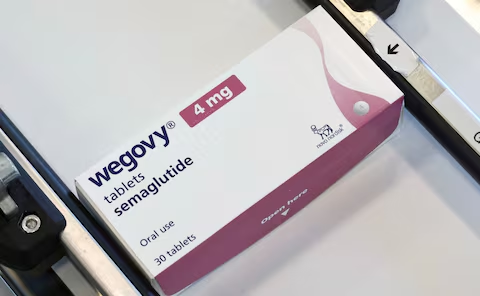
On August 27, 2026, Chinese regulators accepted Novo Nordisk’s marketing application for the oral version of Wegovy (semaglutide). This is not yet an approval, but it moves one of the world’s leading obesity franchises closer to competing in China’s emerging oral weight-loss market.
The filing comes as competition in China’s GLP-1 market intensifies rapidly. Eli Lilly submitted its Chinese application for once-daily orforglipron at the end of 2025 and could potentially launch the drug in China in 2026, while Novo Nordisk, Lilly, Pfizer and Innovent Biologics are already competing across the broader weight-management market. China’s overweight and obesity rate could exceed 65% by 2030.
More importantly, oral Wegovy is entering at a point when the competitive equation is changing. The next phase of the obesity market may be determined not only by weight-loss efficacy, but increasingly by route of administration, affordability, supply capacity and patient reach.
Why It Matters
- Oral therapy could materially expand the addressable patient population. Removing the injection barrier may attract patients reluctant to initiate injectable GLP-1 therapy and potentially make long-term treatment more convenient.
- China could become one of the world’s most important obesity-pharmaceutical markets. J.P. Morgan estimates that Chinese sales of GLP-1 therapies for weight management could rise from roughly RMB3–4 billion today to RMB30 billion over the next five to seven years.
- Novo’s early-mover advantage is narrowing. Wegovy was the first once-weekly GLP-1 launched for weight management in China, but Lilly, Innovent and Pfizer have since entered the market. Reuters has reported increasing patient interest in tirzepatide and Innovent’s mazdutide.
- Patent pressure adds another strategic dimension. Novo reports that the active-ingredient patent for semaglutide in China expires in 2026, although formulation, manufacturing and regulatory protections may provide additional layers of exclusivity. The company expects generic competition could begin from the second quarter of 2027.
Healthcare Insight Analysis
Healthcare Insight views the China filing as more than a portfolio extension. It represents an attempt by Novo Nordisk to defend the semaglutide franchise as obesity treatment evolves into a multi-product, multi-mechanism and increasingly price-sensitive market.
During the first phase of the GLP-1 boom, the central question was whether these therapies could deliver meaningful weight reduction. The next question is different: how easily can patients access treatment, how long will they remain on therapy, who will pay for it, and which companies can supply the market at scale?
An oral formulation could significantly alter that equation. Once-daily treatment without injections may expand obesity pharmacotherapy beyond specialist endocrinology and weight-management centers into a much broader healthcare environment.
But convenience alone will not guarantee commercial leadership.
China restricts direct-to-consumer advertising of prescription medicines, making physician education, disease-awareness initiatives, digital healthcare platforms, hospitals and pharmacy networks critical components of patient acquisition and treatment adoption.
The eventual winner of China’s obesity market may therefore not simply be the company with the strongest molecule. It may be the company capable of building the most effective patient-access ecosystem around it.
Market Implications
If approved, oral Wegovy could turn China into a major test case for the global Novo–Lilly oral GLP-1 competition.
For pharmaceutical companies, the shift creates greater pressure around pricing strategy, lifecycle management, differentiation and manufacturing scale as incretin portfolios become increasingly crowded.
For the broader healthcare ecosystem, oral obesity therapies could stimulate growth in obesity clinics, metabolic screening, digital weight-management platforms, pharmacy services and integrated programs combining pharmacotherapy with nutrition and behavioral interventions.
For investors, the next question is therefore not simply whether oral Wegovy gains Chinese approval, but whether Novo can convert oral convenience into durable market share quickly enough in a market becoming more competitive, more price-sensitive and increasingly driven by domestic innovation.