

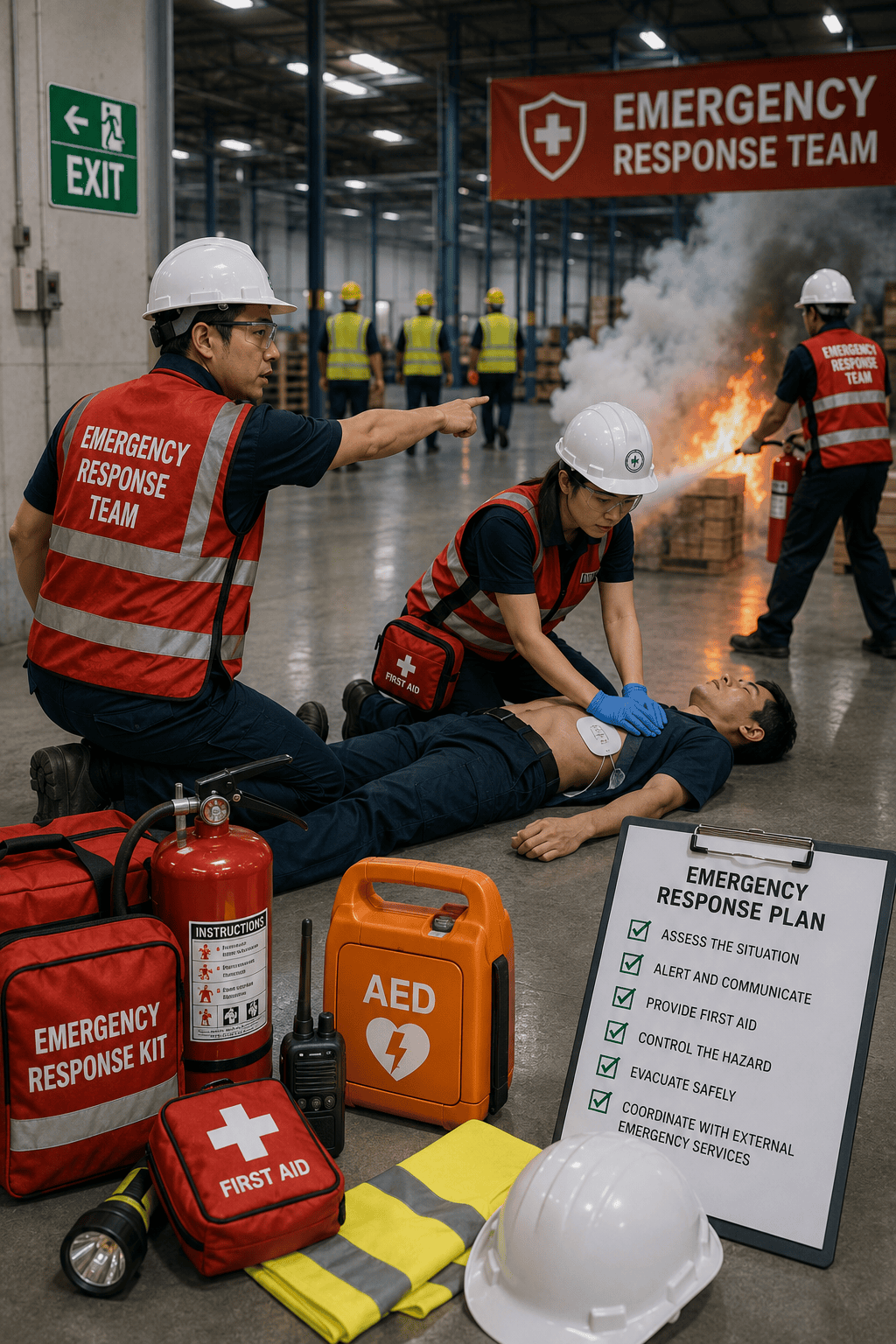
A small fire in the warehouse. An employee collapsing in cardiac arrest at their desk. A chemical spill on the production floor. Emergencies never announce themselves in advance, and the gap between when an incident occurs and when someone responds correctly often determines the final scale of the damage. That’s exactly why an Emergency Response Team (ERT) has shifted from being a “nice to have” to becoming a core part of how modern businesses operate.
What Is an Emergency Response Team?
An Emergency Response Team (ERT) is an internal group of trained employees responsible for recognizing, initially managing, and coordinating the response to emergencies at the workplace — from fires and workplace accidents to medical emergencies, natural disasters, or security incidents. Unlike relying solely on external emergency services, an ERT functions as the “first line of response” on-site, acting during those critical first minutes before professional responders can arrive.
Why Businesses Need an ERT
1. Shrinking the “Golden Window” for Response
In most emergencies — fires, cardiac arrest, serious injury — the first few minutes largely determine the outcome. A team already trained and present on-site can act immediately: performing initial first aid, extinguishing a small fire, or guiding an evacuation — rather than waiting for external responders to travel to the scene, which inevitably takes time.
2. Limiting Damage to People and Property
An incident caught and addressed early usually stays contained. But a slow or incorrect response can allow the situation to escalate quickly — both in terms of casualties and financial loss. An ERT helps businesses limit the scope of an incident from its earliest moments.
3. Meeting Regulatory and Safety Standard Requirements
In many countries and industries, having an internal emergency response capability isn’t just recommended — it’s a legal requirement under workplace safety regulations, fire safety codes, or safety management standards such as ISO 45001. Lacking this capability can expose a business to legal risk on top of operational risk.
4. Building a Culture of Safety
The presence of a well-trained ERT sends a clear message to every employee: safety is a genuine priority, not just a policy on paper. This helps foster risk-awareness across the entire organization — not just within the response team itself.
5. Protecting Reputation and Business Continuity
An incident handled quickly and professionally minimizes operational disruption while reinforcing trust among employees, partners, and customers. Conversely, a slow or disorganized response to a crisis can leave lasting damage to a company’s reputation and brand image.
What Should an Effective ERT Include?
A strong Emergency Response Team is typically built around several core elements:
- Well-trained personnel: basic first aid, fire safety, evacuation procedures, and industry-specific emergency skills.
- Clear response protocols and playbooks: prepared in advance for each type of potential incident, rather than improvised in the moment.
- Essential equipment: fire extinguishers, first-aid kits, automated external defibrillators (AEDs), and appropriate protective gear.
- Regular drills: to ensure every team member is genuinely proficient, not just familiar with the theory.
- Clear communication and coordination channels with external emergency services for situations that need to be escalated.
The Bottom Line
No business wants an emergency to happen, but being prepared for the worst-case scenario is exactly what separates a well-managed incident from a full-blown crisis. An Emergency Response Team isn’t just a compliance checkbox — it’s a practical investment in people’s safety, operational stability, and the long-term reputation of the business.